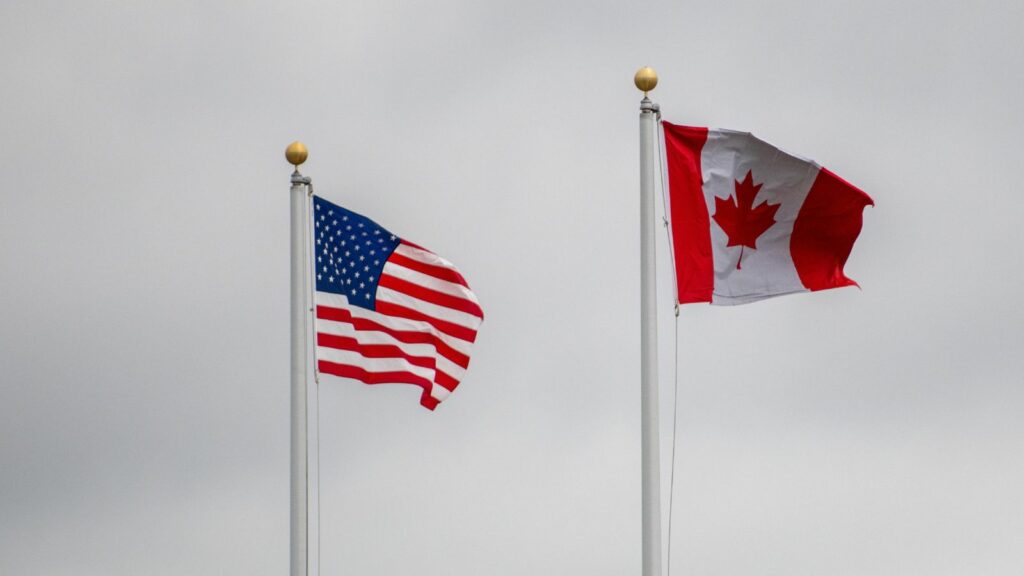
The idea of a U.S. military attack on Canada has moved from an almost unthinkable hypothetical into public discussion between senior political and security figures. Alaska Gov. Mike Dunleavy pushed back forcefully against the possibility at a business gathering in Banff, Alberta, saying there was “zero chance” Washington would contemplate a military incursion into Canada. His comments came days after Prime Minister Mark Carney disclosed that Ottawa had examined U.S.-led military action as an “extreme tail risk.” Carney was equally clear that such an event was not the government’s expected outcome. The exchange highlights an extraordinary feature of the current Canada–U.S. relationship: economic and political tensions have become serious enough for extreme scenarios to be discussed publicly, even while the two countries remain deeply integrated militarily through NORAD.
Dunleavy Says an Attack Is Essentially Unthinkable
Dunleavy delivered his reassurance during an onstage discussion at the Global Business Forum in Banff on September 25. The Alaska governor told the audience an American invasion of Canada would shock ordinary people in the United States and said there was “zero chance” his country would contemplate such a move. He drove the point home with an intentionally improbable comparison, saying Pennsylvania had a better chance of being invaded by neighbouring West Virginia. The remarks carried additional symbolism because they came from the governor of Alaska, a state directly connected to Canada geographically and deeply involved in North American Arctic security.
Former Canadian national security and intelligence adviser Jody Thomas expressed a similarly low assessment at the forum, describing a U.S. invasion as “improbable, slightly impossible.” Thomas said that if military movements ever appeared to point in such a direction, senior diplomatic and military channels would quickly become active. Her comments emphasized how many institutional relationships exist between the two countries before a hypothetical confrontation could develop into something larger.
Carney Called It a Tail Risk, Not His Expected Scenario
Carney’s original comments were more limited than some of the reaction to them suggested. During an interview with The New York Times published September 23, he said leaders have a responsibility to consider “extreme tail risk” when managing national security. He declined to explain exactly what Ottawa had examined or what preparations might have been discussed. Importantly, he also stressed that military action by the United States was “not a base case.” In other words, the government was not presenting an invasion as its working expectation for Canada–U.S. relations.
The wording reflects the risk-management language familiar from Carney’s previous career in central banking. Tail risks are low-probability events whose consequences could be severe enough that decision-makers still plan for them. Carney said ignoring such scenarios altogether would be irresponsible. That distinction matters: acknowledging that government officials have considered an extreme possibility is different from saying officials believe it is likely to occur.
Trump’s 51st-State Remarks Created the Political Backdrop
The discussion did not emerge without context. Donald Trump has repeatedly raised the prospect of Canada becoming the 51st U.S. state, rhetoric that Canadian political leaders have rejected. At a January 2025 news conference, Trump was specifically asked whether he would consider military force against Canada. He answered that he would not, instead referring to “economic force” while arguing that eliminating the international border would benefit the two countries. Canadian officials strongly rejected the idea of annexation.
Those statements help explain why Ottawa’s contingency planning has attracted attention even though Trump explicitly ruled out military force against Canada in that exchange. The issue for Canadian officials has been less about one isolated remark than the repeated questioning of a sovereign relationship that had long been treated as exceptionally stable. The political rhetoric has coincided with a much more tangible dispute over tariffs, procurement and cross-border trade, giving questions about Canada’s dependence on its largest partner greater prominence in Ottawa.
Canada and the U.S. Still Operate a Military Command Together
Any discussion of a hypothetical military confrontation has to be set against one of the closest defence relationships in the world. Canada and the United States established the North American Aerospace Defense Command in 1958. NORAD remains a binational organization responsible for aerospace warning, aerospace control and maritime warning, with its commander accountable to both governments. Canada’s Department of National Defence describes NORAD as a joint Canadian-American organization built specifically to monitor and defend North America.
That cooperation remains active in 2026 rather than merely existing on paper. Exercise AMALGAM DART, held from August 24 to September 1, brought Canadian and American personnel together in scenarios involving mixed fighter operations, command and control, air battle management and cruise-missile defence. Forces participated across the Alaskan, Canadian and continental U.S. NORAD regions. That ongoing integration is one reason the military scenario Carney described sits so far outside the normal operating structure of the bilateral defence relationship.
Alaska and Canada Work Together in the Same Arctic Security Environment
Dunleavy’s comments also stand out because Alaska is central to North American Arctic defence. The Alaskan NORAD Region is one of the command’s three geographic regions, alongside the Canadian and continental U.S. regions. Earlier in 2026, Arctic Edge brought together Canadian participants, U.S. forces, the Alaska National Guard and other agencies for exercises in Alaska and Greenland intended to improve readiness and interoperability in the Arctic.
Canada has simultaneously expanded its own northern military activity. Operation LATITUDE involves Canadian naval, air, special operations and Coast Guard assets operating in northern waters, including the Bering Sea, in cooperation with U.S. forces. National Defence says the operation contributes to continental defence and helps improve awareness of the approaches to North America. For personnel operating in Alaska, Yukon and the wider Arctic, the practical military relationship is therefore generally built around detecting and responding to external threats together rather than treating the other country as the threat.
Ottawa Is Still Trying to Reduce Strategic Dependencies
Carney’s remarks also fit into a broader debate about how dependent Canada should remain on American-controlled technologies and defence supply chains. In the same interview in which he discussed the extreme military scenario, Carney addressed efforts to reduce reliance on systems such as Starlink and the continuing examination of alternatives connected to Canada’s planned purchase of American-made F-35 fighters. The government’s formal F-35 review considers operational requirements, NORAD and NATO obligations, industrial benefits, strategic partnerships and potential alternatives.
That diversification is becoming visible in major procurement decisions. In August, Canada awarded an initial contract worth roughly $2.3 billion to Canadian company Telesat for military satellite communications supporting Arctic operations. On September 25, Ottawa announced a non-binding term sheet with Sweden’s Saab as negotiations advance toward a potential acquisition of the GlobalEye airborne early-warning platform. These decisions do not mean Canada is abandoning U.S. defence cooperation; official documents continue to stress interoperability with allies. They do show Ottawa seeking more sovereign and non-U.S. options within a still highly integrated defence system.
The Real Confrontation Is Currently Economic
While officials debate highly unlikely military scenarios, Canada and the United States are already engaged in a significant economic dispute. The Canadian government says Washington imposed 50 per cent tariffs on $27.6 billion worth of Canadian goods effective in August. Ottawa responded with counter-tariffs of 15, 25 and 50 per cent on $27.6 billion in U.S. imports beginning September 8, targeting sectors including steel, dairy, appliances, agricultural equipment, pulp and paper and electronics.
That conflict matters because Canada remains heavily dependent on the American market despite efforts to diversify. Statistics Canada reported that 71.7 per cent of Canadian merchandise exports went to the United States in 2025. That was down from 75.9 per cent in 2024, while Canadian exports to non-U.S. destinations rose 17.2 per cent during the year. The figures help put the political tension into practical terms: economic leverage, rather than military force, is the pressure Canadians and Canadian businesses are experiencing directly.
Carney and Trump Are Still Talking Despite the Disputes
The strained relationship has not eliminated direct communication between the two governments. Carney said earlier in September that he speaks with Trump regularly and confirmed conversations had taken place even as the trade conflict escalated. He described the relationship as something the two leaders could “compartmentalize,” allowing cooperation on issues such as Ukraine to continue despite major bilateral disagreements. The New York Times interview similarly reported that Carney and Trump had continued speaking frequently after trade negotiations collapsed.
That makes the Dunleavy-Carney exchange less a story about governments preparing for an imminent conflict than one about how dramatically the boundaries of Canada–U.S. political debate have shifted. Carney has said Ottawa must plan for remote but consequential risks. Dunleavy, speaking from a neighbouring U.S. state closely connected to continental defence, says a military attack is effectively inconceivable. Meanwhile, the two countries continue operating NORAD together, maintaining direct political contacts and confronting each other through tariffs and economic policy rather than military force.
