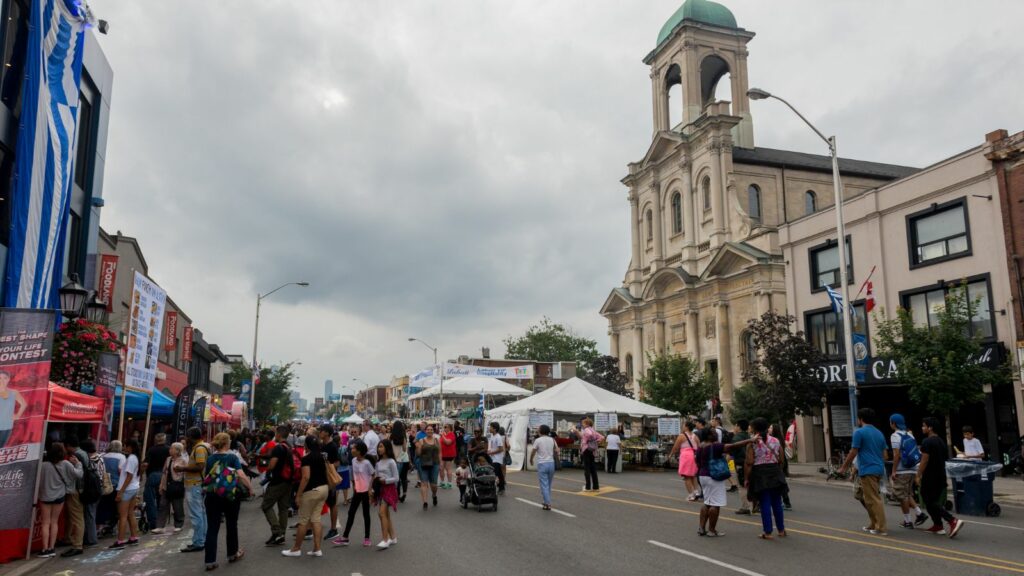
Toronto’s Danforth was crowded again Saturday with the familiar signs of a major summer weekend: long food lines, packed sidewalks, live music and families moving between vendors. Yet the return of Taste of the Danforth carried an unusual undercurrent. A deadly shooting at another Toronto street festival less than a month earlier had heightened anxiety around large public gatherings and prompted organizers and police to strengthen security arrangements.
Despite those concerns, thousands poured into Greektown on August 8. Officers, firefighters, paramedics and private security personnel were visible throughout the festival area. The turnout suggested that safety fears had not erased Toronto’s appetite for one of its best-known cultural celebrations, even as both organizers and attendees acknowledged that crowded events now demand greater vigilance.
Crowds Return to a Festival Toronto Had Been Missing
Saturday offered the clearest indication that Taste of the Danforth had retained its drawing power after a two-year absence. Thousands filled Danforth Avenue on the festival’s second day, with visitors forming substantial lines at food stands and gathering around stages for music and dance performances. The atmosphere resembled the bustling summer weekends that established the event as one of Toronto’s largest street celebrations.
The scale matters because the festival had not operated in 2024 or 2025. Organizers have said historic editions attracted more than 1.5 million attendees over a weekend, while Toronto police projected approximately 1.6 million visitors for the 2026 edition. Those figures remain forecasts or historical benchmarks rather than a confirmed final total for this year. Still, Saturday’s observed crowds showed that the long break had not eliminated demand. For businesses along the Danforth, the sight of packed pedestrian traffic represented a particularly important comeback.
Another Festival’s Deadly Shooting Changed the Mood
The heightened concern surrounding Taste of the Danforth did not emerge in isolation. On July 11, gunfire erupted during Toronto’s Salsa on St. Clair festival, where thousands had gathered for an evening of music, food and community celebrations. Seven people were shot. Shaquan Quashie, 25, and Cesar Vernaza, 20, died, while five other victims survived, some with injuries police described as life-altering.
Toronto police announced a major development on August 7, the opening day of Taste of the Danforth. Two 18-year-old Toronto men had been arrested and each charged with two counts of first-degree murder and five counts of attempted murder, among other allegations. Police said investigators believe the July attack was targeted. The timing inevitably placed public-event security back in the spotlight just as crowds were arriving in Greektown. For festivalgoers, the issue was no longer an abstract possibility but something Toronto had experienced only weeks earlier.
Security Became Far More Visible Along the Danforth
Organizers responded with a security operation involving Toronto police, emergency services and private personnel. Festival representatives said preparations included crowd-management planning and coordination among agencies responsible for keeping the large pedestrian zone functioning safely. Toronto police separately announced that an increased police presence would remain in place throughout the weekend and encouraged visitors with concerns to approach officers.
That presence was visible Saturday. Police officers, Toronto Fire and paramedic personnel and private security guards patrolled the stretch of Danforth Avenue between Broadview and Jones avenues. The arrangement reflected the challenges of protecting an event where extremely large numbers of people can be concentrated inside a relatively narrow commercial corridor. Security at such gatherings is not limited to preventing intentional violence; organizers also have to consider emergency access, crowd movement and the ability of first responders to reach people quickly. The result was heightened protection without turning the festival into a closed or heavily restricted event.
Visitors Balanced Caution With a Desire to Participate
For some attendees, the recent violence was impossible to ignore. Festivalgoer Shaleena Clements told The Canadian Press that the Salsa on St. Clair shooting had made her more conscious of her surroundings at crowded events. She said she was paying attention to what was happening around her in a way she might not have before, but did not want fear to take away the enjoyment of participating in a public celebration.
Others expressed similar confidence. Dadir Yusuf, who travelled from Oshawa with his girlfriend, said the security question had crossed his mind, yet the lively atmosphere helped him feel comfortable. Another attendee, Saqeeb Hassan, said he continued to feel safe attending large events. The crowd even included people travelling specifically for the festival, including visitors from Midland, Ontario. Their presence illustrated an important part of Saturday’s story: concern remained real, but for many people it did not outweigh the desire to gather, eat and celebrate.
The Comeback Required Government Help
Taste of the Danforth’s return was not guaranteed. After the long-running celebration disappeared from Toronto’s summer calendar for two years, public funding became an important part of bringing it back. The City of Toronto and Ontario government each committed $200,000 to the 2026 festival, providing a combined $400,000 aimed at supporting the event and the businesses, tourism operators and neighbourhood activity surrounding it.
Federal support followed shortly before opening weekend. On August 5, Canadian Heritage announced up to another $100,000 through the Multiculturalism and Anti-Racism Program, bringing announced federal, provincial and municipal commitments to as much as $500,000. The government support highlighted how complicated major street festivals have become to operate. Beyond entertainment and food vendors, organizers must cover infrastructure, public-safety measures, logistics and other rising costs. For Greektown businesses, the investment was therefore about more than staging a three-day celebration; it helped restore one of the neighbourhood’s most important annual opportunities to attract customers from across the region.
Managing More Than a Million Potential Visitors Is a Major Operation
Police preparations reflected the extraordinary scale associated with the festival. Toronto police said approximately 1.6 million people were expected across the August 7–9 weekend. Earlier, the City of Toronto had used a more conservative projection of at least one million visitors. Neither figure should be confused with an audited 2026 attendance total, but both illustrate why transportation and crowd-management planning were central to preparations.
Danforth Avenue was closed to vehicle traffic between Broadview and Jones avenues beginning at 10 a.m. Friday, with the closure scheduled to remain until 3 a.m. Monday. Police also warned motorists about delays, while TTC routes serving the area faced diversions. The official festival schedule ran from Friday evening through Sunday night. Transforming a major Toronto roadway into a dense pedestrian festival for that length of time requires space for vendors and stages while maintaining routes for emergency response. This year, those logistical demands carried additional significance because public safety was already at the forefront of visitors’ minds.
Greek Traditions Remain Central, but the Menu Has Expanded
Food remained the strongest magnet. Festival spokesperson Howard Litchman said more than 100 restaurants were offering food representing 24 different ethnic cuisines during the three-day event. Traditional Greek favourites such as souvlaki and spanakopita remained prominent, but the broader range reflected how both the Danforth and Toronto have changed during the festival’s three-decade history.
The GreekTown on the Danforth BIA describes Greek heritage as the celebration’s foundation while emphasizing its increasingly multicultural identity. Beyond food, the 2026 program included live music, cultural performances, family activities, sports zones and free entertainment. That mixture helps explain why the festival can attract people who have no direct connection to the neighbourhood’s Greek community. For longtime residents, the weekend remains a celebration of a community that helped shape the Danforth. For newer visitors, it functions as something wider: an accessible Toronto street festival where food provides the entry point to several cultures sharing the same stretch of pavement.
The Weekend Is Becoming a Test of Toronto’s Festival Resilience
Taste of the Danforth’s comeback carries significance beyond one neighbourhood. Toronto says nearly 300 festivals take place across the city annually, supporting restaurants, retailers, artists and cultural workers. Large gatherings are therefore part of the city’s cultural identity as well as its visitor economy. The July shooting demonstrated how quickly violence at one event can affect perceptions surrounding other celebrations weeks later.
Saturday’s turnout showed another side of that equation. Crowds returned even with more officers on the street and recent violence still fresh in public memory. That does not mean the safety concerns disappeared, nor does a busy weekend guarantee that future festivals will face fewer challenges. Instead, Taste of the Danforth demonstrated the increasingly difficult balance event organizers must strike: maintain the open, spontaneous atmosphere that makes a street festival appealing while preparing seriously for emergencies. On the Danforth, at least through Saturday night, heightened vigilance and public enthusiasm were able to exist side by side.
