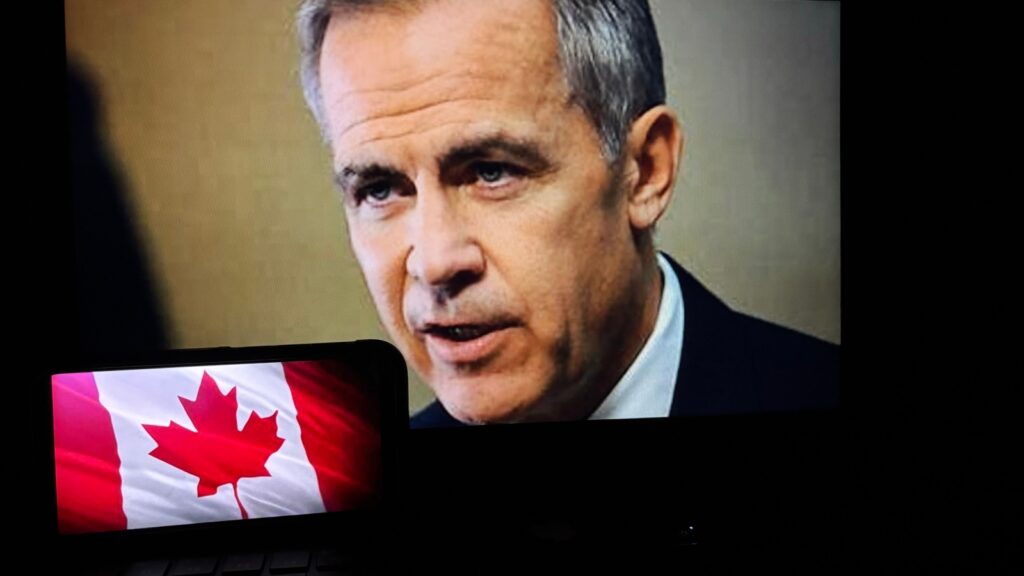
The political lines around Canada’s escalating trade fight with the United States are proving less predictable than expected. New Abacus Data polling shows that 54% of Canadians who voted Conservative in the 2025 federal election believe Prime Minister Mark Carney made the right decision to suspend negotiations rather than accept Washington’s terms, even with higher tariffs and economic uncertainty as the price.
That support comes despite Conservative voters remaining much less enthusiastic about Carney’s overall management of the relationship. Nationally, 71% backed the decision to stop negotiating, giving Ottawa unusual cross-party room to resist U.S. pressure at a moment when 50% American tariffs have already hit billions of dollars in Canadian goods. The numbers suggest Canadians may be distinguishing between support for the government and support for drawing a line in the trade dispute.
Conservative Voters Are Breaking From the Expected Partisan Pattern
The 54% figure stands out because these are not voters who have suddenly become broadly supportive of the Liberal government. Among 2025 Conservative voters, 31% said Ottawa should have accepted the U.S. terms rather than face additional tariffs and uncertainty, while 16% were unsure. In other words, the largest group sided with Carney on this specific decision even though the broader political relationship between the Liberal government and Conservative electorate remains deeply competitive.
A separate Angus Reid Institute poll conducted shortly after negotiations collapsed produced an almost identical result. It found 53% of 2025 Conservative voters believed Canada was right to walk away. Across the entire country, that poll found support at 76%. Two independent sets of polling therefore point toward the same unusual dynamic: Canadians may disagree strongly over who should govern the country while still believing there are limits to the concessions Ottawa should make to Washington simply to preserve a deal.
What Carney Actually Walked Away From
Carney announced on August 21 that Canadian negotiators were returning to Ottawa after last-minute changes to the American position. His government said the revised terms did not provide enough economic benefit or reliability for Canada. At the same time, Ottawa’s stated objectives included protecting tariff-free access for most Canadian businesses, lowering tariffs on strategically important industries and maintaining Canadian flexibility and sovereignty.
The immediate consequence was significant. The United States imposed a 50% tariff on roughly $28 billion worth of Canadian goods beginning August 22. Ottawa subsequently confirmed it would respond dollar for dollar, applying new Canadian tariffs of 15%, 25% and 50% on $27.6 billion worth of American imports beginning September 8. Products affected include goods from sectors such as steel, dairy, appliances, agricultural equipment, electronics, furniture and apparel. Ottawa also announced billions of dollars in additional liquidity, business support, worker assistance and diversification funding to soften the economic impact.
Supporting the Decision Is Not the Same as Supporting Carney
One of the most revealing findings is the gap between Conservative voters’ view of the decision itself and their assessment of the government’s overall performance. While 54% supported suspending negotiations, only 36% of Conservative voters approved of the way Carney and his government had handled the broader negotiations. Another 38% disapproved, while 23% were neutral.
That difference matters politically. It indicates that many Conservative voters are not rewarding the Liberals for the entire trade strategy; they are endorsing one particular line in the sand. Among Canadians overall, 60% approved of Ottawa’s handling of negotiations and 18% disapproved. Liberal voters were overwhelmingly supportive, while NDP and Bloc Québécois voters also leaned strongly toward approval. The Conservative electorate was the clear exception. For Carney, that means the cross-party support should not automatically be interpreted as a permanent political realignment. It is better understood as conditional backing for refusing terms many voters believed were unacceptable.
Support Stretches Across Canada, but Age Makes a Big Difference
Regional divisions exist, but none of the major regions polled produced a majority against Ottawa’s decision. Quebec showed the strongest support at 79%, followed by Ontario at 70% and British Columbia at 68%. Support stood at 66% in Saskatchewan and Manitoba combined and 66% in Atlantic Canada. Alberta registered the lowest level, yet even there 61% said suspending negotiations was the correct decision.
Age produced an even sharper divide. Among Canadians aged 18 to 29, 56% backed Ottawa while 28% thought Canada should have accepted the proposed agreement. Support rose to 63% among people aged 30 to 44, 70% among those aged 45 to 59, and 85% among Canadians 60 and older. That pattern may reflect differences in how generations weigh sovereignty against near-term economic risk. Younger workers and households often have less financial cushion when employment becomes uncertain or prices rise, making the potential costs of a prolonged trade conflict especially tangible.
Canadians Support the Stand but Do Not Expect a Quick Victory
Backing Carney’s decision does not translate into confidence that the dispute will end soon. Only 15% of respondents expected Canada and the United States to return to negotiations and remove most new tariffs within days. Another 32% expected the confrontation to drag on before an eventual agreement. Together, those groups meant 47% still anticipated some form of eventual settlement.
The pessimistic side was nearly as large. Twenty-two percent expected the dispute to escalate through additional tariffs or other measures, while 18% believed a lasting breakdown could emerge, potentially involving the end of the existing North American trade arrangement. That put the combined conflict-oriented outlook at 40%. Conservative voters were similarly uncertain: 45% expected an eventual agreement while 44% expected either escalation or a lasting dispute. The numbers suggest Canadians are not supporting confrontation because they think it will be painless. Many appear prepared to tolerate some economic risk while remaining deeply unsure about the outcome.
Confidence in the Old CUSMA Model Has Eroded
The tariff fight is unfolding against an even larger source of uncertainty. The United States declined in July to extend the Canada-U.S.-Mexico Agreement at its first six-year joint review. That decision did not terminate CUSMA. Under the agreement’s review mechanism, the pact remains in force, but the countries move into recurring annual reviews unless all parties eventually agree to extend its term.
Public confidence that the old trading relationship will simply return is low. Only 17% in the Abacus polling expected CUSMA eventually to be renewed or updated while preserving a close trading relationship. Thirty percent expected it to survive with significant restrictions, while 29% thought the agreement would ultimately break down. Conservative voters were the most likely partisan group to expect a breakdown, at 35%. Alberta was even more pessimistic, with 41% expecting CUSMA eventually to fail. The trade debate has therefore moved beyond one tariff deadline toward a larger question about North America’s economic structure.
Canada’s Dependence on the U.S. Explains Both the Resolve and the Risk
The stakes remain enormous because the United States is still overwhelmingly Canada’s largest merchandise market. Statistics Canada reported that 71.7% of Canadian merchandise exports went to the U.S. in 2025, even after that share fell from 75.9% the year before. In June 2026 alone, Canada exported about $53.9 billion in merchandise to the United States out of roughly $77.5 billion in total exports.
Yet Canadian attitudes toward deeper economic cooperation remain more nuanced than the tariff confrontation might suggest. The Abacus polling found Canadians split 42% to 42% on whether American gains from Canadian resources are inherently a problem when Canada benefits too. Among Conservative voters, 50% said U.S. benefits were acceptable provided Canada also gained. That distinction may prove important. The public mood does not necessarily point toward economic separation from the United States. Instead, it increasingly appears to favour continued trade built around reciprocity, bargaining power and a willingness to reject arrangements perceived as one-sided.
