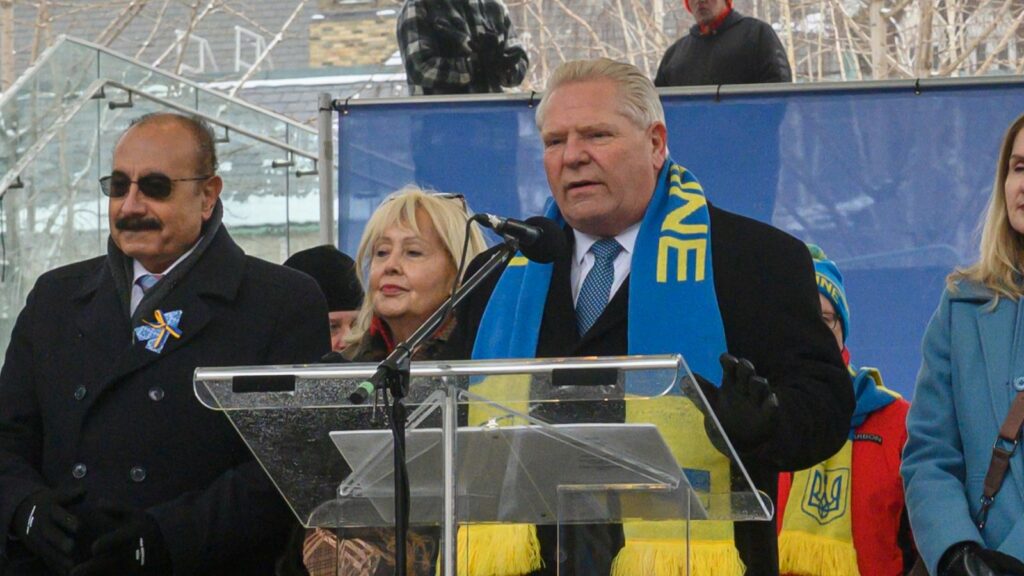
Ontario voters delivered a night of stability with a warning attached. In three provincial byelections on September 3, Doug Ford’s Progressive Conservatives kept Hamilton East—Stoney Creek and York—Simcoe, while Marit Stiles’s NDP held Scarborough Southwest. The Ontario Liberals failed to win any of the three contests, despite stronger performances in two ridings and hopes that the federal Liberal brand might carry over.
Hovering over every race was the worsening trade fight with the United States, where Donald Trump’s tariffs have put Ontario’s steel, auto and manufacturing economy under renewed pressure. The results therefore offered more than a simple status-quo verdict: they showed Ford can still turn economic anxiety into political resilience, the NDP can defend difficult urban turf, and the Liberals remain a rebuilding party even when their vote share is moving in the right direction.
PCs Survive a Three-Riding Test
The broad result was straightforward: every party that entered the night defending a seat kept it. Progressive Conservative Jeff Beattie won Hamilton East—Stoney Creek with 10,500 votes, or 38.87 per cent, while PC Susan Lahey carried York—Simcoe with 11,491 votes, or 49.81 per cent. In Scarborough Southwest, New Democrat Fatima Shaban finished first with 8,914 votes and 40.47 per cent. No riding changed party hands on Thursday night.
That matters because byelections are often treated as opportunities to punish governments between general elections. Ford avoided that outcome. The PCs did not sweep all three contests, but they protected both of their vacancies and preserved the basic balance at Queen’s Park. The NDP likewise prevented a Liberal breakthrough in Toronto. For the Liberals, the zero in the win column is the clearest headline, yet the detailed numbers show a more complicated picture than a simple three-race rejection by voters across Ontario.
Hamilton Gives Ford His Most Politically Valuable Hold
Hamilton East—Stoney Creek was the race with the greatest symbolic weight for Ford. Beattie, a longtime Hamilton city councillor, defeated former NDP MPP Monique Taylor by 1,614 votes. Taylor captured 32.90 per cent, while Liberal Heino Doessing finished third at 23.45 per cent. The riding had been held by PC Neil Lumsden since 2022, after years of New Democratic representation, making it fertile ground for an opposition comeback.
The comparison with 2025 shows how competitive the seat became. Lumsden won 42.07 per cent in the general election, while the NDP took only 17.60 per cent. Taylor nearly doubled that NDP share in the byelection, even as the PCs slipped slightly. The Liberals moved in the opposite direction, falling from 31.61 per cent in 2025 to 23.45 per cent. Ford held the seat, but the result also confirmed Hamilton remains a serious three-party battleground with unusually fluid voter loyalties this time.
York—Simcoe Stays Blue, but the Margin Tightens
York—Simcoe remained Conservative territory, but the size of the victory changed dramatically. Lahey won 49.81 per cent of the vote against Liberal Naomi Davison’s 38.76 per cent, a margin of 2,549 votes. The NDP finished far back with 4.22 per cent. The riding has elected conservatives since it was created in 2007, so a PC victory was widely expected.
Still, the comparison with the 2025 general election is striking. Caroline Mulroney won 59.4 per cent last year, while the Liberals took 23.9 per cent, producing a margin of roughly 35.5 percentage points. In the byelection, the gap narrowed to just over 11 points. Different candidates, a smaller electorate and byelection quirks make direct comparisons imperfect. Even so, Davison’s nearly 39 per cent showing gave Ontario Liberals fresh political evidence that suburban and exurban voters can still be moved, even if the party could not convert that movement into a seat.
NDP Defends Scarborough Southwest After a High-Profile Defection
Scarborough Southwest presented the NDP with a different challenge: defending a seat after losing its incumbent to another party. Doly Begum, a former Ontario NDP deputy leader who had represented the riding since 2018, resigned in February to run federally for Mark Carney’s Liberals. She later won that federal byelection, creating an obvious opening for provincial Liberals to argue that the local coalition had shifted.
Instead, Shaban kept the riding orange with 40.47 per cent of the vote. Liberal Ahsanul Hafiz finished second at 30.30 per cent, and the PCs placed third at 23.37 per cent. Compared with 2025, the NDP share dipped only modestly from Begum’s 42.89 per cent. The Liberals rose from 22.94 per cent, while the PCs fell from 30.65 per cent. That combination suggests the Liberals did gain ground, but not enough to dislodge a local NDP organization that remained competitive even after a damaging defection.
Liberals Go 0-for-3, but the Scorecard Is Mixed
For the Ontario Liberals, the bluntest reading is unavoidable: three candidates ran and none became an MPP. Yet the vote-share movement was uneven rather than uniformly negative. In York—Simcoe, the Liberal share rose by almost 15 percentage points from the 2025 general election. In Scarborough Southwest, it increased by more than seven points. Hamilton East—Stoney Creek was the clear setback, with the Liberal share dropping by roughly eight points.
Those numbers arrive at an awkward moment for a party choosing its next leader. Ontario Liberal members are scheduled to vote from November 9 to November 20, with the result announced November 21. That means leadership contenders inherit two competing messages. The party can argue that it is rebuilding in places like York—Simcoe and Scarborough Southwest, but it still lacks the concentrated support needed to turn second-place finishes into seats. A provincial revival remains possible, but it is not yet complete.
Trump’s Tariffs Reframed a Provincial Vote
The campaign unfolded under heavy international pressure. The federal government says the United States imposed a new 50 per cent tariff on $27.6 billion of Canadian goods effective August 22, prompting Canada to prepare matching counter-tariffs for September 8. Ontario is exposed because the United States accounted for 77.2 per cent of the province’s merchandise exports in 2024, while a provincial workforce plan says about 285,000 Ontario jobs are linked to U.S. exports.
Ford leaned into that vulnerability, presenting himself as Ontario’s chief defender against Trump. After the Hamilton victory, he again framed the PC win around protecting jobs and communities from U.S. trade action. That message gave the governing party a way to shift attention from midterm frustration toward an external economic threat. In a province built around cross-border manufacturing, tariffs were not an abstract foreign-policy issue; they were a direct question about paycheques, factory shifts and investment decisions.
Hamilton Shows Why Steel Politics Matter
No riding made the tariff issue more tangible than Hamilton East—Stoney Creek. Hamilton’s industrial economy is tied to steel, advanced manufacturing and cross-border supply chains. On August 31, the federal government announced more than $12.5 million for nine Hamilton-area businesses to help them respond to tariff pressure, strengthen supply chains and protect jobs. Ontario had also announced in Hamilton that it was widening access to its tariff-focused financing program after U.S. measures.
That backdrop helps explain why the trade fight carried political force in the riding. Beattie argued that residents were anxious about what the future could hold with the United States, while Taylor warned that a steel city would feel tariffs directly. The result did not prove that trade was the only issue—health care, education and affordability were repeatedly raised at doors—but it showed how an international dispute can become intensely local when families depend heavily on export-oriented industries.
Low Turnout Limits the Size of the Message
The biggest caution against overreading the results is turnout. Elections Ontario reported participation of 29.25 per cent in Hamilton East—Stoney Creek, 26.50 per cent in Scarborough Southwest and just 21.00 per cent in York—Simcoe. That means roughly three-quarters of registered electors in each riding did not cast a ballot. Across the three contests, turnout was only a little above one quarter.
Participation was also well below the 2025 general election. Hamilton East—Stoney Creek had turnout of about 43.8 per cent last year, Scarborough Southwest about 42.0 per cent and York—Simcoe about 40.6 per cent. The drops were therefore roughly 15 to 20 percentage points. Summer scheduling and the lower stakes of a byelection can produce a very different electorate from a province-wide campaign. The results are politically meaningful, but they should not be mistaken for a precise forecast of how the same ridings would vote in a full general election.
Ford Escapes a Summer of Controversy Without Losing Ground
The PC holds are notable following months of headlines around the government. During the campaign, opponents cited Ford’s short-lived purchase of a private jet for nearly $29 million and controversy over Toronto-area ministers billing hotel stays to taxpayers. The hotel issue contributed to Tourism Minister Stan Cho’s resignation, while several other legislators repaid expenses. Those stories gave the opposition material for a midterm accountability campaign.
They were not enough to cost the PCs either of their seats. McMaster University political scientist Peter Graefe argued that escalating trade tensions helped Ford because voters often look toward incumbent leaders during periods of uncertainty, especially in a steel-producing community such as Hamilton. That does not erase the controversies or prove voters approved of them. It does suggest the tariff confrontation changed the hierarchy of concerns, allowing Ford to campaign more as an economic defender than as the head of a government under scrutiny.
What the Results Mean for the Fall at Queen’s Park
The byelections leave Ontario politics familiar, but not static. Ford’s PCs kept both seats they were defending, the NDP retained Scarborough Southwest, and the Liberals remain without a breakthrough. At the same time, narrower PC margins in York—Simcoe and Hamilton, plus stronger Liberal shares in two ridings, give every major party something to study rather than celebrate without qualification.
The next test will come when Queen’s Park returns. The legislature is scheduled to resume October 27 after a lengthy break, despite opposition calls for an earlier recall to debate tariff relief. Ford’s government says it has assembled nearly $30 billion in tariff-related relief and support, including financing for affected businesses. The Liberals will choose a new leader on November 21, while the NDP can point to a successful defence of Scarborough Southwest. The September 3 vote preserved the map, but the political arguments over affordability, trade and leadership are intensifying.
