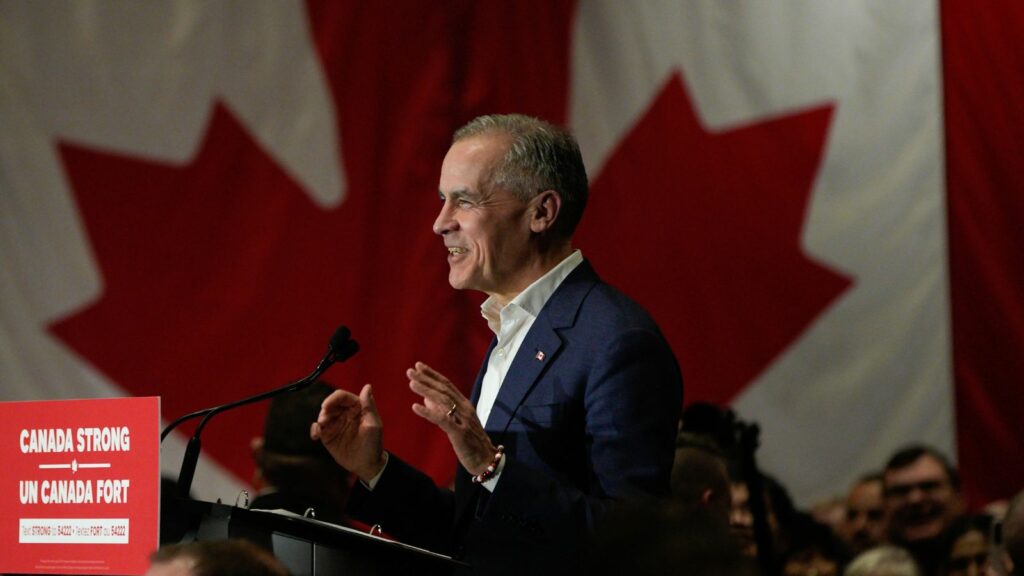
A new federal poll has given Prime Minister Mark Carney’s Liberals one of their strongest readings of the year, placing the party 14 percentage points ahead of Pierre Poilievre’s Conservatives while Carney’s approval reaches 66%. The Liaison Strategies tracker, released September 7, puts the Liberals at 45% among decided and leaning voters, compared with 31% for the Conservatives. The result lands after a turbulent stretch in Canada-U.S. relations and only days after Liberals won three federal byelections. Other recent pollsters have also shown a Liberal lead, although the size varies. The numbers therefore point to a genuine political advantage for Carney, but they are better read as a snapshot of a fast-moving environment than as a prediction of the next federal election.
The Liberal Lead Has Reached Double Digits
The headline number is difficult to miss: Liaison Strategies places the Liberals at 45% among decided and leaning voters, with the Conservatives at 31%. The NDP follows at 13%, the Bloc Québécois at 6%, while the People’s Party and Greens are each at 2%. A 14-point national advantage would represent a markedly more comfortable position for the governing party than the close popular-vote contest Canadians saw in the 2025 federal election.
The broader polling picture supports the direction of the result, even if not the exact margin. Abacus Data reported a 45% to 35% Liberal lead in fieldwork conducted August 21 to 26, while Nanos said its September 1 weekly tracking showed an 11-point Liberal advantage. Different methods and field periods naturally produce different numbers, but three separate measures showing the Liberals ahead by double digits suggests the Liaison finding is not standing alone. That is a meaningful convergence overall.
Carney’s 66% Approval May Be the Bigger Number
Carney’s 66% approval rating may be the most politically important number in the Liaison release. Only 26% disapprove, giving the prime minister a wide positive balance at a moment when his government is confronting Washington over tariffs and trade terms. The result also runs well ahead of the Liberals’ 45% vote intention, suggesting Carney is receiving at least some approval from Canadians who are not currently prepared to vote Liberal.
That pattern appears in other research as well. Abacus Data recently found 53% of Canadians had a positive impression of Carney and 28% a negative one, for a net rating of plus 25. Spark Insights reported government approval at 70% in early September. The measures are not identical—approval, government performance and personal impressions ask different questions—but together they indicate that Carney’s personal standing has become a significant political asset rather than merely a reflection of partisan support across multiple measures.
The U.S. Trade Fight Looms Over the Numbers
Timing matters because every interview in the new Liaison tracker was conducted after August 21, when Canada-U.S. trade talks broke down and Carney announced that Canada would match new American tariffs dollar for dollar. The United States moved to impose 50% tariffs on billions of dollars in Canadian goods, and Ottawa framed its response around protecting workers, businesses and Canadian economic sovereignty. Liaison fielded its poll from August 23 through September 5.
That does not prove the trade confrontation caused the Liberal lead, but the surrounding evidence makes the issue impossible to ignore. Abacus found Donald Trump and his administration had become one of the country’s most frequently cited concerns, while other recent research has found broad support for rejecting Washington’s terms. In political terms, the dispute has shifted attention toward leadership, national unity and relations with the United States—terrain on which recent polling has generally favoured Carney and the Liberals.
Ontario and Quebec Are Driving a Powerful Regional Map
The national lead becomes more significant when broken down by region. Liaison reports Liberal advantages in Atlantic Canada, Quebec, Ontario and British Columbia, while the Conservatives remain ahead in Alberta and the Prairies. In Ontario, the Liberals lead 49% to 33%. In Quebec, they sit at 45%, compared with 26% for the Bloc Québécois and 18% for the Conservatives. Those are especially important provinces because they contain a large share of Canada’s federal seats.
Carney’s approval is even stronger in some of those regions. Liaison records 80% approval in Quebec, 75% in Atlantic Canada and 70% in British Columbia. Alberta is the clear exception: 44% approve there and 50% disapprove. The split captures a familiar Canadian political reality. A national lead can look commanding while still resting on sharply different regional coalitions, and Conservative strength in Alberta and the Prairies remains substantial even during a favourable period for the Liberals.
Women and Older Canadians Are Central to the Liberal Advantage
The demographic splits show where much of the Liberal advantage is being built. Among women, Liaison has the Liberals at 50% and the Conservatives at 24%, a 26-point gap. Among voters aged 65 and older, the Liberal lead is even larger at 59% to 27%. Men are much closer, with the Liberals at 41% and the Conservatives at 38%. Those differences help explain how a large national margin can emerge from very different voting blocs.
Older voters are particularly important because they historically participate at higher rates than younger adults, although turnout in any future election cannot be assumed from a poll. Abacus also recently found its strongest Liberal support among adults 60 and over, with 56% choosing the party compared with 30% for the Conservatives. The consistency across pollsters strengthens the case that older Canadians currently form a central part of Carney’s coalition, while the gender gap remains another major challenge for Conservatives.
Poilievre’s Personal Ratings Remain a Conservative Vulnerability
Pierre Poilievre’s personal ratings are another warning sign for the Conservatives. Liaison finds 34% of Canadians have a favourable view of the Conservative leader and 54% an unfavourable one. The result is especially difficult in Quebec, where 71% view him unfavourably, while negative ratings also reach 65% in British Columbia and 58% in Ontario. Those are regions where the party needs to remain competitive if it hopes to narrow the national gap.
The pattern is not limited to one pollster. Abacus recently measured Poilievre at 35% positive and 46% negative, producing a net impression of minus 11. In the same research, Carney stood at plus 25, creating a 36-point gap between the leaders’ net ratings. Leader favourability does not translate mechanically into votes, but persistent personal weakness can make it harder for an opposition party to capitalize on dissatisfaction with the government, particularly when the prime minister himself remains comparatively popular.
Younger Voters Reveal a Much More Fragmented Contest
Younger voters tell a more complicated story than the national topline. Among Canadians aged 18 to 34, Liaison puts the Liberals at 36%, the Conservatives at 27% and the NDP at 23%. That leaves the New Democrats much closer to the two larger parties among younger adults than they are nationally, where Liaison has them at 13%. It is a reminder that the apparent two-party contest changes considerably when age is taken into account.
The NDP’s position also varies noticeably across pollsters. Abacus had the party at 9% nationally in late August, while Nanos placed it around the low teens in recent tracking. Liaison finds NDP leader Avi Lewis almost evenly viewed by the public, at 30% favourable and 31% unfavourable, with stronger ratings among younger adults. For Liberals, that fragmentation can be helpful if centre-left competition remains divided; for the NDP, it shows there is still a younger constituency to build on despite weaker national numbers.
The Poll’s Methodology Matters Before Reading Too Much Into It
The methodology deserves as much attention as the topline. Liaison interviewed a random sample of 1,526 Canadians between August 23 and September 5 using interactive voice response technology and random-digit dialing to landline and cellular numbers. The results were weighted to targets based on the 2021 Census. Liaison reports a national margin of error of plus or minus 2.5 percentage points, 19 times out of 20, for the total sample.
That uncertainty is larger for regional and demographic subgroups because fewer people are represented in each category. Professional polling standards therefore caution against treating every small difference in a crosstab as meaningful. It also helps explain why Liaison, Abacus and Nanos can produce different Conservative numbers while agreeing on the broader direction of the race. Polls are estimates, not vote counts. Their strongest value comes from patterns that repeat across methods and over time rather than from treating any single percentage as exact.
A 14-Point Lead Cannot Simply Be Converted Into Seats
Even a 14-point national polling lead should not be converted directly into a seat forecast. Canada elects members of Parliament riding by riding, so the geographic distribution of support matters as much as the national total. The 2025 federal election illustrates the point: Elections Canada recorded roughly 8.60 million Liberal votes and 8.11 million Conservative votes, yet the Liberals won 169 seats to the Conservatives’ 144 in the 343-seat House.
That election’s national popular-vote gap was only about 2.5 percentage points, far smaller than the current Liaison spread. Since then, political circumstances and the parliamentary balance have changed, including recent Liberal byelection victories. Still, a polling lead can shrink quickly if support moves in a handful of competitive regions. Ontario, Quebec and British Columbia are therefore more consequential than the national number alone suggests, while Conservative dominance in Alberta adds votes without necessarily producing many additional seats once most ridings are already safely held.
The Biggest Question Is Whether the Lead Can Last
The strongest conclusion from the new numbers is not that the next election is settled, but that the Liberals currently hold a meaningful advantage across several independent indicators. Liaison has them 14 points ahead, Abacus recently measured a 10-point lead, and Nanos reported an 11-point gap. The Liberals also swept three federal byelections at the start of September, including a Quebec seat that had previously been Conservative, reinforcing the impression of momentum beyond national polling alone.
The next test is whether that advantage survives when the political agenda changes. Cost of living remains a major concern, and trade tensions can produce economic pain as well as political solidarity. If attention shifts from confrontation with Washington toward household finances, jobs, housing or government performance, voter priorities may move again. For now, Carney’s 66% approval gives the Liberals unusually strong political cover. The challenge for Conservatives is to narrow both the vote-intention gap and the much wider leadership gap before that support hardens into a durable governing coalition.
