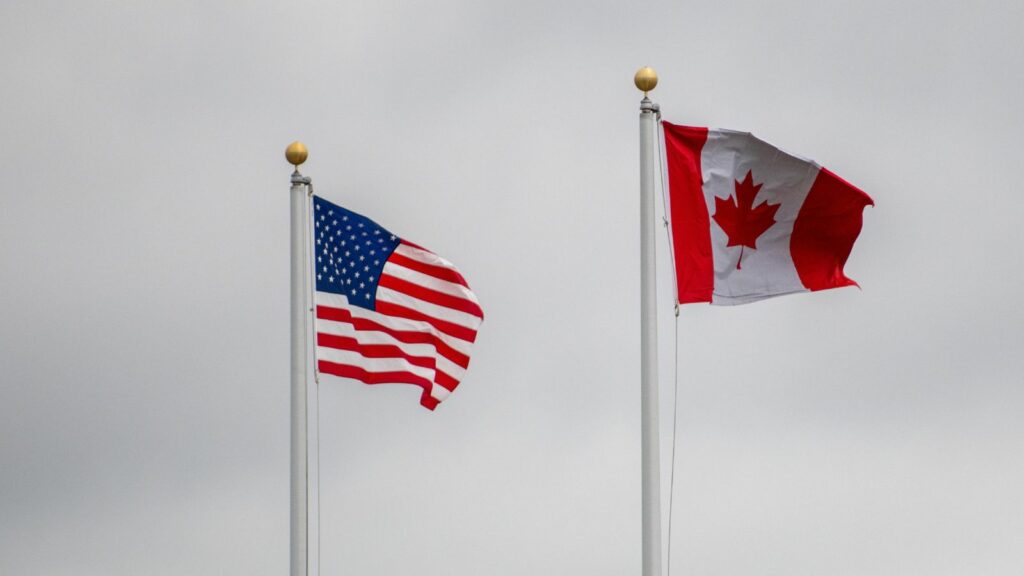
A Republican closely aligned with Donald Trump is publicly pushing back against the president’s trade war with Canada, revealing that he personally contacted the White House in an effort to end the dispute.
Mike Rogers, the Republican candidate in Michigan’s closely watched U.S. Senate race, made the disclosure during a heated debate on October 8, 2026. His comments followed a campaign advertisement calling for an immediate end to tariffs that have disrupted trade between Michigan and its northern neighbour.
The political shift is particularly significant because Rogers previously defended Trump’s tariff policies and has received the president’s endorsement.
With Michigan’s automotive industry deeply dependent on Canadian suppliers and customers, the disagreement exposes growing tensions within the Republican Party over the economic consequences of Washington’s trade strategy.
Mike Rogers Reveals He Contacted the White House About Canada
During Michigan’s first televised U.S. Senate debate on October 8, Republican candidate Mike Rogers made a significant admission about his efforts to influence the Trump administration’s trade policies. Facing questions about his changing position on Canadian tariffs, Rogers said he had contacted the White House during the week and spoken with the U.S. commerce secretary about reaching an agreement with Canada. He explained that he wanted the negotiations concluded and the dispute resolved. His comments came during a contentious exchange with Democratic opponent Abdul El-Sayed, who challenged Rogers over his previous support for the tariffs.
The exchange took place in Grand Rapids during a debate hosted by WOOD-TV, where both candidates faced questions about rising prices, manufacturing jobs and economic uncertainty. Rogers acknowledged that American tariffs on Canadian products had become excessive and argued that some should be eliminated. Speaking with reporters afterward, he explained that the administration had originally indicated the Canadian tariff dispute would be resolved quickly, but that had not happened. His intervention signals growing concern about the economic consequences of prolonged trade restrictions, even among Republicans who have generally supported Trump’s agenda.
A Campaign Advertisement Declares Canada Is Not America’s Enemy
Rogers’ debate comments followed the release of a 30-second campaign advertisement on October 7 that directly challenged the direction of America’s trade relationship with Canada. The advertisement opens in a neighbourhood bar, where Rogers references drinking Labatt beer and watching the Detroit Red Wings, two familiar elements of Michigan’s cultural connection with its northern neighbour. He then delivers the central message: “Here in Michigan, we know that Canada is not our enemy.” Rogers goes on to call for the tariff war to end immediately, presenting cooperation with Canada as an essential part of lowering prices for Michigan families.
The advertisement’s setting was carefully chosen to make an international trade dispute feel relevant to everyday life. Rather than discussing complicated tariff classifications or diplomatic negotiations, Rogers connects trade policy with recognizable Michigan experiences. Canadian products, professional hockey and cross-border friendships are familiar parts of life in communities near the border. The message also allows Rogers to distance himself from a controversial Trump policy without directly criticizing the president by name. Instead, he presents ending the dispute as a practical economic priority that Republicans and Democrats should pursue together.
Rogers Previously Supported Trump’s Tariff Strategy
The sharpest political question surrounding Rogers’ announcement concerns his earlier support for Trump’s trade policies. During much of his Senate campaign, the former congressman defended tariffs as a way to encourage manufacturers to invest in American production and protect domestic employment. In August 2025, Michigan Democrats criticized Rogers for backing the administration’s approach. As recently as September 2026, he continued defending tariffs as a necessary component of Trump’s economic agenda, while acknowledging that they were not appropriate for every situation. That position was considerably different from his October call to end the Canadian tariff war immediately.
During the debate, moderator Rick Albin confronted Rogers over this apparent reversal, asking him to explain how his latest message aligned with his earlier support. Rogers maintained that he wanted a better agreement rather than abandoning every trade restriction. He also argued that some manufacturers had benefited from Trump’s policies, describing conversations with businesses that had added work shifts because of changes in trade conditions. His response highlighted an important distinction: opposing the current tariff dispute with Canada does not necessarily mean rejecting tariffs as an economic tool. Nevertheless, the timing of the change has invited questions about whether economic concerns or election pressure played the larger role.
Trump’s Endorsement Makes the Disagreement More Significant
Rogers is not a Republican who built his campaign around opposing Donald Trump. The president formally endorsed his Senate candidacy in July 2026, and Rogers welcomed that support enthusiastically. In September, Trump recorded a campaign message encouraging Michigan voters to elect Rogers, praising his military and law enforcement background and presenting him as a reliable supporter of the administration’s economic and security priorities. The endorsement strengthened Rogers’ standing among Republican voters and established a clear political connection between the two men.
That relationship makes his criticism of Canadian tariffs especially noteworthy. Rogers is attempting to persuade voters that he can maintain access to the president while still challenging policies that he believes harm Michigan. His campaign advertisement presents cooperation across party lines as a way to reduce prices and support local employment. For Trump, however, tariffs remain a central instrument of his effort to secure more favourable trade terms and promote American manufacturing. Rogers therefore faces a delicate political calculation. He must convince independent voters that he understands their economic concerns without appearing to abandon the president whose endorsement remains important to his Republican supporters.
Canada Accounts for a Remarkable Share of Michigan’s Exports
Michigan’s relationship with Canada is far more economically significant than its international border might suggest. According to the Office of the United States Trade Representative, Michigan exported approximately US$23.2 billion in goods to Canada during 2025. That represented roughly 39% of the state’s total merchandise exports, making Canada its largest foreign customer by a substantial margin. Mexico ranked second at US$16.6 billion, while Germany, China and Japan purchased considerably smaller amounts of Michigan goods. For companies that depend on foreign customers, the Canadian market is not simply another export destination. It represents a major source of revenue and employment.
Manufacturing is particularly important to this relationship. Michigan exported US$56.7 billion in manufactured products worldwide during 2025, with transportation equipment accounting for approximately US$25.2 billion of its total goods exports. The state also had more than 13,600 businesses exporting internationally in 2024, most of them small and medium-sized enterprises. These figures help explain why trade restrictions can create concern far beyond major automobile manufacturers. Smaller suppliers, specialized equipment producers and businesses supporting industrial production may also experience reduced orders, narrower profit margins or delayed expansion plans when cross-border trade becomes more expensive.
The Detroit-Windsor Automotive Corridor Is Especially Vulnerable
The close relationship between Detroit and Windsor provides one of the clearest examples of why tariffs can create economic problems on both sides of the border. Automotive manufacturers have spent decades developing production systems that use factories and suppliers in both countries. A vehicle assembled in Michigan may contain components produced in Ontario, while Canadian assembly plants frequently depend on American parts and specialized equipment. This interconnected structure allows manufacturers to source materials and expertise efficiently, but it also leaves them vulnerable when governments introduce additional costs at the border.
The scale of cross-border commerce is substantial. According to the U.S. Bureau of Transportation Statistics, goods trade passing through the Detroit border crossing totalled approximately US$125.8 billion in 2025. The Port Huron crossing handled another US$116.6 billion. These figures reflect trade moving through the crossings rather than goods produced exclusively in Michigan, but they demonstrate the importance of the region’s transportation infrastructure. In a September 2026 discussion of Canada’s retaliatory tariffs, automotive industry representatives warned that additional trade costs could place pressure on manufacturing margins. For an automotive supplier working with customers in both countries, even relatively small disruptions can complicate production schedules and future investment decisions.
Trump’s Latest Tariffs Have Escalated the Trade Dispute
The current disagreement intensified in July 2026, when the Trump administration announced new tariffs targeting Canadian products. The measures relied on Section 338 of the Tariff Act of 1930, a provision allowing the United States to respond to what Washington considers discriminatory foreign trade practices. The administration accused Canada of unfairly restricting American automotive exports, alcoholic beverages and dairy products. The new duties eventually took effect in August, imposing 50% tariffs on approximately C$27.6 billion worth of Canadian goods. Unlike ordinary preferential treatment available under the Canada-United States-Mexico Agreement, the targeted products did not receive a general exemption simply because they qualified under the trade agreement.
Washington argued that these restrictions were necessary to address unequal treatment of American businesses. Canadian officials rejected that justification, maintaining that several of the disputed Canadian measures were themselves responses to earlier American tariffs. The disagreement therefore moved beyond a simple negotiation over tariff rates. Each government increasingly portrayed its actions as justified responses to the other’s policies. Additional American restrictions announced in September included import bans on selected Canadian products. The resulting uncertainty has complicated planning for businesses that previously relied on relatively predictable trading arrangements across North America.
Canada’s Retaliation Has Added Pressure on American Exporters
Canada responded to Washington’s latest measures with another round of retaliatory tariffs, increasing the financial pressure on American exporters. On September 8, 2026, Ottawa introduced countermeasures covering approximately C$27.6 billion in goods imported from the United States. Depending on the product, the new tariff rates were set at 15%, 25% or 50%. The restrictions targeted sectors including steel, aluminum, dairy, appliances, agricultural equipment, pulp and paper, plastics and electronics. Certain existing Canadian tariffs also increased to match comparable American duties. Ottawa described the response as an effort to defend Canadian businesses and workers against the economic consequences of the new American measures.
For Michigan manufacturers, these Canadian countermeasures introduce another commercial challenge. American businesses exporting materials, equipment or finished products to Canadian customers may find their goods more expensive relative to competing suppliers. Some businesses could absorb part of those costs to retain customers, while others may reduce shipments or increase prices. The consequences vary depending on individual products, supply contracts and the availability of alternatives. Michigan’s automotive industry is particularly exposed because of its dependence on established cross-border relationships. Rogers’ call for an agreement reflects concern that prolonged retaliation could damage businesses that benefit from maintaining customers and production partnerships on both sides of the border.
Economic Research Helps Explain the Growing Concern About Prices
The political argument over tariffs is increasingly connected to household affordability, particularly as Americans confront higher prices for essential goods. Research published by the Federal Reserve Bank of New York in October 2026 examined how tariffs introduced during 2025 and 2026 affected consumer prices. The researchers found that approximately 26% of tariff increases passed through to consumer prices in their analysis. Some of that effect occurred directly through more expensive imported products, while additional pressure emerged when American manufacturers faced higher input costs or increased their prices as competing imported products became more expensive.
Separate estimates from Yale University’s Budget Lab underline the potential household consequences. In its August 2026 assessment, the research group projected that the prevailing American tariff regime would raise consumer prices by approximately 0.7%, equivalent to an average annual household cost of roughly US$1,100. These estimates reflect the broader American tariff system, not the Canada dispute alone. Nevertheless, they help explain why Rogers has made lower prices a central theme of his campaign. Tariffs may provide protection for certain domestic producers, but they can also impose costs on businesses that import materials and consumers purchasing affected products.
Abdul El-Sayed Accuses Rogers of Changing His Position for Political Reasons
Democratic candidate Abdul El-Sayed has been quick to challenge Rogers over his changing position on Canadian trade. During the October 8 debate, El-Sayed argued that Rogers had supported Trump’s economic policies until their consequences became politically difficult to defend. He suggested the Republican’s latest position reflected concerns about his standing in the election rather than a consistent commitment to protecting Michigan consumers. El-Sayed also described the administration’s tariff policies as chaotic and poorly executed, arguing that they were contributing to higher costs for residents. The exchange became one of several heated moments during a debate marked by frequent interruptions and personal attacks.
However, El-Sayed’s own trade position is more nuanced than an outright rejection of tariffs. He explained that trade restrictions can serve a legitimate purpose when they support a coherent industrial strategy and protect domestic employment. He also referenced the United Auto Workers’ support for targeted trade measures designed to strengthen American manufacturing. That means the candidates do not fundamentally disagree about whether tariffs should ever be used. Their disagreement concerns how tariffs are designed, which trading partners should be targeted and whether the current dispute with Canada is delivering meaningful economic benefits. For Canadian businesses hoping for relief, that distinction matters because a change in political leadership would not necessarily eliminate every trade restriction.
Michigan’s Senate Election Could Influence Washington’s Trade Debate
The controversy has emerged during one of the most closely watched Senate elections in the United States. Rogers is running against El-Sayed for the seat being vacated by retiring Democratic Senator Gary Peters. Rogers previously lost Michigan’s 2024 Senate election to Democrat Elissa Slotkin by fewer than 20,000 votes, demonstrating how narrow statewide political margins can be. In the 2026 Democratic primary, El-Sayed defeated Representative Haley Stevens by less than one percentage point. With both parties expecting a competitive general election, economic concerns have become an important part of their attempts to persuade undecided voters.
The national stakes are substantial. Democrats need a net gain of four Senate seats to secure a majority, making Michigan one of several states that could determine control of the chamber. Rogers’ decision to challenge Trump’s Canadian tariff strategy also follows another notable shift in his campaign. In September, he called for a quick end to the war with Iran after previously supporting the conflict, citing its consequences for gasoline prices and household expenses. Reuters has documented similar efforts by Republican candidates in competitive races to distance themselves from selected administration policies. Whether those positions reflect genuine policy disagreements, electoral strategy or both, they demonstrate how economic pressures are reshaping political messaging ahead of November’s vote.
A White House Phone Call Does Not Mean a Trade Agreement Is Close
Despite Rogers’ public intervention, there is no confirmed indication that his reported conversations have resulted in a change to American tariff policy. On October 8, U.S. Trade Representative Jamieson Greer said Washington was maintaining its position in discussions with Canada. Greer acknowledged that officials from both countries continued communicating, including at senior levels, but suggested that meaningful progress depended on Canada becoming more willing to accept an agreement. His comments offered little indication that the administration was preparing to remove its trade restrictions immediately. Rogers’ announcement therefore establishes that he claims to have pushed for a resolution, not that the White House has agreed to his request.
The uncertainty extends to the future of North America’s broader trade framework. During the July 2026 review of the Canada-United States-Mexico Agreement, Washington declined to extend the pact for another 16-year term in its existing form. The agreement remains legally in force, but the decision triggered continuing reviews while the countries attempt to resolve disagreements. For Canadian exporters and Michigan manufacturers, that means the problem extends beyond a single tariff announcement or election campaign. Rogers has made a politically significant appeal for an end to the dispute, yet the outcome remains dependent on negotiations between governments. Until those negotiations produce a concrete agreement, businesses and households on both sides of the border will continue living with the consequences of an unresolved trade conflict.
