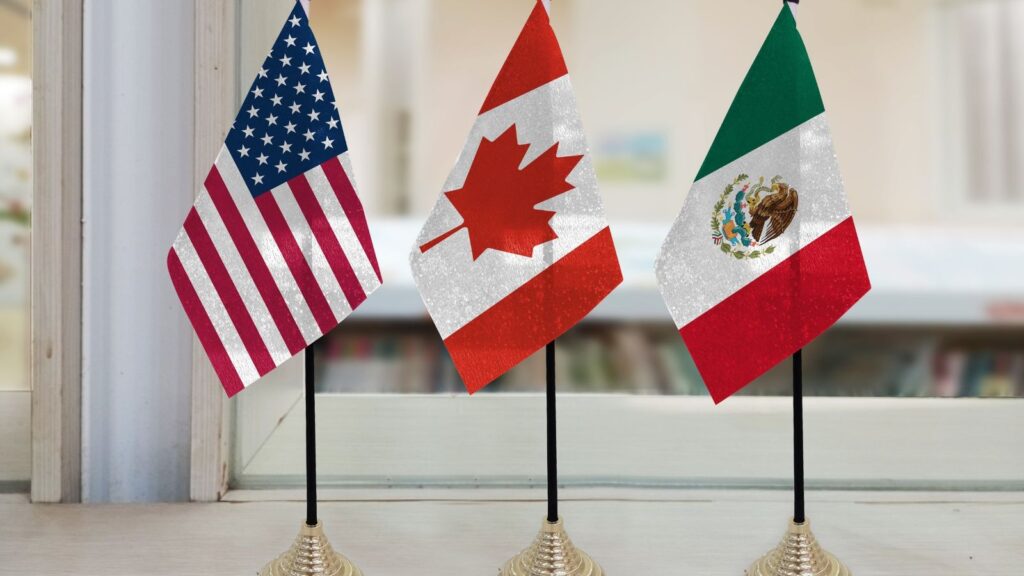
The future of North American trade has taken another unexpected turn, with President Donald Trump suggesting the United States is approaching a major agreement with Mexico while Canada remains without a renewed negotiating process with Washington.
Speaking at a political rally in Kansas on October 19, 2026, Trump said the United States and Mexico were very close to reaching what he described as a great trade deal. His comments arrived just days after reports of disagreements within his own administration over proposed tariff reductions.
For Canada, the contrast is significant. Prime Minister Mark Carney suspended formal trade negotiations on August 21 after rejecting last-minute American demands, leaving major questions unresolved over automobiles, steel, aluminum and other exports.
Although the existing Canada–United States–Mexico Agreement remains legally in force, the prospect of Washington reaching a separate understanding with Mexico raises new questions about Canada’s competitive position in North America’s integrated economy.
Trump Signals Progress With Mexico but Offers Few Details
President Donald Trump delivered an optimistic assessment of U.S.–Mexico trade relations during an October 19 political rally in Park City, Kansas. According to Reuters, Trump said the two countries were very close to agreeing on a great trade deal. The announcement was notable because Mexico has been engaged in extended negotiations with Washington over tariffs, market access and the future of North American trade. For Mexican manufacturers facing uncertainty over access to their largest export market, even the suggestion of progress could offer some reassurance.
However, Trump’s remarks did not include a signed agreement, a timetable for implementation or specific commitments on tariff reductions. There was no accompanying announcement establishing how automobiles, steel or aluminum would be treated under a new arrangement. That distinction is particularly important given the history of rapidly changing negotiations involving the Trump administration. An agreement described as nearly complete can still encounter major obstacles before its terms become legally effective. For Canada, the statement demonstrates Washington’s willingness to pursue progress with one North American partner, but it does not yet establish that Mexico has secured better trade conditions.
Mexico’s Negotiations Have Faced Resistance Inside Washington
The apparent progress comes against a complicated negotiating backdrop. On October 15, The Wall Street Journal reported that efforts to reach a tariff agreement with Mexico had encountered resistance from U.S. Commerce Secretary Howard Lutnick. According to people familiar with the discussions, the proposed arrangement would have reduced American tariffs on Mexican steel, aluminum and automobiles in exchange for concessions from Mexico. Lutnick reportedly objected to significant reductions in the 25% tariff on Mexican vehicles and the 50% tariffs affecting steel and aluminum.
Mexican Economy Secretary Marcelo Ebrard disputed suggestions that the negotiations had stopped. Speaking on October 16, he said communications with American officials were continuing and expressed confidence that tariff reductions remained possible. Mexico has been seeking to reduce automotive tariffs toward 15%, although no such reduction has been finalized. The disagreement between reports of internal resistance and optimistic comments from Mexican officials illustrates the difficulty of assessing negotiations from public statements alone. Trump’s latest declaration may signal renewed political momentum, but unresolved tariff demands remain an obstacle to a completed agreement.
Canada’s Negotiations Have Been Suspended Since August 21
Canada’s position is considerably more strained. On August 21, Prime Minister Mark Carney announced that his government was suspending trade negotiations with Washington and directing Canadian negotiators to return to Ottawa. The decision followed intensive discussions during which both sides had appeared to move closer to an agreement. Carney said the United States introduced last-minute terms that were unfair, economically damaging and inconsistent with Canada’s negotiating objectives. The collapse came shortly before new American tariffs were scheduled to take effect.
The disagreements involved more than the percentage charged on individual exports. In an August 22 address, Carney explained that Canada had been willing to reduce retaliatory tariffs on strategic industries if Washington offered meaningful relief in return. He also discussed possible steps involving American alcohol sales and dairy administration. However, the Canadian government rejected demands it believed would undermine industrial independence, cultural protections and national sovereignty. The dispute demonstrated why an agreement that initially appears commercially attractive can become unacceptable when broader conditions are introduced. Since then, no formal restart of the suspended negotiations has been announced.
Technical Discussions Continue, but a Breakthrough Remains Distant
The suspension does not mean Canadian and American officials have stopped communicating. During the G20 trade ministers’ meeting in Milwaukee on October 1, U.S. Trade Representative Jamieson Greer acknowledged that technical discussions with Canada were continuing. He also said several outstanding issues remained particularly difficult to resolve. Canada’s International Trade Minister Maninder Sidhu held a separate conversation with Greer during the gathering, providing another opportunity for diplomatic contact despite the absence of renewed formal negotiations.
Greer indicated that the Trump administration remained open to an agreement but was not inclined to eliminate tariffs entirely. That position creates a difficult starting point for Canada, which has been seeking substantial relief for its most exposed industries. Carney and Trump also spoke by telephone on October 11, although the Canadian government’s account focused on international security and energy issues rather than announcing renewed trade talks. These contacts show that diplomatic channels remain available. Nevertheless, routine communication and technical exchanges are different from a negotiated settlement with agreed terms, implementation dates and enforceable commitments.
CUSMA Remains in Force Despite the Push for Separate Deals
The continuing uncertainty has created confusion about the status of the Canada–United States–Mexico Agreement, known as CUSMA in Canada and USMCA in the United States. The agreement entered into force on July 1, 2020, replacing the original North American Free Trade Agreement. Its first mandatory joint review occurred on July 1, 2026. Although the three countries did not agree to extend the arrangement at that review, the treaty remains legally in force until 2036.
The distinction matters because bilateral tariff negotiations do not automatically cancel the existing trilateral framework. Mexico’s President Claudia Sheinbaum emphasized this point on October 12, explaining that Washington had chosen to negotiate separately with Mexico and Canada while the broader agreement remained operational. The treaty permits its members to agree on another 16-year term and provides for continuing reviews when an extension is not approved. Businesses can therefore still rely on applicable CUSMA provisions, although separate American tariffs may affect specific products. Whether bilateral understandings eventually reinforce the existing treaty or create competing rules remains an important unanswered question.
Tariffs Are Creating Different Challenges for Both Countries
Canada and Mexico face many of the same American trade restrictions, but their negotiating strategies have diverged. Both have sought relief from U.S. tariffs on automobiles and industrial metals. Covered steel and aluminum imports generally face a 50% American tariff, while automotive duties can reach 25%, subject to product-specific rules and adjustments for qualifying U.S. content. These measures operate under separate American trade authorities, which means preferential CUSMA treatment does not automatically eliminate them.
Canada also faces additional restrictions that have triggered retaliatory action. After Washington imposed 50% tariffs on approximately C$27.6 billion worth of specified Canadian goods in August, Ottawa introduced counter-tariffs covering an equivalent value of selected American imports. Those measures took effect September 8, with rates of 15%, 25% or 50% depending on the product. The targeted categories include metals, appliances, agricultural equipment, pulp and paper and electronics. Existing Canadian countermeasures affecting American vehicles also remain relevant. These overlapping rules create a complex environment in which the cost of trade can vary substantially according to the product, its origin and the legal authority behind the tariff.
Ontario’s Auto Industry Could Face a New Competitive Disadvantage
The possibility of a separate U.S.–Mexico agreement is particularly significant for Ontario’s automotive industry. Federal economic development data indicate that Ontario exported approximately C$60 billion in automobiles and automotive parts to the United States in 2025, representing 96% of the province’s automotive exports. The sector supports more than 95,000 workers in the province and depends heavily on integrated North American production networks involving assembly plants, parts manufacturers and suppliers across all three countries.
A separate agreement granting Mexico lower American automotive tariffs could create a competitive disadvantage for Canadian production if Ontario manufacturers continued facing higher duties. That outcome is a possibility rather than an established result, because no new Mexican tariff schedule has been announced. Statistics Canada research helps explain the stakes: in 2024, American demand supported approximately 76% of Canadian automobile and light-duty motor vehicle manufacturing payroll jobs. For workers in communities such as Windsor, Oshawa and Cambridge, long-term investment decisions by automakers can have consequences extending well beyond the assembly line. Parts suppliers, logistics companies and nearby businesses all depend on reliable production volumes.
Steel and Aluminum Producers Are Also Under Pressure
Canadian steel and aluminum producers have already experienced considerable disruption from American tariffs. Reuters reported on October 16 that Canadian steel shipments to the United States had fallen by approximately 60% following the increase in American steel duties to 50% in June 2025. Reduced access to the American market has forced companies to reconsider how they allocate production, pursue customers and make investment decisions. Although recent domestic demand has offered some support, replacing a major established export market is not straightforward.
The industry has been adapting rather than relying exclusively on a future trade agreement. According to the same reporting, the share of Canadian steel production directed toward domestic consumption increased from 41% in 2024 to 51% in 2025. Demand from energy infrastructure, mining and other industrial projects has helped absorb some output. Still, domestic customers cannot necessarily replace every American order, particularly for specialized products. A negotiated reduction in U.S. tariffs could materially improve conditions for Canadian producers. Conversely, an agreement benefiting Mexican metals while leaving Canadian duties unchanged could increase competitive pressure on Canadian suppliers serving similar American customers.
Canada’s Dependence on U.S. Trade Makes the Stakes Enormous
Canada’s economic relationship with the United States remains exceptionally large. Global Affairs Canada reports that approximately C$3.5 billion in goods and services crossed the border in both directions every day during 2025. The United States also accounted for 71.7% of Canadian merchandise exports that year, according to Statistics Canada. Although that was lower than the 75.9% recorded in 2024, American demand still represents the dominant market for many Canadian industries.
The numbers help explain why developments between Washington and Mexico attract attention in Ottawa. North American production is organized around the ability to move materials, components and finished goods across borders with predictable costs. Changing the rules for one partner can influence investment decisions throughout the region. Canada and Mexico also maintain a substantial direct trading relationship, with nearly C$62 billion in two-way merchandise trade recorded in 2025. Ottawa has been promoting greater diversification beyond the American market, and exports to non-U.S. destinations increased during 2025. Nevertheless, creating new markets and supply relationships takes time, particularly for industries whose factories and distribution networks were built around North American demand.
The Bank of Canada Says Trade Uncertainty Is Affecting Businesses
The economic consequences of the breakdown are becoming clearer. On October 19, the Bank of Canada released its third-quarter Business Outlook Survey, which included responses gathered before and after the August collapse in trade negotiations. Although overall business sentiment improved during the earlier part of the quarter, firms responding after the breakdown reported weaker confidence and lower expectations for export sales. The central bank also found that renewed trade tensions were weighing more heavily on investment decisions and raising concerns about input costs.
The findings require some context. Approximately three-quarters of the main business interviews occurred before negotiations collapsed, meaning the headline improvement in sentiment does not fully describe conditions afterward. The Bank also noted that confidence remained stronger than during the most severe trade tensions of 2025. Nevertheless, some manufacturers reported adjusting supply chains, delaying investments or considering production outside Canada to reduce tariff exposure. Others were pursuing customers in Europe or expanding sales within Canada. These responses reveal how uncertainty can influence business decisions even before another tariff increase occurs. A factory considering expensive new equipment may postpone the investment when future market access remains unclear.
Canada’s Next Challenge Is Avoiding a Deal That Leaves It Behind
The immediate question is whether Trump’s optimism about Mexico will translate into an agreement that alters the competitive balance within North America. American Trade Representative Jamieson Greer indicated in July that Washington was seeking interim arrangements with its North American partners before the end of 2026, while more complicated CUSMA questions could extend into 2027. Mexico’s officials have continued pursuing tariff relief, and Ebrard indicated on October 16 that another formal bilateral negotiating round should take place before the end of the year. No final agreement or confirmed implementation timetable has emerged.
For Canada, the strategic challenge is maintaining access to the American market without accepting conditions Ottawa considers economically damaging or inconsistent with its sovereignty. Resuming formal negotiations could provide an opportunity to reduce tariffs and restore business confidence, but it would not guarantee that Washington offers acceptable terms. Remaining outside an emerging U.S.–Mexico arrangement could also carry risks, especially for automotive and metals producers. The existing CUSMA framework provides important continuity, but it does not resolve the present tariff disputes. Until concrete agreements replace political statements, Canadian workers, manufacturers and investors will continue facing uncertainty over the future of North American trade.
