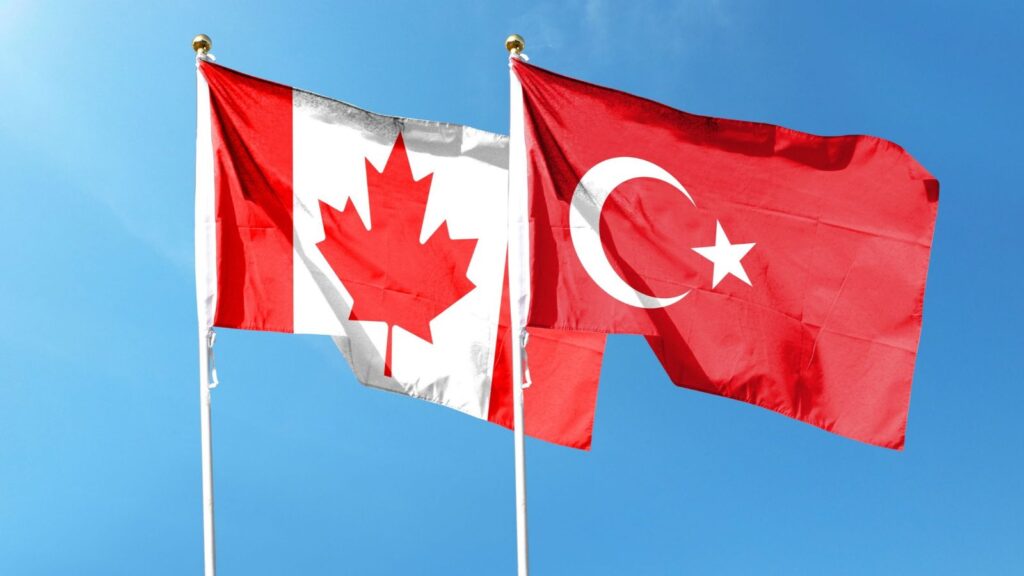
Canada’s search for trade breathing room is moving well beyond Washington. Prime Minister Mark Carney’s visit to Türkiye has put a Canada-Türkiye free-trade agreement onto an active negotiating track, alongside a wider strategic partnership covering investment, energy, defence and transportation. The timing is no accident. Canada is trying to reduce its exposure to a U.S. trade relationship that has become less predictable under President Donald Trump, whose tariffs and threatened tariff increases have hit sectors ranging from steel and aluminum to autos. Türkiye will not replace the United States as Canada’s dominant market, but it offers a large economy, an important regional gateway and growing demand in sectors where Canadian firms already compete. The talks therefore matter as much for what they signal about Canada’s changing trade strategy as for the bilateral deal itself.
A Historic Visit Turns a Trade Plan Into Active Negotiations
Carney’s trip to Ankara carries unusual diplomatic weight because it is the first bilateral visit to Türkiye by a Canadian prime minister. He and President Recep Tayyip Erdoğan used the meeting to launch a broader strategic partnership built around trade and investment, energy, defence and security, and people-to-people ties. The leaders also welcomed the first round of Canada-Türkiye free-trade negotiations and signed an expanded air transport agreement intended to make travel, tourism and business links easier.
The trade process itself has been building for months. Canada and Türkiye began exploratory discussions in June, publicly announced the launch of negotiations during the NATO summit in Ankara on July 7, and completed Canadian public consultations in September. Ottawa then tabled its formal notice of intent in Parliament on September 21. That sequence matters because this week’s announcement is not a sudden diplomatic pivot. It is the point where months of political groundwork are being turned into detailed bargaining over tariffs, market access and trade rules.
Trump’s Tariffs Have Changed Canada’s Trade Calculation
The push toward Türkiye is happening against the backdrop of a much harsher Canada-U.S. trade environment. In August, Washington imposed 50 per cent tariffs on roughly C$27.6 billion of Canadian goods under a new round of U.S. trade measures, prompting Ottawa to announce matching counter-tariffs. Separate U.S. actions have also hit Canadian steel and aluminum, while the Trump administration has threatened higher duties on Canadian autos and parts. For companies tied to cross-border supply chains, the risk is no longer theoretical; tariff decisions can change investment plans, hiring and sourcing almost overnight.
Carney’s response has been to argue that Canada cannot return to its old level of dependence on one market. The government has set a goal of doubling exports to non-U.S. destinations over the next decade and is using trade agreements, investment deals and sector partnerships to widen the country’s options. Türkiye fits that strategy neatly: it is not large enough to offset lost U.S. demand by itself, but it can become one piece of a much broader diversification effort.
Canada-Türkiye Trade Is Small but Growing Quickly
Canada and Türkiye are starting from a modest but fast-growing commercial base. Two-way merchandise trade reached about C$4.3 billion in 2025, up by almost 50 per cent over five years. Canadian exports were roughly C$1.1 billion, while imports from Türkiye totalled about C$3.2 billion. The relationship is therefore still small compared with Canada’s trade with the United States, but it is large enough to support established supply chains and a meaningful group of exporters on both sides.
The mix of goods also shows why negotiators see room to grow. Canada’s leading exports to Türkiye in 2025 included lentils worth C$173 million and aircraft worth C$161 million, along with alloy steel scrap and optical instruments. Major imports included pharmaceuticals, fishing vessels, rugs and textiles, and turbine-engine components. These are not purely consumer flows; they include industrial, aerospace and agricultural products. That gives negotiators several practical areas where lower tariffs, clearer rules or improved customs treatment could translate relatively quickly into more business.
Cutting Tariffs Is Only One Part of What Canada Wants
Ottawa’s published negotiating objectives go far beyond simply cutting customs duties. Canada wants better access for goods and services, fewer non-tariff barriers, clearer rules of origin and more predictable conditions for investors and traders. The government also wants provisions covering areas such as digital trade, labour, the environment and regulatory transparency. For Canadian exporters, the value of a deal would often come from reducing the administrative friction that can make a market expensive even when headline tariffs look manageable.
Türkiye remains a relatively protected market in several areas. World Trade Organization data show that its simple average most-favoured-nation tariff was 17.5 per cent in 2024, while less than one-fifth of tariff lines were duty-free. A bilateral agreement could therefore produce meaningful savings for some Canadian products. At the same time, Ottawa has already drawn domestic red lines: it says the negotiations will preserve Canada’s supply-management system for dairy, poultry and eggs and retain policy space for Indigenous obligations, culture and public-interest regulation.
Energy, Aerospace and Defence Could Become the Bigger Prize
The biggest opportunities may sit outside traditional merchandise trade. Canada and Türkiye are openly discussing cooperation in aerospace, advanced technology, mining, critical minerals and energy. During Carney’s visit, the two countries signed a new energy cooperation statement covering renewables, carbon capture, geothermal technology, mining services and stronger mineral supply chains. They have also discussed nuclear power and the potential role of Canadian technology, while Türkiye is looking for investment as it expands its energy and industrial capacity.
Defence is another part of the reset. The two NATO allies have been working toward deeper military and defence-industrial cooperation, and the strategic partnership gives that effort a wider political framework. For Canadian firms, Türkiye offers a substantial manufacturing base and an increasingly important defence industry. For Turkish companies, Canada offers capital, natural resources, advanced engineering capabilities and North American expertise. A free-trade agreement would not automatically create joint projects, but it could make the commercial environment surrounding those projects easier to navigate and give companies on both sides more confidence to invest.
Türkiye Has Its Own Reasons to Want a Canadian Deal
Türkiye also has reasons to view Canada as more than a secondary trade partner. The country had a population of nearly 86 million in 2025 and a gross domestic product of about US$1.6 trillion, giving it the scale of a major emerging market. Canadian direct investment in Türkiye reached roughly C$3.3 billion in 2025, up from C$1 billion in 2022, while Turkish direct investment in Canada stood at about C$233 million. Those figures suggest the relationship already extends well beyond the exchange of goods at the border.
Erdoğan has set an ambitious political target: raising bilateral trade first to roughly US$5 billion and eventually to US$10 billion. Achieving that would require much more than signing an agreement. Businesses would still have to build distribution networks, manage currency and financing risks, and find customers in unfamiliar sectors. But the target shows that Ankara sees the relationship as strategically expandable. For Canada, that matters because diversification works best when the partner country is also actively trying to deepen the relationship.
The New Partnership Comes With Political Baggage
The warmer relationship does not erase the difficult history between Ottawa and Ankara. Ties cooled over Canadian concerns about human rights and restrictions on defence exports, issues that complicated cooperation even though both countries are NATO members. Canada removed its broad defence-export restrictions on Türkiye in 2024, opening the door to a gradual thaw that accelerated through ministerial meetings, the 2026 NATO summit and now Carney’s bilateral visit. The new strategic partnership represents a clear decision by both governments to place more weight on cooperation.
That choice will attract scrutiny. Amnesty International Canada urged Carney to raise concerns about repression, opposition figures, journalists and civil society during the visit. The challenge for Ottawa is familiar in trade diplomacy: deeper commercial ties can create leverage and channels for dialogue, but they can also expose the government to criticism that economic goals are crowding out rights concerns. The final agreement, if reached, will therefore be judged not only on tariff reductions but also on how Canada applies its stated labour, environmental and public-interest commitments.
Türkiye Cannot Replace the U.S.—and That Is Not the Strategy
Even an ambitious Canada-Türkiye agreement would not end Canada’s dependence on the U.S. market. Statistics Canada reported that 71.7 per cent of Canadian merchandise exports still went to the United States in 2025, even after that share fell from 75.9 per cent a year earlier. Türkiye, by contrast, accounted for less than 0.3 per cent of Canada’s total merchandise trade. The arithmetic makes the strategic reality clear: diversification is a long-term portfolio shift, not a one-for-one replacement for American demand.
That is why the significance of the Türkiye talks is larger than their current trade volume. Ottawa is trying to build overlapping alternatives through Europe, Asia, the Middle East and other emerging markets so that Canadian companies have more places to sell when one relationship becomes disruptive. If negotiations produce lower barriers and more investment, Türkiye could become a stronger foothold across the eastern Mediterranean, Europe and surrounding markets. The test will be whether political momentum in Ankara is converted into a detailed agreement that businesses can actually use.
