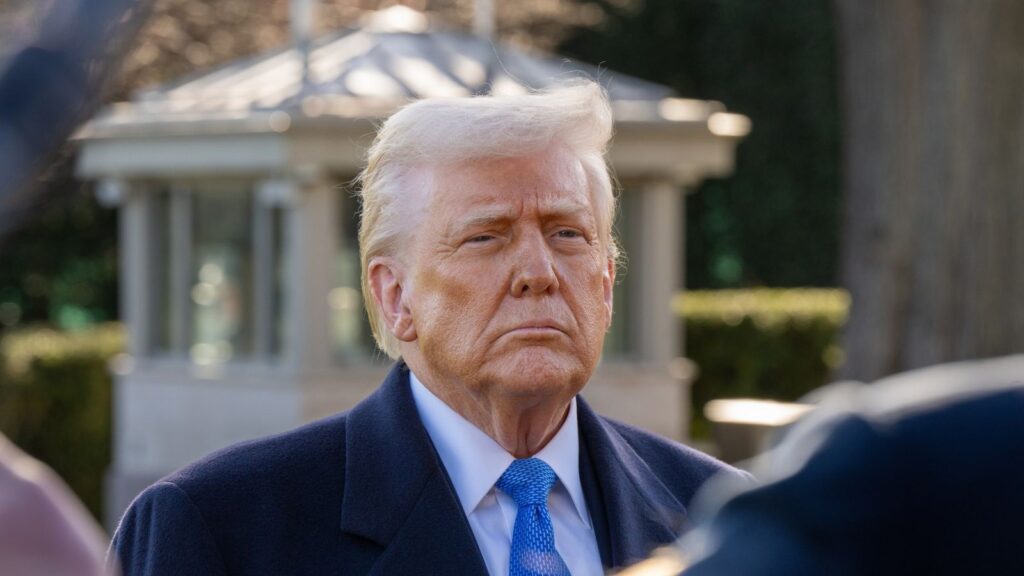
Michigan’s closely watched U.S. Senate race has taken an unexpected turn, with President Donald Trump praising a Democratic congresswoman for endorsing a Republican candidate who has publicly called for an end to the trade war with Canada.
On November 1, Democratic Representative Haley Stevens announced her support for Republican Mike Rogers rather than Abdul El-Sayed, the Democrat who defeated her in the August primary. Trump celebrated the endorsement as a demonstration of political courage, even though Rogers has increasingly challenged the president’s tariff policies.
The development comes just ahead of the November 3 midterm elections, with Michigan’s automotive economy facing uncertainty over cross-border trade. It also highlights an unusual political reality: disagreements over Canada are becoming difficult for Republican candidates to ignore, even as Trump works to maintain party unity.
A Michigan Democrat Delivers a Surprise Endorsement
The political drama unfolded on Sunday, November 1, when Representative Haley Stevens endorsed Republican Senate nominee Mike Rogers just two days before the election. Stevens, who lost Michigan’s Democratic Senate primary to Abdul El-Sayed in August, had previously indicated that she would support her party’s nominee. Instead, she appeared alongside Rogers at Perfecting Church in Detroit, marking a remarkable break from the Democratic campaign. The appearance immediately attracted national attention because Michigan’s Senate contest is considered important to determining which party controls Congress. Stevens defended her decision as a matter of principle rather than political convenience, arguing that she could no longer support El-Sayed’s campaign. Rogers welcomed her endorsement, describing himself as honoured to receive support from someone who had been a prominent figure in the opposing party.
The circumstances surrounding the announcement made the endorsement particularly striking. Stevens had originally been expected to attend a separate Detroit church event with El-Sayed and Democratic Representative Jim Clyburn of South Carolina. That planned show of unity collapsed amid disagreements over campaign messaging and accusations of hostility within the Democratic coalition. Instead of appearing beside her former primary opponent, Stevens joined the Republican nominee. She subsequently released a video explaining her decision and confirmed that her Senate vote would go to Rogers. However, she emphasized that she remained a Democrat and intended to support Democratic candidates in most other races. Her decision created an unexpected political distraction for Democrats just as they were trying to consolidate support before Election Day.
Trump Celebrates the Endorsement Despite Rogers’ Tariff Position
President Donald Trump responded enthusiastically to Stevens’ announcement, praising the Michigan Democrat in a Truth Social post. Trump described her as a respected political figure and argued that her decision reflected exceptional loyalty to Michigan residents. He also highlighted her standing among Black and Jewish voters, groups that both parties have been courting in the closely watched Senate contest. Speaking later at a campaign rally in Iowa, Trump invited Stevens to join the Republican Party and indicated that he wanted to personally thank her. Republican leaders quickly recognized the potential political value of the endorsement. House Speaker Mike Johnson said he had spoken with Stevens, while Republican officials portrayed her decision as evidence that some Democrats were dissatisfied with their party’s Senate nominee.
However, Trump’s enthusiastic response revealed an interesting contradiction in the campaign. Although Rogers has Trump’s endorsement, the Republican candidate has openly challenged the president’s handling of trade relations with Canada. Rogers has argued that the tariff dispute should end because of its consequences for Michigan’s economy and consumers. Trump’s praise for Stevens was directed at her decision to support Rogers, not at Rogers’ position on Canadian tariffs. The distinction matters because Rogers is attempting to appeal to voters who may support Republican candidates while disagreeing with certain White House economic policies. Trump also used his Iowa appearance to make inflammatory and false accusations against El-Sayed, further intensifying the political confrontation. The endorsement therefore gave Republicans an unexpected advantage in campaign messaging without resolving their disagreement over the trade war.
Why Stevens Turned Against Her Party’s Senate Nominee
The disagreement between Stevens and El-Sayed did not emerge overnight. Their Democratic primary contest had been deeply contentious, particularly over Israel and the direction of the party’s foreign policy. Stevens has been a strong supporter of Israel, while El-Sayed has been an outspoken critic of Israeli government policies and U.S. military support. Tensions intensified shortly before the general election when Stevens criticized an advertisement produced by an independent progressive group. The advertisement connected American support for Israel to rising grocery prices, an argument Stevens condemned as antisemitic. El-Sayed responded that his campaign had not produced the advertisement and explicitly stated that he disagreed with its contents. Nevertheless, the dispute revived longstanding disagreements between the two politicians.
Democratic Representative Debbie Dingell later explained that she had asked Stevens not to participate in the planned joint church appearance because the controversy had become a distraction. Stevens interpreted her exclusion as further evidence that she no longer belonged in El-Sayed’s campaign. Her endorsement of Rogers prompted an immediate backlash from Democratic leaders. Senate Democratic Leader Chuck Schumer condemned the move as a betrayal, while Michigan Democratic Party Chair Curtis Hertel accused Stevens of abandoning the principles she claimed to support. The fallout also extended into Stevens’ congressional office, where her longtime chief of staff resigned and additional departures were expected. El-Sayed largely avoided engaging in the personal dispute, telling reporters that his attention remained on Michigan residents struggling with living costs, economic uncertainty and other everyday concerns.
Rogers Has Called for an Immediate End to the Canada Tariff War
Mike Rogers’ position on Canadian tariffs has become one of the more unusual elements of Michigan’s Senate campaign. On October 7, the Republican candidate released an advertisement calling for an immediate end to the United States’ trade dispute with Canada. The commercial featured Rogers sitting in a neighbourhood bar holding a bottle of Labatt Blue, a Canadian beer familiar to many Michigan residents. He argued that Canada should not be treated as an enemy and said the tariff conflict needed to end. The advertisement was a deliberate attempt to connect trade policy with Michigan’s everyday economic relationships, using a familiar cultural reference to emphasize the closeness of communities on both sides of the international border.
The message represented a significant shift from Rogers’ earlier position. He had previously defended Trump’s tariff agenda as part of the president’s effort to protect American manufacturing and strengthen domestic industry. By October, however, Rogers was arguing that the dispute with Canada had gone too far. He presented himself as a Republican capable of working with Trump while also pushing for policies better suited to Michigan’s economic interests. His position was not necessarily an outright rejection of every tariff. Rogers has continued to support selected trade restrictions when he believes they benefit Michigan manufacturers. Instead, his argument has focused on ending a broader confrontation that threatens businesses dependent on Canadian trade. For voters concerned about automobile prices, factory employment and household expenses, that distinction has become an important part of his campaign.
Michigan’s Economy Explains Why Canada Has Become a Major Election Issue
Michigan’s economic relationship with Canada helps explain why the tariff dispute has become such a sensitive political issue. According to the Office of the United States Trade Representative, Canada was Michigan’s largest export market in 2025, purchasing approximately $23.2 billion in goods, representing 39% of the state’s total merchandise exports. Transportation equipment is among Michigan’s most important export industries, making international trade particularly significant for automotive manufacturers and parts suppliers. The state’s geographic position also gives it an unusually direct connection to Canada. Federal transportation statistics show that Detroit and Port Huron together accounted for approximately 46% of the value of merchandise transported by truck between the United States and Canada in 2025. Those figures illustrate how closely the two economies depend on each other.
The relationship is especially important for the automotive industry, where components and finished vehicles move across the border through interconnected manufacturing networks. An engine component manufactured in Ontario may be shipped to Michigan for further assembly before returning to Canada as part of another production process. Additional tariffs can increase costs, complicate procurement decisions and create uncertainty about future manufacturing investments. Canada’s federal government reported that Ontario exported approximately $60 billion in automobiles and automotive parts to the United States in 2025, accounting for 96% of the province’s automotive exports. These numbers demonstrate why Michigan and southern Ontario have a shared interest in stable trade conditions. For factory workers, transportation companies and smaller suppliers, uncertainty over tariffs can influence everything from production schedules to hiring decisions.
Trump and Carney Signal Progress, but the Trade Dispute Remains Unresolved
While Michigan’s political dispute was unfolding, Washington and Ottawa were reporting fresh signs of progress in their trade negotiations. On November 1, Prime Minister Mark Carney confirmed that he had spoken with Trump about the outlines of a potential agreement. Carney described the exchange as constructive and said negotiating teams would continue working toward an arrangement intended to support employment, improve affordability and respect Canada’s sovereignty. Trump subsequently told reporters that the two countries had developed the concept of a deal and suggested an agreement was close. He also raised the possibility of reviving the Keystone XL pipeline, although important questions about financing, construction and regulatory approvals remained unresolved. Neither government announced a finalized trade settlement.
The discussions followed months of escalating economic tensions. Negotiations broke down in August after Ottawa rejected American demands that Carney said crossed Canadian red lines involving sovereignty, French-language protections and the automotive industry. Washington subsequently imposed 50% tariffs on approximately $20 billion in Canadian goods, prompting retaliatory measures from Canada. The two governments have since discussed possible relief for industries including steel and automobiles, but the details of a broader agreement remain unsettled. For Canadian businesses, even a constructive conversation offers limited certainty until specific tariff changes are announced and implemented. Carney has also been pursuing stronger relationships with markets outside the United States, including the European Union. That diversification strategy reflects Ottawa’s growing concern about relying too heavily on an American trade relationship increasingly influenced by political disputes.
The Endorsement Could Reshape Michigan’s Final Election Debate
The timing of Stevens’ endorsement makes its political consequences difficult to predict. A New York Times/Siena University poll released November 1 showed El-Sayed leading Rogers by 53% to 42% among likely Michigan voters. However, much of the survey was conducted before the endorsement became public, meaning it cannot establish how voters responded to the surprise announcement. The controversy also generated an immediate fundraising response for the Democratic nominee. According to El-Sayed’s campaign, it raised approximately $1.2 million in the four hours after Stevens endorsed Rogers. That suggests the endorsement energized at least some Democratic supporters rather than simply weakening the campaign. Meanwhile, more than 1.8 million Michigan residents had already voted by October 30, limiting the number of ballots still potentially influenced by the late-breaking development.
The stakes extend well beyond Michigan. Republicans are defending their congressional majorities in the November 3 midterms, while Democrats are attempting to regain control of the House and Senate. Michigan’s open Senate seat, currently held by retiring Democrat Gary Peters, is an important part of that contest. Rogers hopes to attract voters concerned about economic conditions while retaining support from Trump’s political base. El-Sayed, meanwhile, is emphasizing affordability and arguing that Democrats should remain focused on the needs of Michigan families rather than internal disagreements. For Canada, the outcome will offer an indication of how voters in a major border state respond to the trade dispute. Regardless of which candidate wins, Michigan’s campaign has demonstrated that disagreements over Canadian tariffs now extend into Trump’s own party, where economic concerns are increasingly competing with political loyalty.
