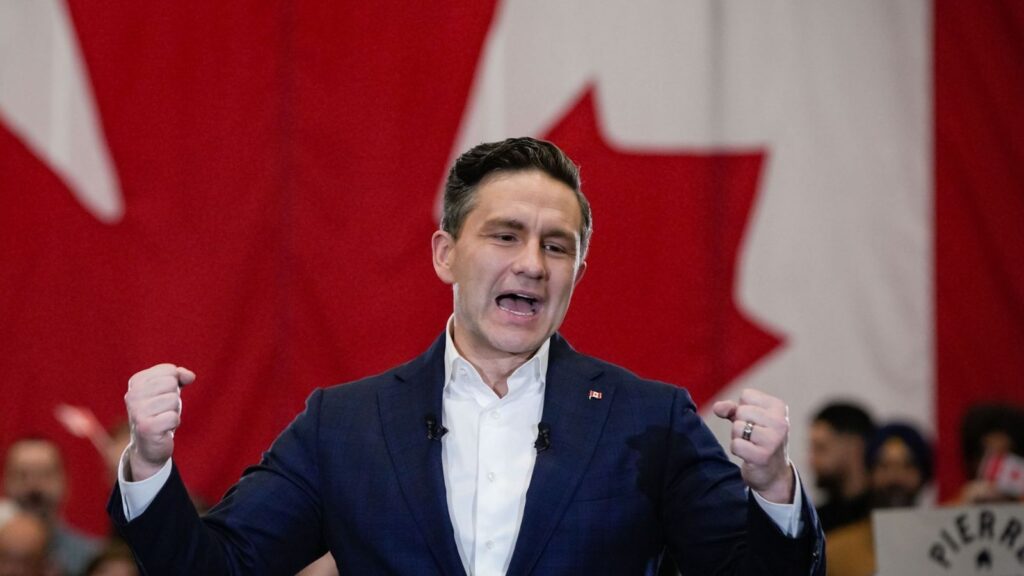
Canada’s trade dispute with the United States and mounting pressure over the cost of living have collided just days before Ottawa’s next federal budget. Conservative Leader Pierre Poilievre is demanding that Prime Minister Mark Carney deliver tangible results from negotiations with U.S. President Donald Trump while eliminating federal diesel taxes and reining in government spending. The demands come as Carney signals renewed progress in trade discussions, although no agreement has been finalized.
With Finance Minister François-Philippe Champagne scheduled to present the federal budget on November 5, 2026, the political stakes are rising. Behind the confrontation are questions affecting businesses and households across Canada: how quickly trade barriers can be reduced, whether fuel-tax relief can lower everyday expenses, and how Ottawa intends to balance affordability measures against growing federal borrowing.
Poilievre Turns the Federal Budget Into a Test of Carney’s Promises
Conservative Leader Pierre Poilievre intensified pressure on Prime Minister Mark Carney on November 1, outlining demands that combine immediate affordability measures with longer-term fiscal restraint. In a letter to the prime minister, Poilievre called for eliminating federal taxes on diesel until Canada Day 2027, temporarily removing the goods and services tax from fuel purchases, and reducing what he described as unnecessary government spending. His argument is that Canadians should see meaningful financial relief rather than another round of promises about economic improvement. The proposals place household affordability at the centre of the opposition’s response to the upcoming budget.
Poilievre reinforced that message during a news conference alongside representatives of the Canadian Taxpayers Federation, using a truck displaying a federal debt clock to illustrate his concerns about government borrowing. He also urged Carney to honour commitments involving federal deficits and debt relative to the size of the economy. The timing was deliberate, coming only four days before the November 5 budget. By publicly identifying his priorities before the fiscal plan is released, Poilievre is establishing benchmarks against which Conservatives can evaluate the government’s decisions and argue whether they address the financial pressures facing Canadian households.
Conservatives Demand Results From Trump’s Trade Negotiations
Beyond domestic taxes, Poilievre is demanding faster progress toward a trade agreement with the United States. Speaking on November 1, he urged Carney to secure a favourable deal with President Donald Trump and argued that Canadians cannot afford an indefinite negotiating process. The Conservative leader accused the prime minister of falling short of expectations established during the previous federal election, when Carney presented his leadership as an opportunity to improve Canada’s position in its relationship with Washington. Poilievre’s criticism reflects the growing political significance of American tariffs for Canadian manufacturers, exporters, workers, and communities dependent on cross-border commerce.
The demand creates an uncomfortable political challenge for the government. Carney must demonstrate progress without accepting conditions that could weaken Canadian industries or undermine national sovereignty. Poilievre has also previously warned against making excessive concessions to Washington, making the opposition’s position more complicated than simply demanding any available agreement. For a manufacturing worker worried about future shifts or a supplier considering whether to expand production, the details of a deal may matter far more than its announcement date. The central question is whether renewed negotiations can produce meaningful tariff relief while preserving Canada’s ability to defend its economic interests.
Trump Says a Trade Deal Is Taking Shape, but Nothing Is Finalized
There has been a notable improvement in the public tone surrounding Canada-U.S. trade negotiations. On November 1, Carney described a constructive conversation with Trump and said officials from both countries would continue working toward an agreement over the coming weeks. Trump subsequently told reporters in Iowa that the two governments had developed the concept of a deal. Both leaders presented the discussions positively, although neither announced finalized terms, a formal timetable for signing, or a comprehensive settlement of the existing tariff dispute. The distinction matters because encouraging statements from political leaders do not immediately change the costs facing exporters.
Trump also raised the possibility of reviving the Keystone XL oil pipeline as part of the broader discussions. The original project, designed to transport approximately 830,000 barrels of oil per day, was cancelled after a key U.S. presidential permit was revoked in 2021. A related but separate pipeline proposal, Prairie Connector, is being considered by South Bow and its U.S. partner. However, Trump’s comments did not establish that Keystone XL had been formally revived or that Canada had committed to funding construction. For Canadian businesses, the immediate priority remains understanding which tariffs might disappear, what concessions Washington expects, and whether any eventual agreement provides durable market access.
American Tariffs Continue to Threaten Canadian Jobs and Investment
The urgency surrounding the negotiations reflects the economic damage that prolonged trade uncertainty could cause. Canada and the United States have spent much of 2026 imposing additional trade restrictions and responding to each other’s measures. American tariffs affecting Canadian steel and automobiles have become especially important negotiating issues, with duties reaching as high as 50% on some steel products and 25% on covered automobiles. Discussions reported in late October focused on possible relief for these sectors, although officials had not confirmed a final arrangement. For companies operating integrated North American supply chains, tariff uncertainty complicates production planning, investment decisions, and pricing.
The Parliamentary Budget Officer’s October economic outlook provides another measure of the stakes. It estimated that trade measures introduced since early 2025, if maintained permanently, could reduce Canada’s real economic output by approximately 1.4% over the medium term compared with a scenario without those measures. The office also lowered its forecast for Canadian economic growth to 0.9% in 2026 and 1.5% in 2027. These projections illustrate why a negotiated reduction in trade barriers could matter beyond political headlines. Lower tariffs could improve conditions for exporters, while continued uncertainty may leave businesses reluctant to invest or hire even when demand begins to recover.
CUSMA Remains in Force Despite Washington’s Refusal to Extend It
Canada’s immediate trade negotiations are unfolding alongside a separate challenge involving the Canada-United States-Mexico Agreement, known as CUSMA. The agreement entered into force in July 2020 and underwent its first mandatory joint review on July 1, 2026. During that review, the United States declined to extend the agreement in its existing form. That decision created additional uncertainty about the future of North American trade, but it did not terminate CUSMA. The agreement remains legally in force, with its current term extending to 2036 unless the parties reach a different outcome under its provisions.
Because the three governments did not agree on an extension, the agreement now faces annual joint reviews. Washington has already initiated consultations ahead of the 2027 review, with written submissions due in January. This makes the distinction between a near-term bilateral tariff arrangement and the broader trilateral trade framework particularly important. A limited agreement between Carney and Trump might remove specific duties without resolving every disagreement involving automotive production, agriculture, or future market-access rules. Canadian businesses would therefore have reason to welcome immediate relief while continuing to seek a more predictable long-term trading relationship.
Poilievre’s Diesel Tax Proposal Goes Further Than Existing Relief
Poilievre’s proposed diesel relief would extend and expand measures already introduced by the federal government. Ottawa suspended the federal fuel excise tax on April 20, 2026, reducing the applicable tax by four cents per litre for diesel and ten cents per litre for gasoline. The government subsequently extended the full suspension through January 31, 2027, with half of the normal excise tax scheduled to apply from February 1 through March 31. Poilievre wants the full diesel excise tax suspension to continue until at least July 1, 2027, while also removing the GST from fuel purchases during the proposed relief period.
The difference is significant because the opposition is seeking additional relief, not the initial removal of a diesel excise tax that is currently being collected at its regular rate. Ottawa’s existing policy also has a measurable fiscal cost. An October assessment from the Parliamentary Budget Officer estimated that the extended fuel excise tax measures would reduce federal revenue by approximately $4.9 billion in 2026-27. The office calculated average savings of $276 per economic family, assuming the tax benefits are fully passed through to consumers. Further tax reductions would require additional fiscal decisions, particularly as Poilievre simultaneously demands lower deficits and borrowing.
Higher Diesel Costs Are Putting Pressure on Transportation and Groceries
Diesel prices matter well beyond the businesses purchasing fuel directly. Trucks transport food, construction materials, consumer goods, and industrial supplies across Canada, meaning changes in transportation costs can eventually influence the prices paid by households. Statistics Canada reported that trucking transportation prices increased 9.5% year over year in the second quarter of 2026. It also found that producer prices for diesel increased between 40.3% and 58.8% across different regions between July 2025 and July 2026. Those figures help explain why freight operators and businesses exposed to transportation expenses have become central to the affordability debate.
The connection to household finances is particularly sensitive after several years of higher grocery prices. Statistics Canada reported that grocery prices increased 1.7% year over year in September 2026, a slower pace than earlier in the year. Nevertheless, grocery prices remained 33% above their September 2020 level. For families working within tight monthly budgets, slower inflation does not reverse the cumulative increase in food costs. Diesel tax relief could reduce expenses for truckers, farmers, and distributors, but it would not guarantee an equivalent reduction in store prices. Retail competition, labour expenses, supply contracts, and global commodity prices would continue influencing the final amount consumers pay.
Clean Fuel Regulations Become Another Point of Political Disagreement
Poilievre’s demands also target Canada’s Clean Fuel Regulations, which Conservatives argue increase fuel costs and discourage investment in conventional refining. The regulations require suppliers of gasoline and diesel to gradually reduce the lifecycle carbon intensity of their fuels. Companies can satisfy their obligations through measures such as supplying lower-carbon fuels, reducing emissions during production, or acquiring compliance credits. Although Conservatives frequently characterize the regulations as a fuel tax, they are technically a regulatory compliance system rather than a fixed federal excise charge collected at the pump. Their economic impact depends on compliance costs and how those costs are reflected in fuel prices.
The federal government has taken a different approach, proposing amendments on October 27 intended to support Canadian low-carbon fuel producers and make regulatory compliance more flexible. Ottawa says the existing credit market has grown beyond $3 billion and has encouraged investment in cleaner fuel production and technology. Conservatives instead favour removing the regulations and expanding domestic conventional refining capacity as part of their broader energy strategy. Both approaches are presented as ways to strengthen Canadian fuel security, but they assign different priorities to emissions reductions, refinery investment, and short-term affordability. The proposed regulatory amendments remain subject to consultation rather than representing a completed policy change.
A $63.3 Billion Deficit Forecast Raises Questions About Spending
The spending dispute is being intensified by the Parliamentary Budget Officer’s latest projections. In its October 20 economic and fiscal outlook, the office forecast a federal deficit of $63.3 billion for the 2026-27 fiscal year, followed by a peak of approximately $70.2 billion in 2027-28. Although the near-term forecast improved from June, the longer-term outlook deteriorated. The office expects the federal debt-to-GDP ratio to increase from 40.8% in 2026-27 to 42.6% by 2030-31. These projections provide important context for Poilievre’s argument that the government must demonstrate greater spending discipline.
The budget watchdog also projected approximately $732.9 billion in federal borrowing over five years. However, that figure should not be confused with the projected cumulative budget deficits of $333.3 billion. Borrowing requirements are larger partly because they include financing for loans, capital investments, defence procurement, and other financial assets. The distinction is important when evaluating political claims about government debt. The Parliamentary Budget Officer further expects the government to miss its target of maintaining a consistently declining deficit-to-GDP ratio, even though it projects an operating budget surplus in 2028-29. For Carney, the challenge is explaining how proposed investments fit within a credible long-term fiscal framework.
Poilievre Targets Government Bureaucracy and the Alto Rail Project
Poilievre has identified several spending areas he believes Ottawa should reconsider, including federal bureaucracy, foreign assistance he regards as wasteful, and the proposed Alto high-speed rail project connecting Toronto and Quebec City. The rail proposal has become an especially prominent example of disagreement over Canada’s infrastructure priorities. Ottawa has estimated construction costs between $60 billion and $90 billion, while an October Parliamentary Budget Officer analysis placed the potential construction cost between approximately $75 billion and $113 billion. These are preliminary estimates rather than approved final construction budgets, but the scale of the project has made it a major target for fiscal criticism.
The government has already committed to reducing the federal public service from its previous peak, projecting a decline of approximately 40,000 positions, or about 10%, by the end of 2028-29. That creates a more complicated debate than a simple choice between increasing or reducing government spending. Carney’s administration argues that infrastructure and productivity investments can strengthen Canada’s long-term economic capacity, particularly during a period of uncertainty involving its largest trading partner. Conservatives question whether some projects justify their costs and whether savings could instead fund tax relief or reduce borrowing. The coming budget will help establish which priorities receive funding and which face tighter constraints.
The November 5 Budget Will Reveal How Carney Plans to Respond
Carney’s government has framed Budget 2026 as an opportunity to strengthen Canada’s economic independence, increase investment, improve affordability, and advance major national projects. Finance Minister François-Philippe Champagne has indicated that the fiscal plan will address the country’s changing economic circumstances. The government is also pursuing additional international partnerships, including the Alliance for the Future announced with the European Union on October 30. That initiative aims to deepen cooperation in trade, technology, critical minerals, energy, and economic security. Such efforts reflect Ottawa’s strategy of reducing Canada’s vulnerability to disruptions in its relationship with the United States.
For Poilievre, the immediate test is whether the budget delivers more direct household relief, substantial spending restraint, and evidence that Carney can negotiate effectively with Trump. For the government, the challenge involves preserving financial flexibility while investing in sectors intended to support future growth. Neither side can completely separate domestic affordability from international trade conditions, particularly when tariffs and energy prices are influencing business costs. With the federal budget approaching and U.S. trade negotiations continuing, Canadians will soon have a clearer picture of Ottawa’s fiscal priorities. A completed trade agreement, however, remains a separate milestone that will depend on negotiations extending beyond the budget announcement.
