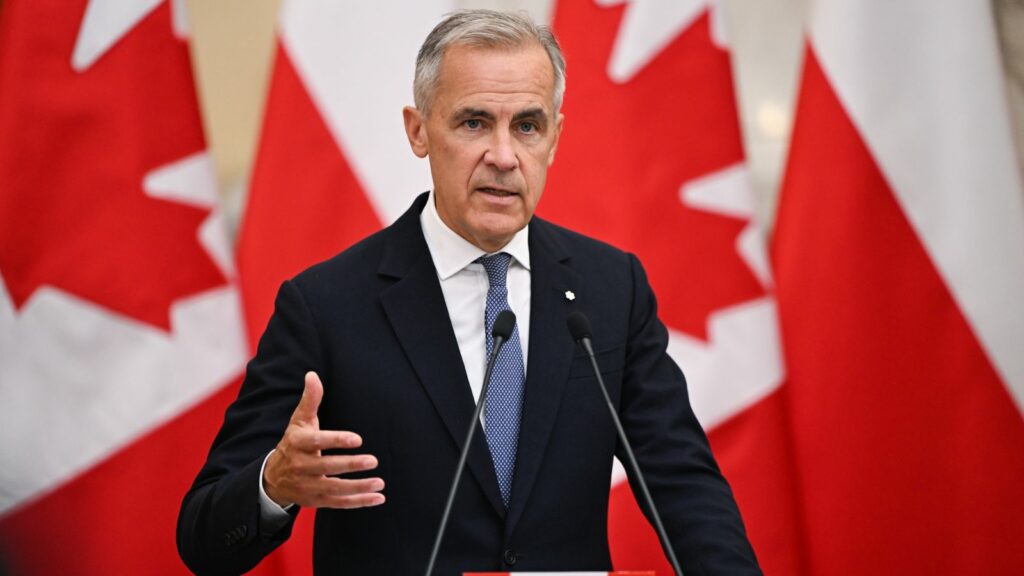
Canada’s economic relationship with the United States has long been one of its greatest advantages. Under President Donald Trump, that same relationship has become one of its biggest vulnerabilities. As Prime Minister Mark Carney’s government prepares to unveil its November 5, 2026, federal budget, the pressure to reduce Canada’s dependence on its southern neighbour is growing.
With approximately 70% of Canadian merchandise exports still destined for the United States, Ottawa faces a difficult balancing act. American tariffs have disrupted established trade relationships, businesses are reconsidering investment decisions, and households remain concerned about affordability.
Carney’s challenge extends beyond managing another difficult budget. His government must demonstrate that Canada can build a stronger, more diversified economy without undermining the American trade relationship that continues to support millions of Canadian livelihoods.
A Federal Budget Built Around Economic Independence
Finance Minister François-Philippe Champagne is scheduled to present Budget 2026 in the House of Commons on November 5, with the government’s economic agenda centred on investment, affordability, and national economic security. The budget carries the theme “Masters of Our Destiny,” reflecting Carney’s broader effort to strengthen Canadian sovereignty during an increasingly unpredictable period for international trade. Ottawa has promised measures to encourage business investment, advance major infrastructure projects, support workers, and improve Canada’s competitiveness. However, translating those priorities into measurable economic improvements presents a considerably greater challenge than announcing them.
The federal government must also confront an uncomfortable reality: many of the industries that contribute significantly to Canada’s prosperity remain deeply connected to American markets. An Ontario automotive supplier, for example, cannot easily replace a long-established U.S. customer simply because trade relations have deteriorated. Production contracts, transportation networks, equipment investments, and employment decisions are often built around cross-border commerce. For Carney, the budget represents an opportunity to demonstrate how Canada can preserve those existing economic relationships while developing new opportunities elsewhere. The credibility of that strategy will depend on financing, implementation, and whether businesses see practical reasons to invest more heavily in Canada.
Canada’s Export Numbers Reveal the Scale of the Challenge
Statistics Canada reported that 71.7% of Canadian merchandise exports went to the United States in 2025, down from 75.9% in 2024. The shift suggests that Canadian exporters have already begun reducing their concentration in the American market. However, the latest figures demonstrate how substantial that dependence remains. In September 2026, approximately 70.2% of Canada’s merchandise exports were still destined for the United States. Exports to American customers increased 0.7% during the month, while shipments to other countries declined 1.1%. Despite growing international opportunities, the United States continues to dominate Canada’s export economy.
The dependence extends well beyond finished products arriving at American stores. Canadian manufacturers supply components to U.S. factories, energy producers serve American utilities and refiners, and agricultural businesses participate in closely integrated North American supply chains. These relationships support jobs and investment across the country, but they also expose Canadian communities to sudden changes in American trade policy. Diversification has nevertheless made some progress. Canadian merchandise exports to countries outside the United States increased 17.2% in 2025. That growth provides evidence that other markets can expand, although replacing decades of established cross-border infrastructure and customer relationships will require sustained investment rather than a single federal budget.
Trump’s Tariffs Are Forcing Difficult Decisions in Canadian Factories
Trump’s escalating tariff measures have made the risks of economic dependence increasingly difficult for Canadian manufacturers to ignore. On August 22, 2026, Washington introduced 50% tariffs on a broad range of Canadian products, including furniture, plastics, electronics, machinery, and paper goods. Unlike many other American tariff measures, these duties do not provide exemptions for products qualifying under the Canada-United States-Mexico Agreement. Separate tariffs also continue to affect automobiles, steel, and aluminum. The consequences are reflected in recent trade figures. Canadian exports of motor vehicles and parts declined 4.9% in September, while forestry products and building and packaging materials fell 9.8%. Although tariffs were not the only factor behind those declines, the figures highlight the pressures confronting Canadian exporters.
The experience of Canadian cabinet manufacturer Cabico illustrates what those pressures can mean for individual businesses. The company previously shipped approximately 90% of its products to the United States, but its American shipment volumes have fallen 25% from 2024 levels. It has also laid off more than one-quarter of its roughly 700 employees. With U.S. tariffs on Canadian kitchen cabinets scheduled to rise from 25% to 50% in January 2027, company owner Alain Ouzilleau has begun considering production partnerships south of the border. For Ottawa, situations like this raise an especially troubling possibility: trade policies intended to protect American manufacturing could gradually encourage Canadian businesses to relocate investment and jobs into the United States.
The Future of CUSMA Adds Another Layer of Uncertainty
The uncertainty extends beyond individual tariffs to the trade agreement governing much of North America’s economy. During the July 1, 2026, joint review of the Canada-United States-Mexico Agreement, Washington declined to extend the agreement in its existing form. Canada and Mexico supported renewal, but the Trump administration sought changes addressing American trade deficits and manufacturing priorities. Importantly, the decision did not immediately terminate the agreement. CUSMA remains in force, with annual reviews now required unless the countries agree on an extension. Without a new agreement or an earlier withdrawal, its existing term runs until 2036. That distinction matters because Canadian exporters retain important trading rights even as future rules remain uncertain.
For businesses making long-term investment decisions, however, the uncertainty can still carry substantial costs. An automaker considering a new assembly line or a parts supplier planning to expand production must estimate conditions several years into the future. Questions about tariffs, regional content requirements, and the durability of North American trade protections make those calculations harder. The United States has already opened consultations ahead of the 2027 review, with written comments due January 12, 2027. Carney cannot resolve those negotiations through domestic spending alone. Nevertheless, the budget can influence Canada’s negotiating position by supporting competitiveness, reducing investment barriers, and strengthening industries that might otherwise become increasingly vulnerable to American policy decisions.
Reducing Dependence on America Requires More Than New Trade Deals
Carney’s government has established an ambitious objective of doubling Canadian exports to markets outside the United States over the next decade. Progress is already visible, although the figures require careful interpretation. According to Global Affairs Canada’s 2026 State of Trade report, Canadian goods and services exports to non-U.S. destinations grew 11.1% in 2025, bringing their share of total exports to 32.8%, the highest proportion in more than four decades. However, much of that growth came from commodities, particularly gold and energy. Higher commodity prices and unusually strong demand can improve export figures without necessarily creating lasting relationships with international customers.
Building a more diversified economy therefore requires improvements in transportation infrastructure, export financing, and access to overseas markets. Ottawa has established a $5-billion Trade Diversification Corridors Fund to improve infrastructure such as ports, railways, roads, and airports. These investments could help Canadian producers reach European and Asian markets more efficiently. The services economy offers another opportunity. In 2025, approximately 47% of Canadian services exports went to destinations outside the United States, compared with roughly 28% of goods exports. Technology companies, engineering firms, financial service providers, and other knowledge-based businesses may find it easier to expand internationally than manufacturers dependent on physical transportation networks. The challenge is turning those opportunities into reliable, long-term sources of Canadian income.
Carney’s Investment Strategy Could Determine Whether the Pivot Succeeds
A central element of Ottawa’s economic strategy involves making Canada more attractive for business investment. In September 2026, the government introduced its proposed Productivity Mega Deduction, intended to let businesses immediately deduct the cost of a much broader range of qualifying investments. The measure would expand immediate-expensing eligibility from roughly 15% of capital assets to more than 65%, covering equipment, technology, infrastructure, and other productive assets. Finance Canada estimates that these changes would reduce Canada’s marginal effective tax rate on new business investment from approximately 13% to 6.4%. The figures suggest a potentially significant competitive advantage, although the actual economic benefits will depend on companies responding with additional investment.
Infrastructure development represents another important part of the government’s approach. Carney’s Major Projects Office was established to accelerate projects considered important to Canada’s economic future, including energy infrastructure, ports, mining developments, and transportation corridors. Recent initiatives include the designation of Roberts Bank Terminal 2 in British Columbia as a project of national interest and the advancement of the proposed Pacific Link oil pipeline. These projects could improve Canada’s ability to reach customers beyond the United States, but designation and planning are not equivalent to completed infrastructure. Financing, regulatory approvals, environmental requirements, Indigenous participation, and construction timelines remain important considerations. For Carney, the challenge is ensuring that ambitious investment announcements eventually produce tangible increases in Canadian productive capacity.
The Federal Deficit Creates a Second Major Test for Carney
Reducing Canada’s economic vulnerability requires investment, but Ottawa’s financial position places limits on how aggressively the government can spend. In its October 2026 outlook, the Parliamentary Budget Officer projected a federal deficit of C$63.3 billion for the 2026–27 fiscal year, with deficits remaining above C$63 billion throughout its five-year forecast. The watchdog also estimated that spending and taxation measures announced since its June outlook would cost an additional C$52.6 billion over five years, exceeding improvements in projected fiscal room. Although it expects the government to achieve an operating budget surplus in 2028–29, it does not expect Ottawa to meet its separate objective of reducing the deficit as a share of GDP every year.
Economists have consequently urged Carney to demonstrate greater fiscal discipline while pursuing his ambitious economic agenda. Desjardins estimates that new spending and tax measures announced since April represent nearly C$140 billion over the next decade. That estimate covers a different period from the Parliamentary Budget Officer’s five-year calculation, but both highlight the cost of Ottawa’s commitments. Major infrastructure investments, defence spending, and business incentives may strengthen Canada’s economy over time, provided their benefits justify their costs. The concern is that borrowing too heavily could eventually reduce the government’s flexibility to respond to another economic shock. Carney must therefore show that his strategy for economic independence is financially sustainable, particularly when future American trade decisions remain outside Ottawa’s control.
Canadians Will Judge the Budget Through Jobs, Prices, and Economic Security
For Canadian households, economic independence is meaningful only if it translates into greater financial stability. September 2026 data showed consumer prices rising 3.1% from a year earlier, with gasoline prices increasing 27.8%. Meanwhile, employment declined by 68,000 during the month, and the unemployment rate reached 6.5%. Canada’s real GDP was essentially unchanged in both July and August. These indicators illustrate the challenges facing Ottawa as it attempts to encourage economic growth while protecting household purchasing power. The Bank of Canada also raised its policy rate to 2.5% in October, citing persistent inflation pressures, and warned that renewed American tariffs could weigh on economic activity toward the end of 2026.
The central question is whether the federal government can create conditions that allow Canadian businesses and workers to prosper despite those external pressures. For a manufacturing employee concerned about layoffs, a small-business owner facing higher costs, or a young family struggling with everyday expenses, promises of economic sovereignty offer little immediate reassurance without measurable results. Carney’s budget will be judged by whether its investments generate jobs, expand productive capacity, and improve Canada’s ability to withstand future disruptions. The United States will remain an essential economic partner, regardless of which government occupies the White House. The more realistic objective is to ensure that Canada’s prosperity no longer depends quite so heavily on decisions made in Washington. That would represent a meaningful step toward the economic independence Carney has made central to his government’s agenda.
