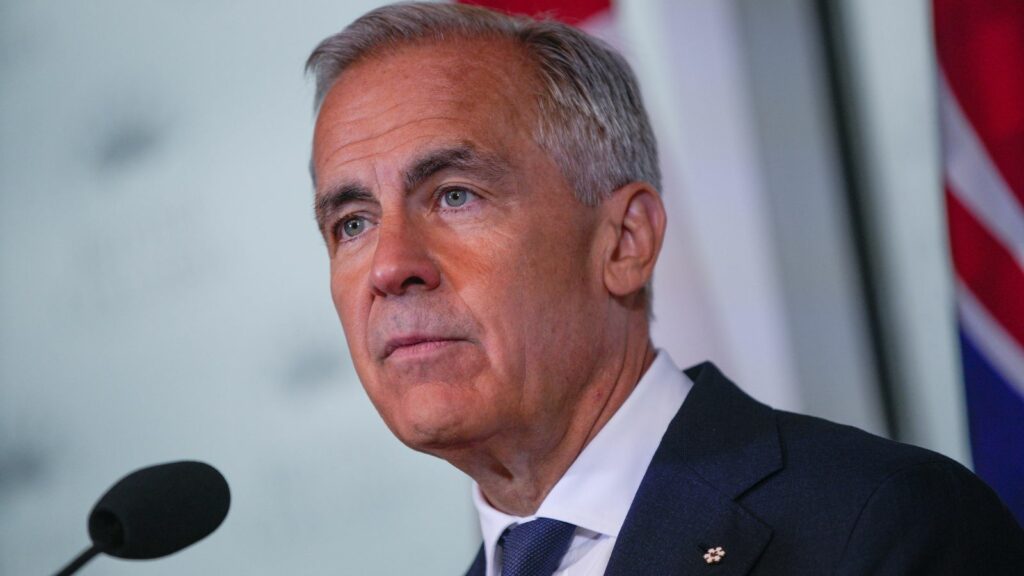
Canada’s efforts to rebuild its relationship with China are entering a delicate phase, with Prime Minister Mark Carney preparing to confront President Xi Jinping over foreign interference while pursuing closer economic cooperation between the two countries.
Carney confirmed on November 10, 2026, that he intends to raise concerns about Chinese interference in Canadian affairs during their upcoming meeting at the Asia-Pacific Economic Cooperation summit in Shenzhen on November 18–19.
The planned discussion comes as Ottawa works to diversify trade beyond the United States and strengthen commercial ties with the world’s second-largest economy. However, allegations of election interference, intimidation of diaspora communities and espionage continue to complicate the relationship.
For Carney, the challenge is balancing Canada’s economic interests with national security concerns while demonstrating that renewed engagement with Beijing does not mean overlooking threats to Canadian sovereignty.
Carney Plans to Confront Xi in Person
Speaking at a Montreal news conference on November 10, Carney made clear that his upcoming conversation with Xi would involve more than expanding commercial opportunities. The prime minister said he intends to emphasize Canada’s expectation that China and other foreign governments respect its political independence. The leaders are scheduled to meet during the APEC summit in Shenzhen, where discussions will also cover international security and their growing economic partnership. Carney believes direct conversations offer an opportunity to address difficult subjects more openly than exchanges conducted through diplomatic channels.
The announcement comes at an important moment for Canada-China relations. Carney has described the economic partnership as deepening while emphasizing that boundaries remain in place. Those boundaries are significant because Ottawa is attempting to improve trade without appearing to compromise Canadian sovereignty. Beijing has consistently denied interfering in Canada’s domestic affairs, meaning the leaders enter their meeting with substantially different positions. For Canadian officials, raising the matter directly is an important diplomatic step, although obtaining meaningful assurances or changes in conduct would be considerably more difficult.
Canada’s Foreign Interference Inquiry Identified China as a Major Threat
Carney’s concerns are supported by findings from Canada’s public inquiry into foreign interference, which released its final report in January 2025. Led by Justice Marie-Josée Hogue, the investigation identified China as the most active foreign state engaged in interference targeting Canadian democratic institutions. Investigators examined activities surrounding the 2019 and 2021 federal elections, including attempts to influence political conversations, candidates and communities. The inquiry also considered how intelligence agencies communicated potential threats to government officials and whether existing safeguards were sufficient to protect democratic institutions.
However, the investigation made an important distinction between attempted interference and actual election outcomes. It concluded that the 2019 and 2021 federal elections remained free and fair, with no interference found to have undermined the outcome in any riding. Nevertheless, the inquiry warned that covert influence operations and disinformation could weaken public confidence in democracy. For Ottawa, the concern extends beyond determining who wins an election. Foreign governments attempting to influence political participation, intimidate individuals or manipulate public discussion can create lasting damage even when election results remain unchanged.
Allegations of Chinese Police Stations Intensify Security Concerns
Concerns about Chinese interference extend beyond elections into the everyday lives of people living in Canada. On November 6, the human rights organization Safeguard Defenders released a report identifying approximately 1,247 overseas liaison points across at least 91 countries that it alleges form part of a broader Chinese surveillance and influence network. Canadian reporting identified at least 18 suspected locations or associations connected to this network. These are allegations and identified liaison points, not a verified count of currently operating illegal police stations. Canadian authorities have previously investigated reports of unauthorized foreign policing activities.
For people who have criticized China’s government or participated in pro-democracy activities, the consequences of suspected foreign intimidation can be deeply personal. Canadian government reporting has documented campaigns involving online harassment, manipulated videos and the exposure of private information. Such tactics can discourage individuals from speaking publicly, particularly when relatives remain overseas. These concerns highlight why Canada cannot treat foreign interference as merely a diplomatic disagreement. At the same time, investigations must distinguish between legitimate Chinese-Canadian community organizations and individuals or networks suspected of unlawful activity, protecting communities rather than stigmatizing them.
A Diplomatic Reset That Began With Carney’s Beijing Visit
Canada’s renewed engagement with China did not begin with the upcoming APEC summit. In January 2026, Carney travelled to Beijing, becoming the first Canadian prime minister to visit the country since 2017. During a January 16 meeting with Xi, the leaders announced an updated strategic partnership covering energy, trade, public safety, international cooperation and cultural exchanges. The visit followed their October 2025 meeting in South Korea, which helped reopen high-level communication after years of strained diplomatic relations. Their discussions reflected a willingness to cooperate in selected areas despite continuing disagreements.
The January agreement established opportunities for collaboration in clean energy, agricultural trade, investment and public safety. Both governments also endorsed renewed economic discussions and signed cooperation arrangements covering several industries. For Ottawa, restoring communication was particularly important because prolonged diplomatic tensions had complicated access to one of the world’s largest markets. However, stronger engagement also creates an expectation that Canadian officials will defend national interests when disagreements arise. Carney’s November meeting with Xi will therefore test whether the renewed relationship can accommodate difficult conversations about security without undermining progress on trade.
Canadian Farmers and Seafood Exporters Are Already Seeing Trade Benefit
For Canadian farmers and seafood exporters, the improving relationship has produced measurable economic benefits. Following the January agreement, China reduced the combined tariff on Canadian canola seed to approximately 14.9% on March 1, down from almost 85%. Additional tariffs on Canadian canola meal, peas, lobster and crab were also suspended. These changes were particularly important for Prairie agricultural producers and Atlantic seafood businesses that depend on reliable access to international buyers. Lower tariffs improve the ability of Canadian products to compete in a massive market where even modest changes in import costs can influence purchasing decisions.
On November 4, Canada’s international trade minister announced a further agreement extending favourable market access for canola meal, peas, lobster and crab until the end of 2028. A U.S. Department of Agriculture report published November 9 indicated that Canadian agricultural exports to China had increased nearly 45% during the first nine months of 2026 compared with the corresponding period in 2025. However, unresolved barriers remain, including China’s 100% tariff on Canadian canola oil. The progress demonstrates why Ottawa sees economic value in maintaining constructive relations, even while addressing serious disagreements over foreign interference and national security.
Chinese Electric Vehicles Have Become a Major Test of the Trade Relationship
One of the most significant changes resulting from the renewed partnership involves electric vehicles. Beginning March 1, 2026, Canada implemented a system allowing an initial annual quota of 49,000 Chinese-made electric vehicles to enter at a tariff rate of 6.1%, replacing the previous 100% surtax for eligible imports. Ottawa says this initial quota represents less than 3% of Canada’s new-vehicle market. The arrangement also provides for annual increases of 6.5% in the quota and gradually expands the allocation reserved for more affordable vehicles. The government hopes the agreement will improve consumer choice and encourage investment in domestic vehicle manufacturing.
However, the decision has also generated opposition from Canada’s automotive industry. Unifor warned that opening the market to lower-cost Chinese vehicles could threaten Canadian manufacturing employment and domestic suppliers, particularly if manufacturers prioritize exports instead of producing vehicles locally. The Carney government maintains that a controlled trade arrangement could encourage Chinese companies to establish partnerships and production facilities in Canada. Those expected investments, however, are not guaranteed outcomes. For Canadian workers, the debate raises an important question about whether expanded trade with China can deliver affordable products while protecting the industrial capacity and jobs that support communities across Ontario and other manufacturing regions.
Canada Is Strengthening Safeguards Against Foreign Influence
While pursuing stronger trade relations, Ottawa has emphasized that cooperation with China will remain limited in sensitive areas. Canadian government briefing documents describe the renewed partnership as narrower than previous approaches, with no plans for a bilateral free trade agreement or expanded military and Arctic cooperation. National security officials have identified artificial intelligence, critical minerals, advanced technology and defence as areas requiring particular caution. The distinction allows Canada to pursue opportunities in agriculture, energy and manufacturing while maintaining restrictions intended to protect strategically important industries and institutions.
Canada has also introduced new measures designed to make foreign influence more transparent. On August 4, 2026, the Foreign Influence Transparency and Accountability Act came into force, establishing a public registry overseen by independent commissioner Anton Boegman. Individuals and organizations engaged in certain arrangements with foreign principals to influence Canadian political or governmental processes must disclose those activities. Penalties for violations can reach $1 million. However, transparency requirements alone cannot prevent covert interference or intimidation. Continued intelligence gathering, law enforcement and international cooperation remain essential to ensuring that increased commercial engagement does not create additional vulnerabilities.
Ottawa Is Rebuilding Diplomatic Channels With Beijing
The renewed relationship involves more than meetings between Carney and Xi. On November 8–9, Chinese Vice Premier He Lifeng met Canadian Finance Minister François-Philippe Champagne and International Trade Minister Maninder Sidhu in Vancouver for the second Canada-China Economic and Financial Strategic Dialogue. The discussions addressed trade, investment, financial services and international economic cooperation. Both governments also agreed to strengthen communication between finance ministries and financial regulators. These developments demonstrate how the relationship is becoming more structured, with officials responsible for translating political commitments into practical economic arrangements.
The economic stakes are substantial. According to figures published by Canada’s Department of Finance, bilateral merchandise trade reached approximately $125.7 billion in 2025, including $35 billion in Canadian exports to China and $90.6 billion in imports. Carney also announced on November 10 that Ottawa had selected a new ambassador to China, with an appointment expected to be announced soon after the necessary diplomatic procedures. The position had been vacant since spring. Restoring full diplomatic representation could help Ottawa manage disputes, pursue commercial opportunities and communicate security concerns without relying exclusively on occasional meetings between national leaders.
U.S. Trade Tensions Are Adding Pressure to Canada’s China Strategy
Canada’s efforts to strengthen economic relations with China are closely connected to its changing relationship with the United States. Statistics Canada reported that the American market accounted for 71.7% of Canadian merchandise exports in 2025, down from 75.9% in 2024. Despite that decline, the United States remains overwhelmingly Canada’s largest export destination. Ongoing tariff disputes and uncertainty surrounding North American trade arrangements have encouraged Ottawa to pursue a wider network of international trading partners. China represents a major opportunity, although expanding business there also exposes Canada to different political and economic risks.
The international calendar illustrates the complexity of Carney’s position. The prime minister is scheduled to attend the ASEAN summit in the Philippines before travelling to China for APEC, where U.S. President Donald Trump is also expected. Carney has indicated that he could speak with Trump during those meetings. For Ottawa, maintaining productive relations with Washington while strengthening commercial ties with Beijing requires careful diplomacy. Canada must demonstrate that economic diversification does not undermine its security commitments or weaken its independence. The upcoming discussions will show how effectively Carney can navigate competing pressures from two of the world’s most influential economies.
The Xi Meeting Will Test Whether Trade and Security Can Coexist
The significance of Carney’s upcoming meeting with Xi extends beyond whether the leaders announce another commercial agreement. Canada has already secured agricultural tariff relief, established an electric-vehicle import arrangement and resumed high-level financial discussions with China. These developments provide evidence that diplomatic engagement can produce economic results. However, progress on trade does not automatically address allegations of foreign interference, intimidation or covert political influence. The real challenge is ensuring that improvements in one area do not weaken Canada’s willingness to confront serious concerns in another.
Any meaningful progress on foreign interference will ultimately need to be measured through actions rather than diplomatic statements. Canada will continue relying on its intelligence agencies, law enforcement institutions and transparency measures to identify and respond to threats. At the same time, government officials will face pressure to maintain opportunities for Canadian exporters, investors and workers. Carney’s approach reflects an increasingly complicated reality: countries can be valuable trading partners while remaining divided over security, democratic values and international conduct. Whether this strategy succeeds will depend on Ottawa’s ability to protect Canadian sovereignty while pursuing the economic benefits of a more diversified international relationship.
