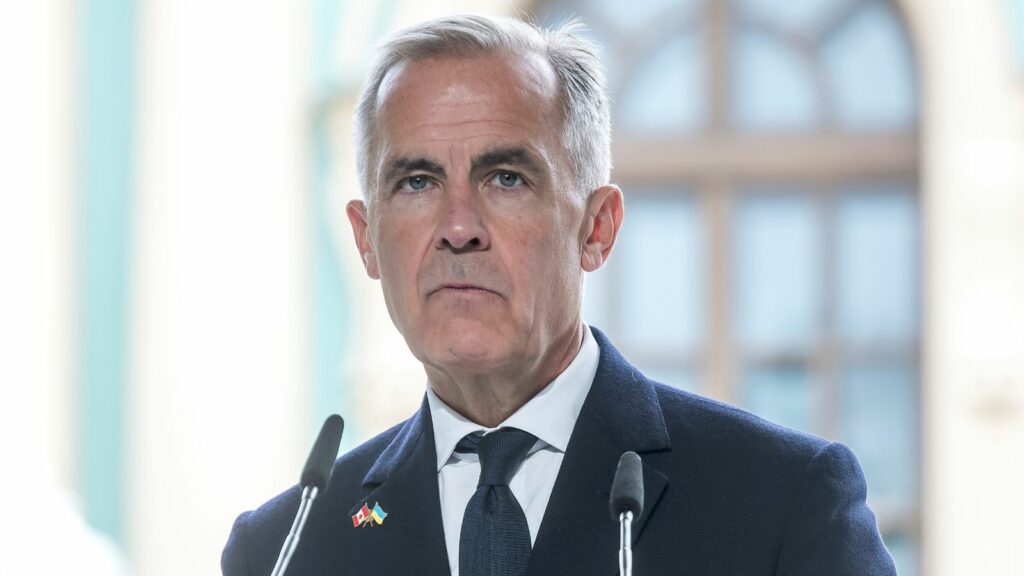
Canadian Prime Minister Mark Carney has offered cautious support for U.S. President Donald Trump’s efforts to bring Russia and China into nuclear disarmament discussions, revealing an important area of agreement between two leaders struggling to resolve a bitter trade dispute.
Speaking during the Asia-Pacific Economic Cooperation (APEC) summit in Shenzhen, China, Carney welcomed Trump’s planned meeting with Russian President Vladimir Putin and Chinese President Xi Jinping, emphasizing that reducing the global nuclear threat remains a priority for Canada.
The endorsement comes at a delicate diplomatic moment. Ottawa and Washington continue negotiating over tariffs and market access, while Canada is simultaneously rebuilding economic ties with Beijing and condemning Russia’s war in Ukraine.
Carney’s position illustrates how governments can cooperate on international security without abandoning their disagreements over trade, sovereignty or foreign policy.
Carney Offers Cautious Support for Trump’s Nuclear Initiative
Carney made his position clear during a November 18 news conference in Shenzhen, where international attention was focused on the unprecedented gathering of American, Russian and Chinese leaders. Although Canada has significant disagreements with Washington over economic policy, the prime minister welcomed the possibility of meaningful discussions about reducing nuclear weapons. He emphasized that Canada supports denuclearization and sees value in diplomatic engagement capable of reducing the danger of nuclear conflict. His remarks were carefully framed around the objective of the meeting rather than an endorsement of everything Trump, Putin or Xi might pursue.
The distinction is important because Canada’s relationships with the three countries are dramatically different. The United States remains Canada’s closest major economic and security partner, China is an increasingly important commercial relationship, and Russia remains subject to Canadian sanctions over its invasion of Ukraine. By supporting the nuclear initiative while maintaining those distinctions, Carney signalled that cooperation on a shared security objective does not require agreement on unrelated disputes.
Trump Prepares for a Historic Meeting With Putin and Xi
Trump’s proposed trilateral meeting is scheduled for November 19 on the sidelines of the APEC summit in Shenzhen. The gathering would bring together the leaders of the world’s three largest nuclear powers in a diplomatic format without a direct historical precedent at the leadership level. The White House confirmed that nuclear arms reductions would be a central subject, reflecting Trump’s interest in opening negotiations that could eventually involve Washington, Moscow and Beijing. Discussions involving Iran are also expected, although the precise scope of the meeting remains uncertain.
Despite the historic setting, American officials have cautioned against expecting an immediate agreement. A senior administration official indicated before the summit that Washington views the meeting primarily as an opportunity to begin conversations rather than finalize binding commitments. That distinction matters because successful nuclear negotiations generally require extensive technical discussions, verification procedures and political compromises. For Carney, the significance lies in establishing dialogue among governments whose increasingly strained relationships have complicated international efforts to control nuclear weapons.
The Expiration of New START Raises the Stakes
The urgency surrounding Trump’s initiative has increased since the New Strategic Arms Reduction Treaty, commonly called New START, expired on February 5, 2026. The agreement had imposed legally binding limits on deployed American and Russian strategic nuclear weapons, including a ceiling of 1,550 deployed strategic warheads and 700 deployed delivery systems for each country. Its expiration left Washington and Moscow without a binding bilateral framework restricting their strategic arsenals for the first time in more than five decades. United Nations Secretary-General António Guterres warned that the development represented a serious setback for international security.
The broader figures underline the danger. According to the Stockholm International Peace Research Institute, the world’s nine nuclear-armed countries possessed an estimated 12,187 nuclear warheads at the beginning of 2026, including weapons awaiting dismantlement. Approximately 9,745 remained in military stockpiles. These weapons are spread across competing governments with different security priorities and increasingly sophisticated delivery systems. Without renewed agreements, the risk is not simply that arsenals could expand, but that mistrust and miscalculation could become more difficult to contain.
China’s Expanding Nuclear Arsenal Complicates Negotiations
China’s participation presents one of the biggest obstacles to meaningful trilateral nuclear negotiations. Beijing has repeatedly argued that its arsenal remains substantially smaller than those of the United States and Russia, making equal disarmament obligations inappropriate. SIPRI estimated that China possessed approximately 620 nuclear warheads in January 2026, compared with military stockpiles of roughly 3,700 American and 4,400 Russian warheads. Although China’s arsenal is expanding rapidly, the numerical disparity helps explain why Beijing has resisted Washington’s calls for three-way arms-control negotiations.
Chinese officials have instead emphasized the importance of reducing nuclear risks and maintaining a policy of no first use, under which Beijing pledges not to initiate a nuclear attack. China has also supported discussions among the five nuclear-weapon states recognized under the Nuclear Non-Proliferation Treaty. For Trump, the challenge is persuading Beijing that greater participation would strengthen its security rather than lock it into an arrangement designed around much larger American and Russian arsenals. A successful meeting could establish a negotiating process, even without immediate agreement on reductions.
Carney Condemns Putin While Supporting Nuclear Diplomacy
Carney’s support for nuclear negotiations did not soften his criticism of Russia. During the same APEC gathering, the Canadian leader directly challenged Putin’s assertion that Western economic sanctions had largely lost their effectiveness. Carney accused the Russian president of misrepresenting the situation and argued that financial restrictions continue to impose meaningful costs on Moscow. His response reflected Canada’s longstanding position that Russia’s invasion of Ukraine violates international law and that economic pressure should continue until Moscow ends its aggression and respects Ukrainian sovereignty.
Canada reinforced that approach in November 2026, announcing sanctions against another 38 entities and 24 individuals associated with Russia’s military supply chains, financial networks and other activities supporting its war effort. Foreign Affairs Minister Anita Anand described the measures as part of Ottawa’s effort to weaken Russia’s ability to strike Ukrainian cities. The contrast captures Carney’s diplomatic balancing act: Canada can support discussions aimed at reducing nuclear weapons while simultaneously holding Putin accountable for the ongoing war. Endorsing dialogue is not the same as accepting Russia’s conduct.
Canada-U.S. Trade Tensions Remain Unresolved
Carney’s endorsement arrives against the backdrop of one of the most difficult periods in recent Canada-U.S. trade relations. Negotiations deteriorated sharply in August after disagreements over tariffs, automotive manufacturing, Canadian cultural protections and sovereignty-related demands. Washington subsequently imposed 50% tariffs on approximately US$20 billion worth of Canadian goods, triggering retaliation from Ottawa. The dispute has created uncertainty for manufacturers, exporters and workers whose livelihoods depend on the highly integrated North American economy. Businesses operating across the border face challenges that cannot be resolved through diplomatic goodwill alone.
The tension remained evident when Carney and Trump held an unscheduled meeting lasting just under 20 minutes in Shenzhen on November 18. Senior American officials, including Secretary of State Marco Rubio, Commerce Secretary Howard Lutnick and U.S. Trade Representative Jamieson Greer, participated in the discussion. According to the Canadian government’s official account, both leaders agreed to continue working toward a mutually beneficial agreement that protects Canadian jobs, affordability, languages, culture and sovereignty. No completed trade agreement was announced, demonstrating that Carney’s support for Trump’s nuclear initiative has not automatically translated into progress on tariffs.
Canada’s Growing China Relationship Creates New Diplomatic Challenges
Carney’s support for the nuclear discussions also comes as Ottawa expands its economic relationship with Beijing. On November 17, the prime minister met Xi Jinping in Shenzhen and announced new measures to reduce trade barriers. The agreement provides additional tariff relief covering approximately C$400 million in Canadian exports, including pork, seafood and other agricultural products. Canada, in return, agreed to extend certain tariff exemptions for Chinese steel and aluminum products. The arrangements reflect Ottawa’s determination to diversify its international partnerships while reducing dependence on the American market.
However, closer Canadian-Chinese cooperation has attracted criticism in Washington. White House trade adviser Peter Navarro publicly objected to Carney’s suggestion that Canada could consider partnerships with Chinese automakers if North American trade negotiations fail to protect Canadian manufacturing. Carney subsequently indicated that Canada’s expanding relationship with China was not among Trump’s highest priorities. The circumstances create an unusual diplomatic picture: Carney is supporting American-led nuclear engagement with Beijing while simultaneously negotiating with China over commercial issues that have generated tensions with Washington.
Canada’s Commitment to Nuclear Disarmament Has Deep Roots
Canada’s position on nuclear disarmament predates the current political disagreements with Washington. As a longstanding participant in the Treaty on the Non-Proliferation of Nuclear Weapons, Canada supports preventing the spread of nuclear weapons, reducing existing arsenals and ultimately achieving their elimination. The treaty entered into force in 1970 and remains central to international efforts to balance disarmament obligations with access to peaceful nuclear technology. Although Canada does not possess its own nuclear weapons, it participates in international security discussions through NATO, the G7 and multilateral arms-control institutions.
Canadian officials reinforced these commitments at the 2026 Nuclear Non-Proliferation Treaty Review Conference. Ottawa expressed frustration with inadequate transparency, deteriorating international trust and the failure of participating countries to reach consensus on a final outcome document. Canada’s position also reflects a difficult balance within NATO, which continues to rely on nuclear deterrence while supporting verifiable arms reductions. Against that background, Carney’s endorsement of Trump’s initiative is consistent with Canada’s established preference for practical, negotiated steps toward reducing nuclear dangers.
History Shows That Nuclear Agreements Require More Than Summits
Previous nuclear negotiations demonstrate that even unsuccessful meetings can create opportunities for meaningful progress. In October 1986, American President Ronald Reagan and Soviet leader Mikhail Gorbachev met in Reykjavik, Iceland, to discuss sweeping nuclear reductions. Their negotiations ultimately broke down over disagreements involving missile defence. Nevertheless, the discussions helped establish the foundations for the 1987 Intermediate-Range Nuclear Forces Treaty, which eliminated an entire category of American and Soviet missiles. The achievement demonstrated that diplomatic breakthroughs sometimes emerge through sustained negotiations rather than immediate agreements between national leaders.
The Shenzhen meeting faces comparable difficulties, complicated by the involvement of three governments with substantially different nuclear capabilities and security priorities. Experts at the Arms Control Association have emphasized that productive negotiations require detailed proposals, verification procedures and continued engagement beyond ceremonial meetings. Historical agreements depended on technical specialists who could establish reliable methods for confirming compliance. Without similar preparations, even promising political declarations risk producing little practical change. The challenge for Trump, Putin and Xi is to transform a high-profile encounter into a credible diplomatic process.
What Meaningful Progress Could Look Like After Shenzhen
The clearest indication of progress would be a commitment by all three governments to continue structured discussions on nuclear risk reduction. Possible early measures include greater transparency about nuclear forces, renewed communication between military and diplomatic officials, and voluntary restrictions on additional strategic nuclear deployments. The Arms Control Association has suggested that a freeze on new strategic launcher deployments could help prevent an escalating arms race while governments negotiate more comprehensive arrangements. Such proposals remain recommendations rather than commitments accepted by the three leaders.
For Canada, a successful outcome would strengthen international security without weakening its existing positions on Ukraine, sanctions or sovereignty. Ottawa would also continue facing the separate challenge of securing a stable economic relationship with Washington. Carney’s willingness to support Trump’s nuclear initiative demonstrates that political disagreements do not necessarily prevent cooperation on shared international priorities. Whether that cooperation produces lasting results will depend on the negotiations that follow, the willingness of Russia and China to participate meaningfully, and Washington’s ability to turn diplomatic ambition into verifiable commitments.
The immediate breakthrough may be simply getting the world’s three largest nuclear powers to begin a sustained conversation. The more difficult task will be ensuring that the conversation leads to measurable reductions in nuclear risks.
