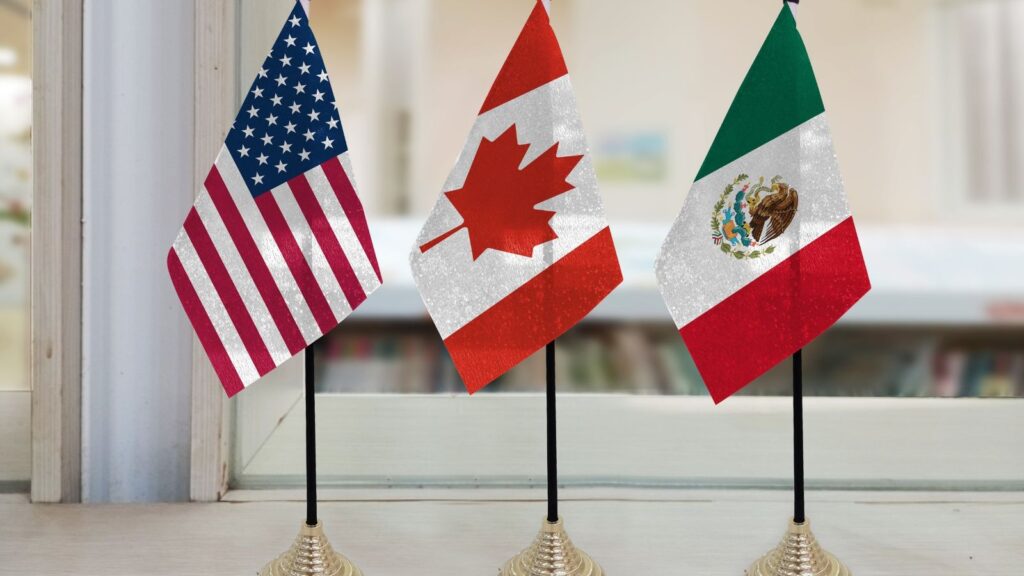
Mexico and Canada are emerging from high-level meetings with U.S. President Donald Trump with noticeably different messages about the future of North American trade. Mexican President Claudia Sheinbaum says negotiations with Washington are “very far along,” following a November 18 meeting in China. Canadian Prime Minister Mark Carney, meanwhile, acknowledges that a new agreement with the United States remains unfinished.
The contrast comes as the three countries face growing uncertainty over the future of their longstanding trade relationship, with tariffs, automotive manufacturing, and the review of the Canada–United States–Mexico Agreement (CUSMA) all weighing heavily on negotiations.
Although neither Mexico nor Canada has announced a finalized new trade deal, Mexico’s optimistic assessment is raising questions about whether Ottawa could face additional pressure as Washington negotiates with its two largest North American partners.
Mexico Declares Major Progress After Trump’s Meeting With Sheinbaum
Mexican President Claudia Sheinbaum delivered an optimistic assessment of trade negotiations following her November 18, 2026, meeting with Donald Trump in Shenzhen, China. The two leaders spoke for approximately 20 minutes on the sidelines of the Asia-Pacific Economic Cooperation summit, focusing primarily on economic relations and unresolved trade disputes. Sheinbaum said Trump had been briefed on the progress made by Mexican Economy Secretary Marcelo Ebrard and his American counterparts. Describing the negotiations as “very far along,” she suggested that months of discussions were producing meaningful progress.
Mexican officials reported that Ebrard and his U.S. counterparts had held 56 technical meetings, demonstrating the extent of the negotiations underway. Sheinbaum described her conversation with Trump positively and confirmed plans for another meeting in December. However, her assessment did not amount to an announcement of a completed agreement. No final terms, implementation dates, or tariff reductions were unveiled. The distinction matters because progress behind closed doors does not necessarily translate into immediate economic relief for Mexican exporters.
Carney Also Met Trump, but Canada Still Has No New Agreement
Canadian Prime Minister Mark Carney also met Trump in Shenzhen on November 18, creating an unusual opportunity to compare the two countries’ negotiating positions. Their conversation lasted just under 20 minutes and included senior American officials such as U.S. Trade Representative Jamieson Greer and Commerce Secretary Howard Lutnick. According to the Canadian Prime Minister’s Office, discussions focused on developing a mutually beneficial agreement supporting employment, affordability, and Canadian sovereignty. Both leaders agreed to continue negotiating and maintain close contact, but no new bilateral trade agreement was announced.
Carney subsequently acknowledged that a favourable arrangement remains possible while emphasizing that Canada is not prepared to accept unacceptable terms. Speaking during a New York Times DealBook event, he said negotiations with Washington were more complicated than Canada’s recent discussions with other trading partners. His comments reflected Ottawa’s determination to protect Canadian interests rather than simply secure an agreement for political appearances. For businesses waiting for relief from American tariffs, however, the continuing uncertainty means investment and production decisions may remain difficult.
The Existing North American Trade Agreement Has Not Expired
One important distinction is that Canada has not lost its existing trade agreement with the United States. CUSMA, known internationally as the USMCA, entered into force on July 1, 2020, replacing the original North American Free Trade Agreement. Under its provisions, the three participating countries conducted a mandatory six-year review on July 1, 2026. The United States declined to approve a new 16-year extension of the agreement in its existing form, while Canada and Mexico supported renewal. That decision created uncertainty about the agreement’s longer-term future, but it did not immediately terminate the pact.
Under Article 34.7, the agreement remains in force, with annual reviews required until all three countries approve an extension or the current term expires in July 2036. Existing trade preferences and rules therefore continue to operate, although separate American tariffs can still affect goods that would otherwise benefit from preferential treatment. This distinction explains why Canadian businesses can continue trading under CUSMA even as Ottawa negotiates a separate arrangement intended to reduce tariffs and address other disputes. For manufacturers planning investments several years ahead, however, the absence of a long-term renewal creates uncertainty that extends well beyond the next shipment.
Mexico’s Economic Relationship With the U.S. Gives the Talks Enormous Importance
Mexico’s negotiations matter because the scale of its commercial relationship with the United States is enormous. According to U.S. Census Bureau data, the two countries exchanged approximately US$779.2 billion in goods during the first nine months of 2026. American imports from Mexico accounted for roughly US$481.6 billion of that amount, while U.S. exports to Mexico totalled approximately US$297.6 billion. Mexico ranked as America’s largest goods-trading partner during the period, ahead of Canada, whose corresponding bilateral trade total was approximately US$568.6 billion.
Those figures illustrate why trade negotiations are about more than diplomatic appearances. Manufacturing operations throughout North America depend on components, materials, and finished products crossing borders efficiently. Automotive production is a particularly important example, with factories and suppliers operating across multiple countries rather than producing every component domestically. A tariff imposed on an imported vehicle or industrial input can therefore affect businesses on both sides of the border. For Mexico, preserving access to American customers is essential to maintaining export activity and attracting industrial investment. For Washington, maintaining reliable Mexican supply chains also has economic consequences, making the relationship difficult to separate from broader American manufacturing policy.
Mexico Is Concentrating on Tariff Relief for Steel, Aluminum and Automobiles
Mexico’s immediate negotiating priorities are relatively clear. Deputy Economy Minister Luis Rosendo Gutiérrez said on November 11 that Mexico was concentrating on reducing the impact of American Section 232 tariffs affecting automobiles, steel, and aluminum. Section 232 of the U.S. Trade Expansion Act allows tariffs to be imposed when imports are determined to threaten national security. American tariffs on Mexican goods vary depending on the product and applicable exemptions, with automotive duties generally affecting non-U.S. content in qualifying vehicles. These measures create additional costs for exporters even though substantial volumes of Mexican trade continue to benefit from CUSMA.
Gutiérrez estimated that approximately 80% of Mexican exports to the United States were already entering tariff-free, making relief for the remaining affected industries especially important. Mexico is seeking improvements that would protect its existing commercial advantages without sacrificing access to the American market. The negotiations are also addressing regional manufacturing requirements and rules determining whether products qualify for preferential treatment. U.S. and Mexican officials have previously identified automotive rules of origin and metal products as central negotiating subjects. For a supplier producing vehicle components or industrial materials, even a partial reduction in applicable duties could improve competitiveness and make future orders more predictable.
Canada’s Auto Industry Remains a Major Obstacle to a U.S. Deal
For Canada, automotive manufacturing is among the most sensitive issues in negotiations with Washington. Carney made that position explicit on November 14, saying his government would not accept an agreement inconsistent with a viable Canadian auto industry. Federal government data show that Canada’s automotive manufacturing sector directly employed more than 120,000 people in 2025 and contributed approximately $17.1 billion to the country’s gross domestic product. The industry also includes nearly 700 parts manufacturers supporting assembly plants operated by major international automakers, including Ford, General Motors, Honda, Stellantis, and Toyota.
The sector’s reliance on American buyers makes tariff policy particularly consequential. Canadian government figures indicate that more than 90% of Canadian-made vehicles and approximately 60% of Canadian-made automotive parts are exported to the United States. Since April 2025, Canadian-built vehicles have faced a 25% American tariff on non-U.S. content, with exemptions applying to qualifying U.S. content. The effects extend beyond assembly plants to parts suppliers, transportation companies, and communities dependent on manufacturing employment. Carney’s refusal to accept terms that undermine the sector suggests Ottawa is seeking more than a temporary diplomatic breakthrough. It wants an arrangement that allows manufacturers to keep producing vehicles competitively in Canada over the longer term.
Trump’s Immigration Demands Add Another Complication for Mexico
Despite Sheinbaum’s optimism, Mexico’s relationship with Washington remains vulnerable to disputes extending beyond traditional trade policy. On November 12, Trump threatened to double tariffs on Mexican goods unless authorities stopped migrant caravans travelling toward the American border. Sheinbaum challenged the suggestion that large groups were approaching the United States, saying that no migrant caravan had reached the northern border since Trump returned to office in January 2025. Mexican authorities reported that migrants were gathering in the southern state of Chiapas, thousands of kilometres from the American border.
The dispute illustrated how immigration policy can become intertwined with economic negotiations. Mexican Economy Secretary Marcelo Ebrard said on November 13 that his government remained in contact with American trade officials and that the migration issue had not disrupted negotiations at that point. Nevertheless, Trump’s willingness to threaten additional tariffs demonstrated that the trade relationship could face pressure from political developments outside the formal negotiating process. Even substantial technical progress offers limited protection against unexpected demands. For Mexican manufacturers, this creates uncertainty similar to that confronting Canadian businesses: improved diplomatic relations may be encouraging, but predictable trade rules remain essential.
China’s Growing Role Is Complicating North American Trade Diplomacy
China has become another important factor in the negotiations involving Canada, Mexico, and the United States. Washington has expressed concern that Chinese goods and materials could enter the American market through Mexico while benefiting from North American trade preferences. Mexican officials have responded by tightening controls on steel imports and improving procedures designed to trace their origins. On November 11, Deputy Economy Minister Gutiérrez said Mexico had removed approximately 1,100 steel mills from its approved registry after identifying irregularities, including registrations for facilities authorities said did not exist.
At the same time, Mexico and Canada are strengthening economic relationships with Beijing. Sheinbaum met Chinese President Xi Jinping on November 17 to discuss cooperation in technology, agriculture, health, tourism, and other sectors. Carney also met Xi and announced expanded bilateral trade arrangements providing additional tariff relief for approximately $400 million in Canadian exports. Ottawa said the measures helped restore access for more than 90% of Canadian trade previously affected by tariff action, representing nearly $7.5 billion in exports. The challenge for both countries is balancing opportunities in China with their continued dependence on the American market, without allowing competition between major economic powers to dictate every domestic investment decision.
Canada Is Pursuing New Trade Partnerships Rather Than Waiting for Washington
While Mexico emphasizes progress with Trump, Carney is attempting to expand Canada’s economic options beyond the United States. During his November visit to the Philippines, Carney announced that negotiations for a Canada–Philippines free trade agreement had concluded and that negotiations toward a broader agreement with the Association of Southeast Asian Nations were substantially complete. ASEAN represents a market of nearly 700 million people. Canadian government projections suggest the proposed agreement could eventually add nearly $2 billion to Canada’s GDP and support approximately 14,000 jobs, particularly in agriculture and manufacturing.
Both agreements are targeted for signing in 2027 and are not yet in force, meaning their anticipated economic benefits remain prospective rather than immediate. Ottawa has also expanded trade arrangements with China while pursuing opportunities with European and other Asian partners. Carney has framed diversification as a way to make the Canadian economy less vulnerable to sudden changes in American trade policy. However, creating new export relationships requires investment, market development, transportation capacity, and time. Canada cannot instantly replace the deeply integrated industrial networks built with the United States over decades. The strategy therefore combines continued negotiations with Washington and a longer-term effort to reduce dependence on any single market.
December’s G20 Summit Could Reveal Whether Mexico’s Progress Produces Results
The next major diplomatic opportunity is expected in December. Following their meeting in Shenzhen, Sheinbaum said she and Trump intended to meet again around the G20 leaders’ summit scheduled for December 14–15, 2026, in Miami. The summit’s officially announced venue is Trump National Doral, although Sheinbaum separately referred to Mar-a-Lago when discussing their next encounter. No final trade agreement or specific timetable for tariff relief was announced following the November meeting. Meanwhile, Canada and the United States have agreed to maintain contact, leaving the possibility of further negotiations open without establishing a definitive deadline.
Another milestone arrives in 2027, when the three North American countries are due to continue their annual review process under CUSMA. The Office of the U.S. Trade Representative has already invited public submissions ahead of that review, with comments due January 12. Ultimately, the clearest indication of progress will be concrete commitments: negotiated tariff reductions, agreed manufacturing requirements, or a formally approved extension of the continental trade agreement. Mexico’s optimism may indicate momentum, but it does not yet establish that a settlement is imminent. Canada’s position is similarly unfinished. For businesses, workers, and investors across North America, the decisive outcome will be the economic protections the three governments actually secure.
