Canada’s growing economic relationship with China is creating new opportunities for exporters while raising fresh questions about the country’s increasingly complicated relationship with Washington. Prime Minister Mark Carney says U.S. President Donald Trump does not consider Canada’s expanding trade with Beijing a leading concern, despite sharp criticism from a senior White House adviser.
The remarks come as Ottawa pursues additional tariff relief with China while attempting to resolve a prolonged trade dispute with the United States. With Canadian agriculture, manufacturing and automotive jobs caught between competing economic interests, Carney faces a difficult balancing act: developing new international partnerships without further damaging Canada’s most important trading relationship.
Carney Says Trump Is More Focused on Other Priorities
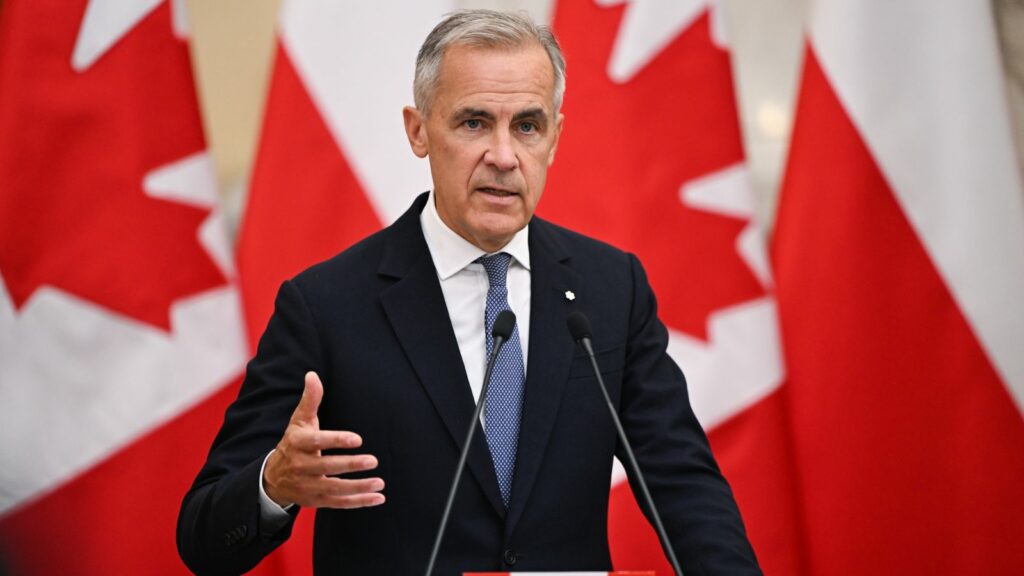
Prime Minister Mark Carney sought to ease concerns about Canada’s increasingly close economic relationship with China during a November 18, 2026, news conference in Shenzhen, where world leaders gathered for the Asia-Pacific Economic Cooperation summit. Carney explained that Trump had asked questions about Canada’s direction with Beijing but suggested the issue was not dominating their conversations. According to the prime minister, the American president was interested in understanding Ottawa’s intentions rather than treating Canada’s trade expansion as an immediate diplomatic confrontation.
Carney acknowledged that he could not speak directly for Trump, describing China’s place in the president’s priorities as relatively low. The distinction is significant because Washington has repeatedly challenged Beijing over economic competition, technology and industrial policy. Carney’s assessment suggests that Canadian officials believe there is room to develop commercial relationships with China while continuing negotiations with the United States. However, the remarks reflect Carney’s interpretation of their conversations, not an independent confirmation of Trump’s position.
White House Adviser Peter Navarro Delivers Sharp Criticism
While Carney has presented Canada’s China strategy as a pragmatic economic decision, White House trade adviser Peter Navarro has taken a considerably more confrontational position. On November 16, Navarro criticized suggestions that Canada could pursue closer relationships with Chinese automakers if negotiations with Washington failed. In a social media message directed at Carney, Navarro questioned whether Ottawa was attempting to play China against the United States. He described the suggestion as “offensive in the extreme” and warned that Canada should be more concerned about the economic influence Beijing could gain.
Navarro’s message attracted additional attention when U.S. Ambassador to Canada Pete Hoekstra reposted it. Navarro also made a provocative claim about Chinese influence in Vancouver, intensifying the political tone of the exchange. However, the adviser’s criticism does not necessarily establish Trump’s personal position on Canada’s trade negotiations. The distinction matters because Navarro has consistently advocated aggressive trade policies, while Carney maintains that his conversations with the president suggest a different set of immediate priorities. The conflicting messages leave Canadian officials navigating uncertainty about which concerns could ultimately shape American trade policy.
Carney and Xi Jinping Reach New Trade Agreement
Carney’s remarks followed a November 17 meeting with Chinese President Xi Jinping that produced additional trade concessions. The two governments agreed to extend and expand an existing arrangement covering Canadian agricultural exports and selected Chinese industrial products. Under the latest agreement, China will suspend additional 25% tariffs on approximately $400 million worth of Canadian pork and seafood exports, based on earlier trade values. The relief is scheduled to run from January 1, 2027, through December 31, 2028, offering affected businesses greater certainty about future market access.
In exchange, Canada agreed to extend existing tariff exemptions for certain Chinese steel and aluminum products through the end of 2028. Ottawa also expanded the exemptions to another 32 product categories where Canadian supply is insufficient or unavailable. The arrangement builds on earlier reductions affecting Canadian canola meal, peas, lobster and crab. According to the federal government, Canada has now restored market access for more than 90% of the approximately $7.5 billion in exports previously affected by Chinese tariff measures. The progress demonstrates how targeted negotiations can resolve specific commercial disputes without requiring a comprehensive free-trade agreement.
Canadian Farmers and Seafood Producers Have Billions at Stake
The benefits of improved access to China are particularly significant for Canadian agricultural and seafood businesses, many of which depend heavily on international buyers. The Canadian Meat Council reported that Canadian pork exports to China declined from approximately $469 million in 2024 to $354 million in 2025, with shipments projected to fall below $250 million in 2026 before the latest relief was announced. Industry representatives estimated that the additional tariffs had already contributed to approximately $126 million in losses. For pork processors, reduced barriers could help rebuild relationships with buyers who shifted orders to competing suppliers.
The seafood industry also stands to benefit. Ottawa’s expanded arrangement covers approximately $96 million in Greenland halibut exports and $87.5 million in certain frozen shrimp and prawns, alongside other seafood products. Such figures represent more than international trade statistics for coastal communities. Stronger export demand can affect seafood processors, shipping companies and fishing businesses that must plan operations around seasonal catches and unpredictable prices. However, the agreement does not remove every Chinese trade barrier, meaning producers will still be looking for additional improvements before declaring the relationship fully restored.
Chinese Electric Vehicles Become a Major Source of Tension
The most politically sensitive element of Canada’s evolving China relationship concerns automobiles. In January 2026, Ottawa agreed to reduce its previous 100% surtax on Chinese electric vehicles, allowing an initial annual quota of 49,000 vehicles to enter Canada at the standard 6.1% tariff. The arrangement took effect in March and was intended to improve access to lower-cost electric vehicles while encouraging Chinese manufacturers to consider investments in Canadian production. The initial quota represents less than 3% of Canada’s annual new-vehicle market, according to federal government estimates.
By November 13, approximately 16,211 vehicles had entered under the new import system, with roughly half recorded at import values of $35,000 or less. Those values represent customs prices rather than necessarily the final prices consumers pay at dealerships. For households struggling with vehicle affordability, additional competition could eventually create more choices. Canadian manufacturers and workers, however, face a different calculation. Lower-cost imports could add pressure to an industry already coping with American tariffs and changing production decisions. Whether Chinese manufacturers establish substantial Canadian operations, rather than simply selling imported vehicles, remains an important unresolved question.
Ontario’s Auto Industry Faces Difficult Decisions
Carney’s suggestion that Canada could look beyond American manufacturers has drawn concern in Ontario, where automotive production is central to thousands of livelihoods. Premier Doug Ford warned that allowing more state-subsidized Chinese-made vehicles into Canada could undermine local jobs and jeopardize access to the American market. His objection points to a difficult trade-off: Canadian consumers might benefit from additional electric-vehicle choices, while assembly plants and parts suppliers face more competition. Carney has argued that any Chinese investment must bring real manufacturing capacity, acceptable labour conditions and increasingly Canadian supply chains rather than simply assembling imported components.
The stakes are visible at Stellantis’s Brampton assembly plant. More than 2,200 Unifor members have been on layoff since the plant was idled for retooling, and a plan to build the Jeep Compass there was subsequently moved to the United States. Unifor opposes Stellantis’s proposed closure and sale of the facility. For those workers, an abstract debate over diversification has an immediate consequence: whether Canada can retain high-value automotive production. A new foreign investor would matter most if it offered durable jobs, investment and a genuine role for Canadian suppliers.
Trump’s Tariffs Have Accelerated Canada’s Search for Alternatives
Canada’s search for new export markets has accelerated against the backdrop of an unusually severe tariff dispute with Washington. After bilateral negotiations broke down in August, the United States imposed additional 50% duties on approximately US$20 billion worth of specified Canadian goods, effective August 22. Canada responded with retaliatory tariffs on about C$27.6 billion worth of American products beginning September 8. The dispute goes beyond ordinary disagreements over prices. It has forced businesses that built their supply chains around predictable cross-border trade to reconsider the cost and reliability of serving their largest market.
Statistics Canada data show why diversification has become a central political objective. The United States accounted for 71.7% of Canadian merchandise exports in 2025, down from 75.9% in 2024. Exports to markets outside the United States rose 17.2% during 2025. Those shifts suggest more Canadian goods are reaching alternative buyers, although the American market remains far too large to replace quickly. A manufacturer cannot redirect an integrated automotive supply chain as easily as a seafood exporter can pursue a new overseas customer. That difference explains why Carney is promoting China and other markets without abandoning negotiations with Trump.
Canada’s Trade Relationship With China Is Fundamentally Different
Carney has also tried to distinguish Canada’s commercial relationship with China from the much larger and more complicated U.S.-China economic rivalry. He has pointed to Canadian exports such as canola, pork, halibut, crude oil and liquefied natural gas, rather than highly sensitive products such as advanced semiconductors. His argument is that expanding sales of agricultural commodities and energy does not necessarily create the same strategic questions as trade in leading-edge technology. The distinction does not erase every security concern, particularly where investment and industrial supply chains are involved, but it helps explain Ottawa’s position.
The overall numbers reveal both the opportunity and its limits. The Canadian government reports that bilateral merchandise trade with China reached $125.6 billion in 2025, including $35.1 billion in Canadian exports. Canadian exports to China then reached approximately $33.5 billion during the first nine months of 2026, almost 40% more than in the same period a year earlier. Yet the United States still receives the majority of Canadian goods exports. China’s growing importance therefore changes Canada’s options at the margin; it does not make the North American relationship expendable.
Carney and Trump Meet as Trade Negotiations Remain Unresolved
The diplomatic balancing act became especially clear later on November 18, when Carney and Trump met on the sidelines of the APEC summit in Shenzhen. According to Carney’s office, the conversation lasted just under 20 minutes and included senior American trade officials, including U.S. Trade Representative Jamieson Greer and Commerce Secretary Howard Lutnick. The Canadian government’s readout said the leaders discussed efforts to reach a trade agreement that would support jobs and affordability while respecting Canadian sovereignty, languages and culture. Both sides agreed to keep working and remain in contact.
The meeting produced no publicly announced breakthrough on tariffs or automotive rules. Carney subsequently emphasized that a favourable arrangement with Washington remained possible, but he would not accept terms that failed to serve Canadian interests. That leaves a gap between reassuring diplomatic language and what businesses need: clear rules they can use to plan investment and production. Just as importantly, the published readout did not say that Trump endorsed Canada’s China policy. Carney’s earlier assessment of Trump’s priorities remains exactly that—an assessment, rather than proof that Washington has resolved its concerns.
Canada’s Larger Trade Strategy Comes With Opportunities and Risks
China is only one part of Carney’s larger effort to make Canadian trade less dependent on a single customer. During the same overseas trip, Ottawa reported the conclusion of free-trade negotiations with the Philippines and the substantial conclusion of negotiations toward an agreement with the Association of Southeast Asian Nations. The government aims to sign both agreements in 2027, and estimates that the ASEAN pact, once implemented, could support nearly 14,000 Canadian jobs. Carney has also set a goal of doubling Canadian exports outside the United States by 2035. None of these initiatives can immediately substitute for the scale of trade with the American economy.
Greater commercial openness also brings difficult decisions about national security and political influence. Carney said before meeting Xi that he intended to raise concerns about foreign interference, and Canada retains authority under the Investment Canada Act to review foreign investments for potential security risks, regardless of value. For Ottawa, the test is whether expanding options abroad delivers actual export orders and Canadian jobs while keeping sensitive industries protected. Navarro’s criticism illustrates how quickly that ambition can collide with Washington’s priorities. Carney’s challenge is to maintain the flexibility to trade with China without turning an already fragile U.S. relationship into a deeper economic rupture.
