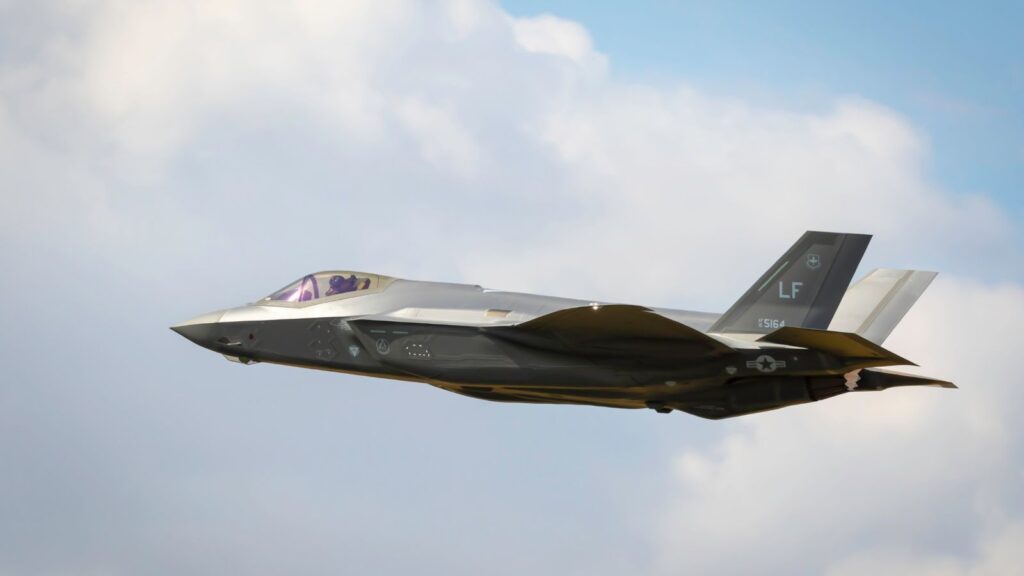
Canada’s next generation of fighter jets has become the centre of a deepening dispute with its closest military ally. In a November 23 assessment, the Pentagon challenged Ottawa’s review of a planned purchase of 88 American-made F-35s, arguing that prolonged uncertainty and equipment shortages weaken the defence of North America.
The criticism comes as Prime Minister Mark Carney weighs alternative aircraft and greater Canadian industrial benefits while his government insists it is rebuilding the military through major new investments. Behind the sharp language lies a difficult question: how can Canada modernize its air force, meet NATO’s rising spending commitments and protect its independence without undermining the long-standing defence partnership with the United States?
Pentagon Delivers an Unusually Public Rebuke
Washington’s criticism arrived in a form normally reserved for laying out official positions: a Pentagon fact sheet released on November 23. The document argued that Canada had not made the difficult choices necessary to modernize its armed forces or become a sufficiently credible partner in defending North America. It singled out the prolonged review of 88 American-made F-35 fighters, but its message extended to military readiness and Ottawa’s long-term spending plans. Under Defence Secretary Pete Hegseth, the department portrayed the disagreement as a question of whether Canada is carrying an adequate share of continental security.
That accusation is considerably broader than a dispute over which company sells fighter aircraft. American officials argue that decades of Canadian underinvestment have placed too much responsibility on U.S. taxpayers. The language also puts pressure on Prime Minister Mark Carney at a moment when bilateral relations are already strained by President Donald Trump’s tariffs and threats against Canadian sovereignty. Yet the fact sheet represents Washington’s assessment, not an independent finding that Canada has abandoned its military obligations. Ottawa has announced substantial new spending, making the timing and effectiveness of those investments the real point of contention.
The 88-Jet Deal Has Years of Planning Behind It
Canada’s planned purchase did not begin with the current political standoff. After a competitive procurement process launched in 2017, Ottawa finalized an arrangement in late 2022 and announced in January 2023 that it would acquire 88 Lockheed Martin F-35A aircraft through the U.S. government. They are intended to replace the Royal Canadian Air Force’s aging CF-18 Hornets, which have been flying since the 1980s. The official project covers far more than aircraft: weapons, training, maintenance preparations, information systems and specialized fighter facilities are also part of introducing an entirely new combat fleet.
The existing schedule illustrates why delays matter. Government planning documents call for initial Canadian aircraft to support pilot training at Luke Air Force Base in Arizona, with the first jets arriving in Canada in 2028. Initial operational capability is scheduled for 2029 and full operational capability for 2033. The CF-18s are expected to retire by 2032, making the transition particularly sensitive. Ottawa has maintained its commitment to an initial group of 16 aircraft and continued scheduled payments during the review. Reconsidering the remaining fleet therefore does not mean that the entire program has been cancelled.
Why Carney Put the F-35 Decision Back Under Review
Prime Minister Mark Carney directed a review of the acquisition on March 14, 2025, asking whether the F-35 remained the best overall choice for Canada. The assessment goes beyond the aircraft’s performance. Defence officials have described a process examining operational requirements, price, industrial benefits, strategic relationships and alternative delivery schedules. For taxpayers, the issue is whether an exceptionally expensive procurement will deliver reliable protection for decades. For military planners, it is whether reconsideration can be completed without opening a dangerous gap as older fighters are withdrawn.
The review has also become inseparable from Canada’s changing relationship with Washington. Trump’s trade tariffs and repeated remarks about Canadian sovereignty have reinforced arguments for diversifying defence suppliers. Carney has questioned the wisdom of directing such a large share of Canada’s military capital spending to the United States. That position does not automatically make a European fighter the better operational choice. Instead, it forces Ottawa to balance several competing goals: maintaining close cooperation with the U.S. military, securing Canadian industrial opportunities and avoiding unnecessary dependence on any single foreign supplier.
A Swedish Alternative Raises the Mixed-Fleet Question
Sweden’s Saab has presented its Gripen E fighter as a possible part of Canada’s future air force. In October 2026, the company announced proposed partnerships with Canadian aerospace firms CAE, IMP and Magellan Aerospace. Its plans include training, support and potentially an assembly line in Canada if the federal government selects the aircraft. Such commitments could appeal to communities that see major defence purchases as opportunities for skilled manufacturing work. They are conditional proposals, however, not evidence that Ottawa has ordered Gripens or replaced its existing F-35 agreement.
The Pentagon sees a serious downside to the possibility of operating both types. It warned that a mixed fighter fleet could deepen personnel shortages and complicate maintenance, training and fleet management. Different aircraft require their own equipment, technical expertise and supply arrangements, even when both can serve allied missions. Canadian officials have acknowledged that mixed-fleet options form part of the review, but no final configuration has been announced. The key comparison is therefore not simply the price of one jet against another; it is the total cost and military value of operating the chosen fleet over many years.
Canada’s Own Readiness Numbers Reveal Genuine Problems
Some of the Pentagon’s sharpest statistics come directly from Canadian military reporting. For fiscal 2025–26, National Defence recorded serviceability of 41.9% for key aerospace fleets, 53.91% for key maritime fleets and 48% for key land fleets. Those figures describe the proportion of equipment meeting defined training and operational readiness requirements. They should not be interpreted as meaning that the same proportion of Canadian soldiers, sailors or pilots can perform their duties, or that every other vehicle and aircraft is permanently unusable.
The department also reported that 61% of Canadian Armed Forces force elements were ready for operations against established targets, with a longer-term goal of reaching at least 90% by 2032. Its report identified aging equipment, maintenance demands, staffing gaps and supply-chain disruption as persistent obstacles. These are tangible pressures for crews and technicians who must keep older systems working while preparing to operate replacements. Ottawa argues that new investments will improve readiness over time. Washington’s criticism, meanwhile, highlights the difficult interval between announcing purchases and actually having trained personnel and serviceable equipment available for missions.
Why NORAD Gives the Fighter Decision Continental Importance
The consequences of Canada’s fighter decision extend beyond its own airspace. Canada and the United States jointly operate the North American Aerospace Defense Command, or NORAD, which provides aerospace warning, aerospace control and maritime warning for the continent. Canadian CF-18s remain part of the forces available to identify and respond to threats. The shared mission depends on fighters, radar, communications and personnel working together quickly, including in the vast approaches to Canada’s North. A new fleet must fit into that system, not merely look impressive on a procurement document.
This is why the Pentagon says uncertainty over the final fighter mix matters to American planners. A divided fleet could require more complex training and sustainment arrangements, while delays in replacing the Hornets could narrow Canada’s operational options. Those are potential risks rather than proof that a mixed fleet cannot function in NORAD. Canada’s defence minister has said cooperation in defence, security and intelligence continues despite the political friction. The central question is whether Ottawa can demonstrate that its chosen aircraft, crews and implementation schedule will preserve dependable continental defence.
Ottawa Has Increased Spending, but NATO’s Target Has Moved
The argument over Canadian defence funding is not simply about whether Ottawa has begun spending more. Budget 2026 states that Canada reached NATO’s former benchmark of spending 2% of gross domestic product on defence in fiscal 2025–26. The government also points to C$81.8 billion committed in Budget 2025 to rebuild and re-equip the armed forces. Responding to the Pentagon’s criticism, a spokesperson for Defence Minister David McGuinty stressed those commitments and maintained that Canada is making concrete progress toward its newer alliance obligations.
That newer target is much larger. At NATO’s 2025 Hague summit, allies agreed to invest 5% of GDP annually by 2035, divided into at least 3.5% for core defence and up to 1.5% for broader defence- and security-related needs. Canada’s November 2026 budget projects combined spending of 4.1% of GDP in 2027–28, including 2.6% for core defence. Both numbers can be true at once: Ottawa has accelerated investment substantially, yet its published projections still fall below the ultimate NATO commitment. The debate concerns how quickly that remaining distance can realistically be closed.
Washington Says the Biggest Decisions Are Being Deferred
The Pentagon accused Ottawa of lacking a credible, fully costed route to NATO’s 5% target and postponing the largest spending increases until after the expected 2029 federal election. That is an allegation about the government’s future choices, not a claim that every announced increase is fictitious. The current budget already shows core defence funding rising over the next several years. What it does not provide is a complete annual spending plan stretching all the way to 2035, when Canada is supposed to meet the higher alliance benchmark.
Canada’s independent Parliamentary Budget Officer has identified the same planning gap without adopting the Pentagon’s political language. In its November 17 assessment, the office noted that Budget 2026 projects 2.6% of GDP in core defence spending through 2030–31, short of the eventual 3.5% requirement. It estimated that reaching 3.5% in 2030–31 would imply roughly C$37 billion more in core spending that year than the budget currently projects. That comparison is illustrative, not an additional commitment due immediately. It shows why promises alone do not settle questions about funding, procurement capacity or future deficits.
The F-35 Audit Shows Why the Financial Stakes Are So High
The F-35 program has financial problems of its own, independently of Washington’s latest criticism. Canada’s Auditor General reported in 2025 that estimated project costs had climbed from C$19 billion in 2022 to C$27.7 billion by 2024, an increase of approximately 46%. The audit also identified at least C$5.5 billion in additional infrastructure and advanced-weapons requirements outside that estimate. Together, those figures indicated a potential requirement of at least C$33.2 billion to achieve the intended capability, based on the costs reviewed at the time rather than a final bill.
The difficulties are not purely financial. Auditors flagged shortages of qualified pilots and construction delays affecting new fighter facilities at Cold Lake, Alberta, and Bagotville, Quebec. National Defence’s later status reporting said the overall aircraft schedule remained on track, while acknowledging cost pressures and the need for temporary arrangements because of construction delays. Eight Canadian F-35As were in production at the end of fiscal 2025–26. These details complicate any suggestion that a purchase decision alone guarantees readiness. Aircraft must arrive alongside the people, buildings and support systems required to operate them safely and effectively.
A Test of Sovereignty and a Long Military Partnership
The public confrontation comes after other unusual strains in the bilateral defence relationship. In May 2026, the Pentagon paused its participation in the Permanent Joint Board on Defense, an advisory body created in 1940. More recently, Hegseth issued a classified directive reportedly restricting certain U.S. military participation in Canadian think-tank events and informal gatherings. Canadian Defence Minister David McGuinty said he had seen no evidence that joint military operations or intelligence cooperation had changed. U.S. Senator Mike Rounds likewise indicated that core military activities were not the target of the restrictions.
The dispute has prompted sharp criticism in Canada. Former Conservative leader Erin O’Toole argued that the Pentagon’s assessment overlooked changes Canada had made during the previous year, while other Canadian security voices said it discounted contributions to NATO and Ukraine. None of that removes the need to address readiness shortfalls or clarify the F-35 decision. Ottawa must explain which fighter configuration it wants, how much the entire system will cost and when it can enter service. Washington, for its part, must decide whether public pressure helps strengthen a vital partnership—or makes an already difficult procurement decision even harder.
