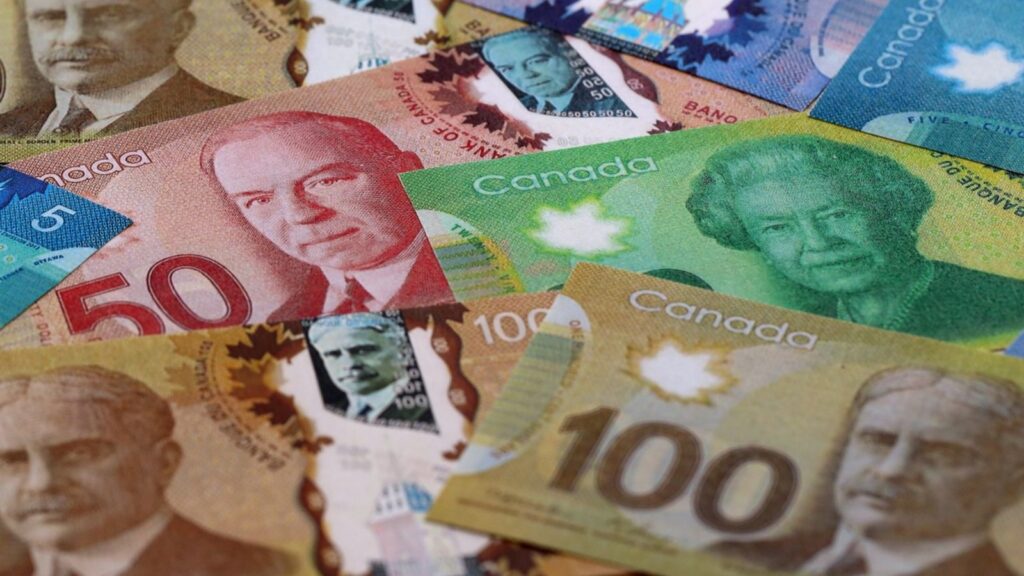
On a day when Wall Street stocks plunged before recovering much of their losses, Canada’s dollar moved in the opposite direction.
The loonie strengthened to 70.42 U.S. cents on Wednesday, November 25, as investors increased expectations for another Bank of Canada interest-rate hike and the American dollar weakened. The rebound came during an unusually turbulent trading session, with concerns about artificial-intelligence investments and new U.S. tariff proposals unsettling financial markets.
For Canadians, the currency’s improvement brings both opportunities and complications. A stronger dollar can make American purchases more affordable, but it can also create challenges for exporters. Meanwhile, the prospect of higher interest rates raises uncomfortable questions for households and businesses already managing elevated costs.
A Two-Week High After a Difficult Stretch
The Canadian dollar’s rise was notable partly because of what had happened just days earlier. On November 25, the loonie traded about 0.5% higher against the U.S. dollar at 70.42 U.S. cents, or roughly C$1.42 for one American dollar. During the session, the exchange rate touched C$1.4194 per U.S. dollar, its strongest intraday level since November 11. It was a meaningful change in direction for a currency that had recently been struggling to find support as investors weighed U.S. interest rates, volatile equities and Canada’s economic outlook.
The previous Friday, November 20, the loonie had been trading near 69.81 U.S. cents and was headed for a third consecutive weekly decline. That contrast explains why a move of less than one U.S. cent attracted attention. Currency markets respond to changes in expectations, sometimes long before households notice a difference at a bank or exchange counter. Yet a two-week high is not the same thing as a sustained recovery. The day’s quotation was a snapshot, not a guaranteed rate for future purchases or travel.
Wall Street’s Selloff Was Severe, but the Close Told a Different Story
The currency advance unfolded during a turbulent session for American stocks. Technology shares bore much of the selling as investors questioned whether enormous spending on artificial-intelligence infrastructure would generate the profits that companies and shareholders expect. The Nasdaq Composite opened more than 3% lower and fell more than 4% at one stage. News of additional U.S. tariff proposals added another source of anxiety, encouraging investors to reassess risks that had seemed manageable only weeks earlier.
By the closing bell, however, the picture was less dramatic. The Nasdaq finished down about 0.6% and the S&P 500 lost about 0.3%, while the Dow Jones Industrial Average actually gained about 0.3%. Buyers had returned to some beaten-down shares, sharply reducing the day’s losses. That distinction matters for understanding the loonie’s rise. The initial selloff helped set the mood, but the entire U.S. market did not finish in free fall. Canadian currency traders were also responding to changing interest-rate expectations and movements in the American dollar itself.
December Rate-Hike Expectations Have Changed Quickly
The clearest domestic support for the loonie came from a reassessment of what the Bank of Canada might do next. After Governor Tiff Macklem spoke on November 24, traders assigned roughly an 80% probability to a December interest-rate increase, compared with about 65% before his remarks, according to Reuters. Such percentages come from market pricing, not a vote or a commitment by central bankers. They can move rapidly as fresh inflation figures, speeches and economic reports alter the outlook.
The currency connection is straightforward, even if the result is not. Higher Canadian interest rates can make Canadian-dollar assets more attractive relative to similar U.S.-dollar holdings. If the difference between the countries’ expected interest-rate paths narrows, that can support the loonie. But the comparison works in both directions: American investors were also expecting further Federal Reserve tightening after fresh U.S. inflation data. A stronger Canadian currency therefore depends less on a single Bank of Canada decision than on how both central banks respond to their own economies.
Macklem’s Warning Was About Persistent Inflation, Not a Promised Hike
The Bank of Canada had already increased its benchmark rate by a quarter of a percentage point to 2.50% on October 28. Its November 24 message explained why the inflation problem remains difficult. Macklem stressed that the bank must distinguish short-lived price shocks from pressures likely to persist and spread across the economy. Canada has also renewed its 2% inflation target for 2027 through 2031, preserving a goal that guides how interest-rate decisions are made.
The distinction is consequential for businesses and households. A temporary jump in oil prices might disappear without much intervention. But if higher energy and transportation costs repeatedly find their way into groceries, services and other bills, waiting too long could make inflation harder to control. Macklem also acknowledged the danger of reacting too forcefully and weakening an already pressured economy. His remarks were not a promise that rates would rise in December. Investors nevertheless interpreted the emphasis on persistent inflation as increasing the possibility of another move.
Canada’s Inflation Figures Explain the Pressure
Statistics Canada’s latest consumer-price figures showed annual inflation at 3.1% in October, unchanged from September and slightly above the upper end of the Bank of Canada’s 1% to 3% control range. The details were uneven. Transportation prices were 8.9% higher than a year earlier, while gasoline alone was up 30.9%. Shelter prices rose 1.4%, and food purchased from stores increased 2.0%. For households, those differences matter more than the headline number because spending patterns vary widely.
There is another side to the data. Excluding energy, consumer prices rose 2.0% over the year, showing how much elevated fuel costs contributed to the overall rate. Still, the central bank is concerned that high energy expenses may eventually spill into other categories as companies adjust prices to recover their costs. Its October outlook projected inflation averaging 3% in 2027. A firmer Canadian dollar could ease some imported costs over time, but it cannot automatically reverse increases in global oil prices or immediately restore family purchasing power.
Strong U.S. Growth Complicates the Currency Picture
American economic figures released on November 25 might ordinarily have supported the U.S. dollar. The U.S. Bureau of Economic Analysis revised third-quarter real GDP growth up to a 4.3% annualized rate from an initial 3.4% estimate. That was also stronger than the 2.2% annualized growth recorded in the second quarter. Consumer spending, investment and government spending contributed to the expansion, offering evidence that the world’s largest economy retained considerable momentum despite market worries.
Inflation offered a less comfortable message. The Federal Reserve’s preferred personal consumption expenditures price index rose 3.8% from a year earlier in October, up from 3.7% in September. Excluding food and energy, the annual increase was 3.3%. Those readings strengthened expectations of additional U.S. interest-rate increases, a factor that could normally help the greenback. Yet the dollar weakened against a basket of major currencies during Wednesday’s trading. The episode showed how even strong economic data can be overshadowed by shifting investor confidence, trade uncertainty and the prices already built into financial markets.
An Oil-Price Rebound Added Support—and New Risks
Oil provided another piece of the currency story. U.S. crude futures were up about 1.8% at US$83.52 a barrel during Wednesday’s session, according to Reuters, before settling near US$83.68. Prices rose after Yemen’s Houthi movement claimed an attack on a major Saudi refinery, adding to worries about energy supplies. For a resource-exporting country such as Canada, higher crude prices can improve export revenues and help support demand for the Canadian dollar, although that relationship is never automatic.
Recent trade figures show why the energy market matters. Statistics Canada reported an 8.2% rise in energy-product exports in September, with crude oil and bitumen exports up 10.2% amid higher prices. But what benefits a producer or provincial treasury does not necessarily benefit a driver filling a vehicle. Gasoline prices were already 30.9% higher year over year in Canada’s October inflation report. Sustained energy costs can raise transport and production bills even as they help the loonie. The economic impact depends on which side of the pump or export contract a Canadian occupies.
Canadian Stocks Recovered While Bond Yields Fell
Toronto’s stock market offered its own reminder that a difficult morning does not dictate the close. The S&P/TSX Composite Index fell sharply early on November 25, then reversed course to finish 217.69 points higher, or about 0.6%, at 34,179.99. Materials shares gained about 3%, energy climbed 1%, and industrials advanced 0.9%. Technology stocks, by contrast, finished down 0.6%, reflecting some of the pressure still facing growth-oriented companies on Wall Street.
The bond market was sending a different but equally useful signal. During the session, Canada’s 10-year government bond yield fell 4.2 basis points to 3.651%, tracking a rally in U.S. Treasuries as investors sought safer assets. This does not contradict rising bets on a near-term Bank of Canada hike. Short-term policy expectations and longer-term bond yields measure different things: the latter also reflect concerns about future growth, inflation and demand for safe investments. The day’s mixed signals were evidence of a market adjusting to several competing forces, not a single, unanimous forecast.
New U.S. Tariff Proposals Keep Cross-Border Trade in Focus
Currency movements are especially important for Canada because so much of its goods trade is tied to the United States. Statistics Canada reported that 70.2% of Canadian merchandise exports went to the U.S. in September. A Canadian manufacturer paid in American dollars may receive fewer Canadian dollars when converting those sales after the loonie rises. The same currency move can help a Canadian importer purchasing machinery, components or other supplies priced in U.S. dollars. For companies with both kinds of transactions, the effect is more complicated.
Trade policy added uncertainty on November 25. The U.S. Trade Representative announced proposed Section 301 actions against 14 economies, including China, the European Union, Japan and India, citing structural excess manufacturing capacity. Canada was not named in this particular group of proposals, which should not be mistaken for a new tariff on Canadian goods. Still, changes affecting other trading partners can alter competitive conditions and supply-chain decisions. Businesses making hiring, purchasing and investment plans must consider both exchange-rate swings and rules that may change before orders are fulfilled.
What Canadians Should Watch After the Rebound
The stronger loonie offers a modest benefit to people paying bills in American dollars. At the quoted market rate of 70.42 U.S. cents, C$1,000 was worth roughly US$704 before conversion charges, compared with about US$698 at the 69.81-cent level reported the previous Friday. That difference matters to someone booking a trip or paying for a U.S.-priced service, but bank spreads and card fees can reduce the amount received. A currency rebound also takes time to influence retail prices, especially when goods were purchased at earlier exchange rates.
The more difficult trade-off concerns borrowing. Another Bank of Canada increase, if it occurs, would tend to raise costs on variable-rate credit tied to lenders’ prime rates, even while a stronger dollar might soften selected import expenses. Two dates now deserve attention: Statistics Canada is scheduled to release third-quarter GDP figures on November 30, and the Bank of Canada’s next interest-rate decision is set for December 9. Those releases will help determine whether the loonie’s improvement reflects a lasting change in Canada’s outlook or simply a short burst of market repricing.
