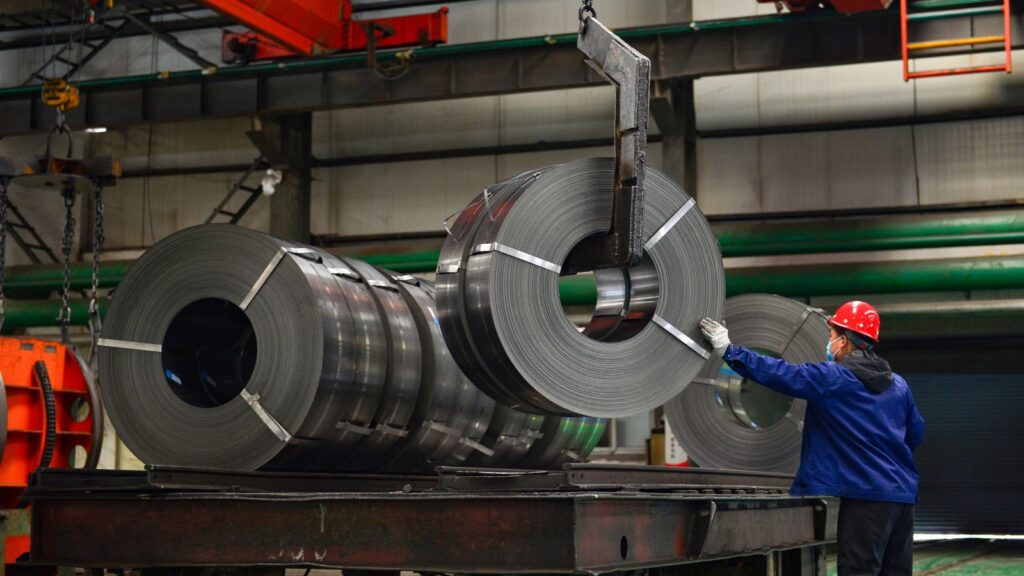
For 175 steelworkers in Hamilton, Ontario, the possibility of returning to work before Christmas now comes with an important condition. Cleveland-Cliffs, the American company that owns Stelco, says those jobs could be restored if Canadian customers increase their purchases of domestically produced steel.
On October 28, 2026, Cleveland-Cliffs CEO Lourenco Goncalves outlined the potential recall, offering a glimmer of hope amid layoffs, U.S. tariffs, and mounting political pressure. The announcement follows an earlier warning that as many as 500 Stelco employees could be affected by production changes. However, the company’s promise is not unconditional, and Ottawa is demanding stronger guarantees. With Christmas approaching, the dispute has become about more than steel sales. It raises difficult questions about Canadian manufacturing jobs, foreign ownership, and who bears responsibility when international trade disputes threaten local livelihoods.
The Christmas Recall Depends on Canadian Customers
The biggest development in Cleveland-Cliffs’ latest announcement is the prospect of restoring all 175 jobs before December 25. Goncalves told The Canadian Press that the company intends to recall the workers if its effort to increase domestic steel sales succeeds. However, he did not announce a firm recall date or disclose how much additional business Stelco must secure. That distinction matters because an expression of intent does not guarantee that employees will actually return to their positions before the holidays.
The announcement also represents a shift in the company’s public approach. Earlier in October, Goncalves had connected the prospect of recalling workers to improved trade conditions and stronger protection against imported steel. Now, he is emphasizing Canadian customers’ purchasing decisions. Manufacturers, construction suppliers, and steel distributors could therefore play an important role in determining whether Stelco increases production. But buying decisions involve prices, product specifications, availability, and delivery schedules. Unless additional orders materialize, the Christmas deadline remains a goal rather than a confirmed commitment.
Why the Original 500-Worker Layoff Warning Changed
On September 28, Stelco warned employees that as many as 500 positions could be affected across its Hamilton Works and Lake Erie Works facilities. The announcement followed a decision to indefinitely idle cold-rolled and coated steel operations in Hamilton, beginning around October 9. At the time, United Steelworkers representatives estimated that roughly 300 to 350 workers in Hamilton alone could face layoffs. The possibility of losing hundreds of manufacturing jobs sent a wave of uncertainty through communities already dealing with the consequences of the Canada-U.S. trade dispute.
By October 28, however, the confirmed figures were substantially lower. Goncalves said the actual number of layoffs was 175, while United Steelworkers Local 1005 president Ron Wells confirmed that all 175 affected employees were in Hamilton. Wells also reported that no layoffs had occurred at Lake Erie Works. The distinction is significant: the original 500 figure described the potential scale of the restructuring, not the final number of workers dismissed. Still, a smaller total does not eliminate the financial uncertainty facing the affected employees or resolve questions about the company’s longer-term staffing plans.
Hamilton and Nanticoke Play Different Roles in Stelco’s Operations
Stelco’s two major Ontario facilities are connected, but they perform different functions. Lake Erie Works in Nanticoke is an integrated steelmaking complex where raw materials are transformed into steel products, including hot-rolled coils. Hamilton Works, whose industrial history stretches back to 1905, specializes in downstream processing, including cold rolling and zinc coating. These processes transform steel into products used by automakers, agricultural equipment manufacturers, infrastructure projects, and other industrial customers.
When Cleveland-Cliffs announced its September restructuring, it said production would increasingly focus on Lake Erie Works while Hamilton’s cold-rolled and coated operations were idled. The company maintained that overall steel production tonnage would not necessarily decline, even though the mix of products would change. It also said affected Hamilton employees would be offered employment opportunities in Nanticoke. Union representatives questioned how many positions were actually available. For workers, transferring between plants is not automatically equivalent to having their previous jobs restored. The distinction matters because the current recall proposal is specifically about rebuilding employment in Hamilton.
A Major Decline in Demand Triggered the Production Cuts
Stelco’s September employee memorandum provided a revealing measure of the pressures facing its finishing operations. According to figures supplied by the company, demand for its cold-rolled and galvanized products in traditional markets declined by almost 25% during the second quarter of 2026 compared with the quarterly average in 2024. Within Canada, the company reported a 10% decline in demand for those products. These figures were company-reported market estimates, rather than an independent measure of the entire Canadian steel industry.
The distinction between different steel products helps explain the restructuring. Hot-rolled steel is processed at high temperatures and commonly serves as an input for further manufacturing. Cold-rolled steel undergoes additional processing for tighter dimensions and improved surface characteristics, while galvanized steel receives a protective zinc coating. Each product serves different customers and faces different competitive pressures. Cleveland-Cliffs says Canadian demand for the more highly processed products has not developed as anticipated when it acquired Stelco. That weakness helps explain why the company can report stronger sales conditions for hot-rolled steel while keeping Hamilton’s finishing operations idle.
Canadian Import Figures Complicate the Company’s Argument
One of the most revealing developments in the Stelco dispute involves where Canada’s imported steel actually comes from. Global Affairs Canada data reviewed by The Canadian Press show that Canada imported 625,726 tonnes of galvanized and coated steel sheet during the first nine months of 2026. Of that amount, 54.1% originated in the United States. South Korea accounted for 13.4%, Taiwan for 7.6%, and Germany for approximately 7%. These figures complicate Cleveland-Cliffs’ argument that cheap overseas imports are among the principal reasons for Stelco’s difficulties.
McMaster University economics professor Colin Mang has questioned whether descriptions of widespread offshore dumping accurately reflect Canada’s steel trade figures. The distinction matters because large import volumes do not automatically prove unfair pricing. Another economist, Dan Ciuriak, has emphasized the damage caused by declining Canadian steel exports to the United States. Nevertheless, imported products can still intensify competition when domestic demand is weakening. The evidence suggests Stelco faces several overlapping challenges, including lost export opportunities, competition from American and overseas suppliers, and weaker Canadian manufacturing demand.
Trump’s Steel Tariffs Have Changed the Economics of Canadian Production
The trade dispute intensified when U.S. President Donald Trump raised Section 232 tariffs on covered steel and aluminum imports from 25% to 50%, effective June 4, 2025. The American administration presented the increase as a measure to protect domestic metal producers and strengthen industrial capacity. Subsequent changes in April 2026 introduced more differentiated rates for metal products and derivatives, with applicable Section 232 tariffs generally ranging from 15% to 50%. For Canadian steel producers, these restrictions have made access to the U.S. market more difficult.
The impact extends beyond mills directly exporting steel. Canadian manufacturers that purchase steel to produce machinery, automotive components, and other goods can also face reduced orders when their American customers encounter higher import costs. Cleveland-Cliffs has cited these disruptions as one reason for Stelco’s weaker sales. Yet the company’s position is politically contentious because Goncalves has publicly supported American steel tariffs, which benefit parts of Cleveland-Cliffs’ U.S. business by limiting foreign competition. Canadian officials and steelworkers have questioned how that support can be reconciled with the company’s responsibilities to its Canadian workforce.
Ottawa Has Already Introduced Measures to Support Canadian Steel
The federal government has not remained inactive while Canadian steelmakers struggle. Beginning December 26, 2025, Canada tightened tariff-rate quotas on steel imports from countries outside the Canada-United States-Mexico Agreement. For countries without a free trade agreement, permitted volumes were reduced to 20% of 2024 import levels. For other free trade agreement partners outside CUSMA, the limit became 75%. Covered imports exceeding those quotas face a 50% surtax. Although American and Mexican steel is exempt from these particular quotas, separate Canadian counter-tariffs of 25% or 50% on certain U.S. steel products took effect in September 2026.
Ottawa has also introduced policies intended to create domestic demand. Its Buy Canadian procurement rules prioritize Canadian-produced steel in qualifying large federal construction and defence contracts. In August 2026, Transport Canada launched a $100-million program offering rebates covering 50% of eligible interprovincial rail or marine shipping costs for Canadian steel. These measures could improve opportunities for producers such as Stelco, but they do not guarantee new orders for Hamilton’s particular products. Customers must still find Canadian supply suitable for their technical and commercial requirements.
The 2024 American Takeover Included Five-Year Employment Commitments
Cleveland-Cliffs completed its acquisition of Stelco on November 1, 2024, in a transaction valued at approximately C$3.4 billion. At the time, the deal was presented as an opportunity to strengthen North America’s integrated steel industry while preserving Stelco’s Canadian identity. Ottawa approved the acquisition under the Investment Canada Act after securing legally binding commitments designed to protect employment, investment, and other Canadian economic interests.
Those undertakings extended over five years and included maintaining Stelco’s head office in Hamilton, continuing to operate under its established brand, protecting collective bargaining agreements, and preserving employment levels. The company also agreed to maintain pension and benefit commitments and make significant capital and research expenditures. The federal government specifically required Cleveland-Cliffs to continue employing at least the same number of unionized workers and the vast majority of non-unionized employees as when the transaction was announced, subject to the detailed terms of the undertakings. That history explains why the October 2026 layoffs immediately became a federal enforcement issue rather than remaining an ordinary dispute between an employer and its workforce.
Cleveland-Cliffs Says It Is Still Meeting Its Employment Obligations
Despite the layoffs, Cleveland-Cliffs maintains that it has fulfilled its legal commitments to Canada. In an October 26 statement, the company said it had reviewed all 34 undertakings associated with the Stelco acquisition and found itself fully compliant. Its employment figures were central to that argument. For the current reporting period, Cleveland-Cliffs projected an annual average of at least 1,879 unionized full-time-equivalent employees, exceeding its required minimum of 1,766. It also projected 627 salaried full-time-equivalent employees, compared with a required minimum of 603.
The government’s interpretation is different. Industry Minister Mélanie Joly has accused Cleveland-Cliffs of violating six binding commitments, including employment-related obligations. The disagreement partly concerns how compliance should be assessed. Annual average employment figures do not necessarily reflect the immediate consequences of layoffs occurring late in a reporting period. However, layoffs alone do not establish precisely how the detailed employment undertakings should be applied. Cleveland-Cliffs says it will update its compliance report after the current reporting period closes on October 31. That report could become important evidence as the dispute continues.
Ottawa Is Demanding a Concrete Plan, Not Just a Christmas Promise
On October 22, Joly escalated the confrontation by issuing an 11-page demand letter giving Cleveland-Cliffs 15 days to address alleged violations of its takeover commitments. The minister warned that failing to comply could lead Ottawa to seek remedies through the courts under the Investment Canada Act. Potential outcomes include orders requiring the company to honour its commitments, financial penalties of up to C$10,000 per day, or an order requiring Cleveland-Cliffs to sell Stelco. These measures remain possible legal outcomes, not penalties that have already been imposed.
Cleveland-Cliffs requested a meeting with Joly and Goncalves on October 23 to discuss restoring employment. However, Joly has insisted that the company first provide a credible plan and timeline for bringing workers back. Her position remained unchanged after the October 28 Christmas recall proposal. The dispute intensified further when Ottawa began consulting lawyers about Goncalves’ comments suggesting that acquiring Stelco had helped protect his company’s American operations from Canadian competition. Cleveland-Cliffs continues to reject allegations of wrongdoing. For now, the two sides remain divided over whether market conditions justify the layoffs and what constitutes an acceptable path toward restoring jobs.
Behind the Layoff Figures Are Families Facing Financial Uncertainty
The impact of Stelco’s restructuring becomes clearer through the experiences of individual workers. Jordan Williams, a Stelco utility technician who began working for the company in 2022, told CHCH News in October that he received a layoff notice with little warning and was instructed not to return after the Thanksgiving long weekend. Williams, a father of two young children, described the emotional shock of saying goodbye to his colleagues. His experience illustrates why the possibility of a Christmas recall carries such enormous personal significance.
United Steelworkers Local 1005 president Ron Wells has repeatedly emphasized the financial and emotional strain facing affected employees. According to Wells, eligible laid-off workers can access Employment Insurance and supplementary unemployment benefits negotiated through their collective agreement. Those protections provide some assistance, but they do not necessarily replace normal earnings or restore job security. The union has also challenged the company’s description of the layoffs as indefinite, treating them as temporary under its collective agreement. For affected families, the crucial question is whether a return to work will actually happen. A conditional promise offers hope, but it cannot provide the certainty of a confirmed recall notice.
Stronger Financial Results Raise Questions About Stelco’s Future
The controversy is unfolding alongside an improvement in Cleveland-Cliffs’ overall financial performance. The company reported third-quarter 2026 revenue of US$5.6 billion, net income of US$165 million, and adjusted earnings before interest, taxes, depreciation and amortization of US$612 million. Those are consolidated corporate results, not financial figures attributable solely to Stelco. Nevertheless, Goncalves described Stelco’s third quarter as its strongest since the 2024 acquisition, saying improved Canadian demand for hot-rolled steel had made the subsidiary a positive contributor to adjusted earnings. He also indicated that approximately 2,000 Canadian jobs were being preserved despite the restructuring.
Ownership questions have added another layer of uncertainty. On October 28, Goncalves said he would not negotiate with potential Stelco buyers during the next calendar year. He suggested he might consider selling after demonstrating a year of higher production and recalling all 175 workers, but only if he chose to do so. Meanwhile, Ottawa has raised the possibility of seeking a forced sale through legal proceedings.
Ultimately, the immediate test will be whether Canadian steel orders increase enough to justify restoring Hamilton’s idled operations. Employment notices, production plans, and progress toward resolving the federal dispute will provide clearer evidence than statements of optimism alone. For 175 workers, the difference between a promising announcement and an actual return to work could determine what this Christmas looks like.
