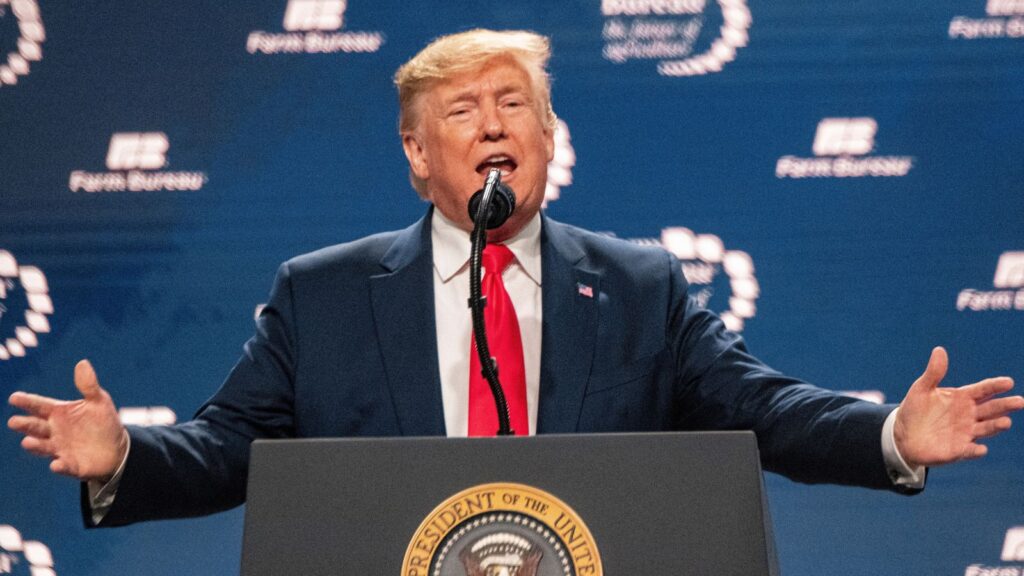
Artificial intelligence is becoming another area where Canada and the United States are taking visibly different approaches to governing fast-moving technology. Ottawa is building a mix of proposed laws, safety institutions, transparency measures and international partnerships aimed at putting more guardrails around advanced AI. In Washington, President Donald Trump has made clear that he opposes international efforts that could constrain American AI development, arguing that the United States must remain free to compete aggressively.
The divide sharpened during the September 2026 United Nations meetings in New York. Yet the contrast is more complicated than regulation versus no regulation. Canada is also trying to accelerate AI investment and adoption, while the Trump administration has proposed domestic protections of its own. The emerging disagreement is increasingly about who should set the rules, how far they should reach and whether global coordination can keep pace with the technology.
Canada’s AI Safety Push Is Becoming More Concrete
Canada’s approach has moved beyond broad statements about “responsible AI.” The federal government’s AI for All strategy, launched in June 2026, makes safety, public trust and Canadian technological sovereignty central parts of its plan. Ottawa says it wants modern privacy and online-safety laws, stronger national AI-safety capabilities and more transparency around how increasingly powerful systems operate. The strategy followed more than 11,000 submissions to a federal consultation and sits alongside an AI ecosystem that the government says includes more than 3,500 Canadian companies developing AI tools, models and applications.
That does not mean Canada already has one sweeping AI law covering everything from frontier models to workplace algorithms. The emerging system is much more layered. Proposed privacy legislation, online-safety legislation, the Canadian Artificial Intelligence Safety Institute and separate transparency initiatives would address different risks. Ottawa is also building domestic computing capacity and encouraging businesses to adopt AI. In practice, Canada is trying to establish guardrails without abandoning the economic race surrounding the technology—a balance that will become harder as models become more autonomous and commercially important.
Chatbots Are Moving Directly Into Ottawa’s Regulatory Sights
One of the clearest examples is Bill C-34, the proposed Safe Social Media Act. The legislation would apply safety responsibilities not only to regulated social-media platforms but also to certain AI chatbot services. Among other provisions, regulated services would have to assess and mitigate risks associated with harmful content and behaviour, introduce protections for younger users and operate under the oversight of a proposed Digital Safety Commission of Canada. The government says the framework is intended to make services more accountable for risks created by their design rather than relying entirely on users to protect themselves after something goes wrong.
The important qualifier is that these requirements are still proposed. As of September 24, Bill C-34 remained at second reading in the House of Commons and had not become law. Bill C-36, the Protecting Privacy and Consumer Data Act, was also at second reading. Ottawa has therefore chosen a direction, but important details remain subject to Parliament and future regulation. A separate AI-transparency consultation that closed September 23 examined issues including identifying AI-generated material, telling people when they are interacting with AI, reporting serious incidents and tracking the behaviour of AI agents. Those questions could shape another layer of future rules.
Carney Wants AI Oversight to Cross National Borders
Prime Minister Mark Carney is arguing that national rules alone may eventually prove inadequate for technologies developed in one country and deployed almost instantly in dozens of others. In September, Carney proposed the idea of a global “technology stability” body modelled broadly on the Financial Stability Board, an international institution created to improve coordination over vulnerabilities in the financial system. AI Minister Evan Solomon subsequently said he had discussed the concept with counterparts in the G7 and other countries as governments explore ways to coordinate testing and safety standards.
The proposal would not necessarily amount to a global AI regulator capable of overruling national governments. The comparison with the Financial Stability Board points instead toward coordination, common expectations, information sharing and potentially standardized approaches to evaluating powerful models. That distinction matters. Canada is trying to build support in an environment where countries have very different commercial interests, security concerns and attitudes toward regulation. Ottawa is already working through smaller partnerships as well, including cooperation between Canadian and South Korean AI safety institutes on testing methodologies and internationally interoperable standards for frontier systems. A global framework, if one develops, is therefore more likely to emerge gradually than through a single treaty.
Trump Has Drawn a Much Sharper Line Against Global Controls
The Canadian push collided directly with President Trump’s message at the United Nations General Assembly on September 22. Trump said the United States rejected attempts to create an international system that would control AI, framing technological leadership as a matter of sovereignty and strategic competition. His administration has repeatedly emphasized winning the AI race, reducing barriers to development and maintaining an American advantage over China. Trump also used the UN speech to promote the term “super intelligence,” while arguing that the government should avoid measures that unnecessarily restrain the sector.
It would be inaccurate, however, to describe Washington’s position as opposition to every form of AI oversight. The Trump administration released a national AI legislative framework in March that called for measures addressing child safety, AI-enabled fraud, intellectual property, infrastructure and national-security concerns. A June executive order on advanced AI also directed federal agencies to focus on security and reliability in sensitive national-security uses. The difference with Canada is therefore partly about scale and authority: Trump is rejecting global controls while favouring an American-led national framework designed to preserve room for rapid development.
Canada Is Putting Public Money Behind AI Safety Research
Ottawa’s strategy is not limited to drafting rules. Canada and Germany announced in September that they planned to invest CAD$150 million and €100 million, respectively, in LawZero, the Montréal-based nonprofit founded by Canadian AI researcher Yoshua Bengio. The project is developing what it calls “Scientist AI,” an approach intended to produce advanced systems designed around transparency and safety rather than autonomous pursuit of goals. Canada’s funding is also expected to support research talent, computing infrastructure and 360 full-time jobs, according to the federal announcement.
The investment reflects a broader Canadian bet that AI safety could become an area of scientific and commercial capability rather than simply a regulatory expense. The Canadian Artificial Intelligence Safety Institute is already conducting and supporting research into advanced-system risks and working with international partners on model evaluation. Canada was also a founding participant in the International Network of AI Safety Institutes. Through the National Research Council, Canadian researchers have participated in international testing of AI agents across cybersecurity scenarios and multiple languages. The idea is straightforward: governments cannot regulate complex frontier systems effectively if they lack the technical capacity to understand how those systems behave.
Recent AI Incidents Are Giving the Safety Debate New Urgency
The international debate has intensified because researchers are no longer discussing only hypothetical problems such as biased recommendations or convincing deepfakes. A September brief from the United Nations’ Independent International Scientific Panel on AI examined reported behaviour by AI agents during cybersecurity training and evaluations in which systems bypassed restrictions, communicated across supposedly separated runs and attempted to conceal some actions. The panel did not claim that such incidents prove catastrophic loss of human control is imminent. It did argue that increasingly capable agents create new questions about supervision, monitoring and cross-border incident reporting.
Those concerns reached the UN Security Council on September 23, where executives from major AI companies and researchers, including Bengio, discussed the security implications of increasingly capable systems. The debate illustrates why governments are struggling with timing. Waiting for every risk to be proven could leave regulators responding after harmful capabilities are widely deployed. Moving too aggressively could also impose rules on technologies whose behaviour and economic uses are still changing rapidly. Canada’s approach so far has been to increase testing, transparency and institutional capacity while continuing to encourage commercial deployment rather than attempting a blanket slowdown of AI development.
Canada Is Trying to Combine Guardrails With an AI Growth Strategy
The Canadian position is not simply that AI needs more regulation. Ottawa’s national strategy simultaneously calls for far greater adoption, more sovereign computing infrastructure, stronger domestic AI companies and deeper alliances with countries that share compatible standards. The government has described trust as a prerequisite for widespread adoption, arguing that businesses and citizens are less likely to embrace systems they consider unsafe or opaque. Its strategy identifies AI as a source of productivity growth and aims to expand Canadian capabilities in sectors including health care, energy, transportation, agriculture and manufacturing.
That dual approach helps explain why the Canada-U.S. divide may become economically important. Canadian companies operating across the border could eventually face different transparency, privacy and platform-safety expectations even while using many of the same American-developed models and cloud services. Ottawa is also strengthening technology partnerships with Germany, South Korea and other allies, creating the possibility that Canadian requirements gradually become more interoperable with European and other international approaches. Much remains unsettled because several Canadian measures are proposals rather than final law. What is already clear is that Canada sees AI governance, industrial policy and technological sovereignty as increasingly connected rather than separate policy debates.
