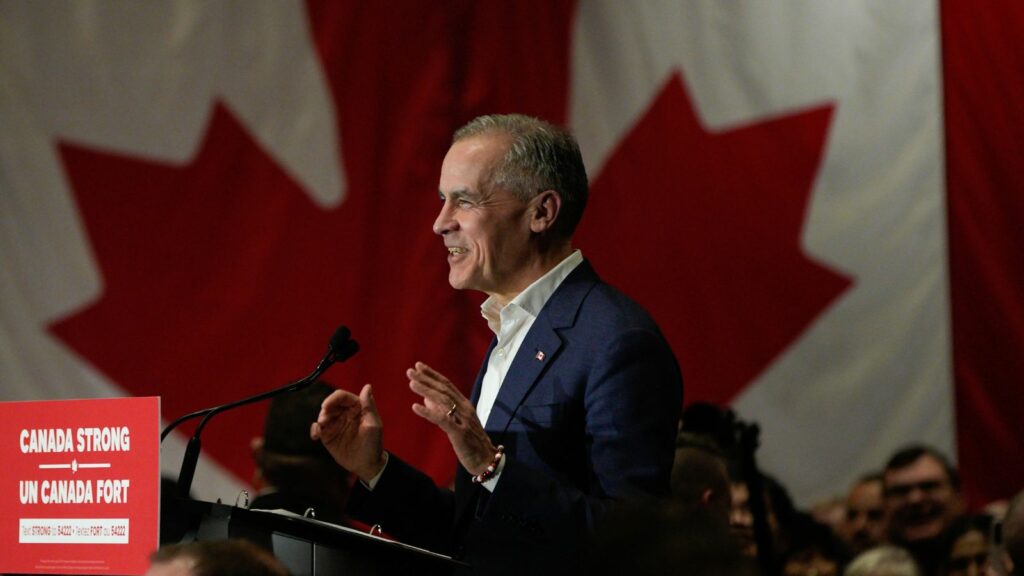
Canada’s escalating confrontation with the United States has produced an unusual political combination: broad support for fighting back, but a much less unified picture when Canadians are asked who should govern. New Ipsos polling shows 73% support Ottawa’s dollar-for-dollar counter-tariffs, while 63% believe Canada was right to stand firm in negotiations even if that means higher costs and significant job losses.
Yet beneath those national numbers, age is becoming a major dividing line. Millennials are less enthusiastic about the tougher trade posture and favour the Conservatives over the Liberals by 40% to 30%. Older Canadians, meanwhile, are considerably more willing to accept economic pain in a confrontation with Washington. The result is a political challenge for Prime Minister Mark Carney: Canadians may support retaliation today, but the durability of that support could depend heavily on who ultimately pays the price.
Counter-Tariffs Have Much Broader Support Than Further Compromise
The clearest number in the latest Ipsos findings is the 73% backing for Canada’s proposed dollar-for-dollar counter-tariffs. Ottawa plans to apply tariffs to approximately $27.6 billion worth of U.S. imports, matching American measures rate for rate. The federal government says the Canadian duties will range from 15% to 50% and will affect products including steel, dairy, appliances, agricultural equipment, pulp and paper, and electronics. The measures are scheduled to take effect September 8.
Support remains strong even when the question becomes more difficult. Ipsos found 63% believed Canada was right to stand firm during negotiations despite the possibility of higher prices and significant Canadian job losses. Only 18% said Ottawa should have offered additional compromises to secure an agreement, while the remainder chose neither position or said they lacked enough information. That suggests Canadians currently distinguish between wanting trade stability and accepting concessions simply to obtain it. For Carney, that provides considerable political room to retaliate — at least while the economic consequences remain manageable.
Millennials Are the Sharp Exception to the National Political Picture
The generational numbers tell a noticeably different story. Millennials give the Conservatives 40% support in federal voting intention, compared with 30% for the Liberals. That reverses the national result, where Liberals lead comfortably. Millennials are also less enthusiastic than Canadians overall about Ottawa’s confrontation with Washington: 57% support standing firm despite potential economic costs, while 59% support the retaliatory tariffs, according to the Ipsos findings reported by Global News.
There is another signal beneath those numbers. Nearly half of Millennials — 49% — agreed that Pierre Poilievre and the Conservatives would have done a better job dealing with the United States on trade. Among Boomers, only 21% agreed. None of this necessarily means Millennials oppose retaliation or favour accepting Washington’s demands. Majorities still support important elements of Ottawa’s response. Instead, it suggests that support for hitting back against the United States does not automatically translate into support for the governing Liberals. A voter can favour counter-tariffs while still questioning which party is best equipped to manage their consequences.
Older Canadians Are Driving the Tougher “Stand Firm” Mood
Age differences become especially striking when Canadians are asked whether the country should tolerate economic damage rather than make more concessions. Only 48% of Generation Z respondents supported standing firm under those conditions. Among Millennials, the figure was 57%. Among Boomers, Ipsos put support at roughly 80%. The partisan numbers move in the same direction: Liberals lead Conservatives 53% to 26% among Boomers, almost the mirror image of the Conservative advantage among Millennials.
The difference becomes even clearer when the potential sacrifice is personal. Overall, 52% said they were willing to endure significant economic pain to help Canada withstand the dispute. That fell to 41% among Generation Z but reached 67% among Boomers. Income produced a similar pattern. Ipsos found 76% of people earning more than $100,000 supported standing firm, compared with 51% among those making less than $40,000. The findings do not prove that financial circumstances cause particular political choices, but they make one point difficult to ignore: enthusiasm for confrontation is strongest among groups that may have more capacity to absorb an economic shock.
Affordability Helps Explain Why the Age Divide Matters
That vulnerability can be seen beyond political polling. Statistics Canada’s household accounts show how heavily debt obligations remain concentrated among younger and middle-aged households. In the third quarter of 2025, households whose main income earner was aged 35 to 44 had a debt-to-income ratio of 245.4%, the highest of any age group. Households under 35 were at 167.2%. Their interest-only debt-service ratios were also elevated, at 10.6% for households aged 35 to 44 and 10% for those under 35.
Those figures do not line up perfectly with Ipsos generational categories, and they should not be treated as an explanation for every Millennial voter. They do, however, illustrate why a tariff confrontation can feel different depending on life stage. A household carrying a large mortgage, consumer debt or other fixed expenses has less flexibility when prices rise or employment becomes uncertain. Older Canadians may face their own risks, including retirement-income and investment pressures, but many have accumulated assets over a longer period. That economic backdrop gives the political age gap more significance than a simple disagreement about foreign policy.
Carney Still Holds a Clear National Advantage
Despite the Millennial reversal, Carney’s Liberals remain well ahead nationally in the Ipsos numbers. Among decided voters and leaners, the Liberals stand at 44%, compared with 33% for the Conservatives. The NDP is at 10% and the Bloc Québécois at 8% nationally. Remarkably, the trade rupture has not dramatically rearranged those numbers: Liberal support is down only one percentage point from Ipsos’ April reading, while Conservative support is unchanged.
That stability makes the generational difference more interesting rather than less. It suggests Canada can simultaneously have a strong national preference for Carney’s government and a substantial Conservative advantage within one major age cohort. Other polling also illustrates why demographic results should be treated as moving indicators rather than fixed truths. Research Co., measuring opinion earlier in August, found Liberals ahead of Conservatives among Millennials, 37% to 30%. Different field dates and methodologies can produce different subgroup estimates, particularly when samples are divided by age. Ipsos nevertheless provides a fresh warning for the Liberals: their comfortable national position is not being experienced uniformly across generations.
Canadians Want Retaliation Paired With Protection
The public appetite for toughness does not mean Canadians expect workers and businesses to absorb the fallout alone. Ipsos found 67% supported creating a major assistance program similar to measures used during the COVID period for workers affected by tariffs. Support was even stronger for several specific interventions: 80% backed giving Canadian-made products preference in government procurement and infrastructure, while 79% supported helping businesses expand into export markets outside the United States. Roughly three-quarters also supported retraining, emergency assistance and extended Employment Insurance for affected workers.
Ottawa is already attempting to occupy that political ground. The federal government announced $7.5 billion in new and enhanced assistance alongside the counter-tariffs. The package includes another $1.5 billion for the Regional Tariff Response Initiative, a $500-million liquidity stream through the Business Development Bank of Canada, $2 billion for a diversification fund and $3.5 billion in rapid-response support for workers and employers. That pairing — retaliation abroad and financial cushioning at home — may become essential if public backing is to survive prolonged economic disruption.
The Appetite for Leverage Goes Well Beyond Counter-Tariffs
Canadians also appear willing to consider measures considerably more aggressive than simply matching U.S. import duties. Ipsos found 75% supported “Buy Canadian” procurement policies explicitly excluding American suppliers from federal and provincial contracts. Seventy-three per cent supported an export tariff on critical minerals such as copper and nickel, while the same proportion backed an export tariff on crude oil, natural gas and electricity sold to the United States.
Other options also attracted majorities. Seventy-one per cent supported limiting critical-mineral exports, 70% supported a tariff on Canadian potash sold south of the border, and 69% backed restrictions on energy exports. An aggressive tax on U.S. technology giants received 66% support, while 64% supported tighter border inspections that would slow incoming American goods. By contrast, only 45% supported allowing the Canadian dollar to weaken naturally to improve export competitiveness. These are measures respondents were asked to consider, not policies Ottawa has necessarily adopted. Still, the breadth of support suggests the public currently sees trade leverage as extending well beyond conventional tariffs.
Parliament Could Become the Next Test of the Trade Strategy
Canadians may support a forceful response, but that does not mean they want the government operating without greater political scrutiny. Ipsos found 62% believe Carney should recall Parliament so MPs can debate and vote on Canada’s response to the United States. That position attracted majority support across regions and age groups. At the same time, Canadians are far more divided over whether negotiations should end completely: 49% said Canada should cease further talks and stop seeking a new deal.
The numbers therefore point to support for resistance without a clear mandate for permanently closing the negotiating door. They also require statistical caution. Ipsos interviewed 1,001 Canadian adults online on August 26 and 27 and reports an overall credibility interval of plus or minus 3.8 percentage points, 19 times out of 20. The interval is wider for subgroups such as Millennials. Electoral behaviour adds another complication: Elections Canada found turnout in 2025 was 59.6% among those aged 25 to 34 and 65.4% among those aged 35 to 44, compared with 77.6% among voters aged 65 to 74. The generational divide is politically significant, but its eventual impact will depend on both opinion and turnout.
