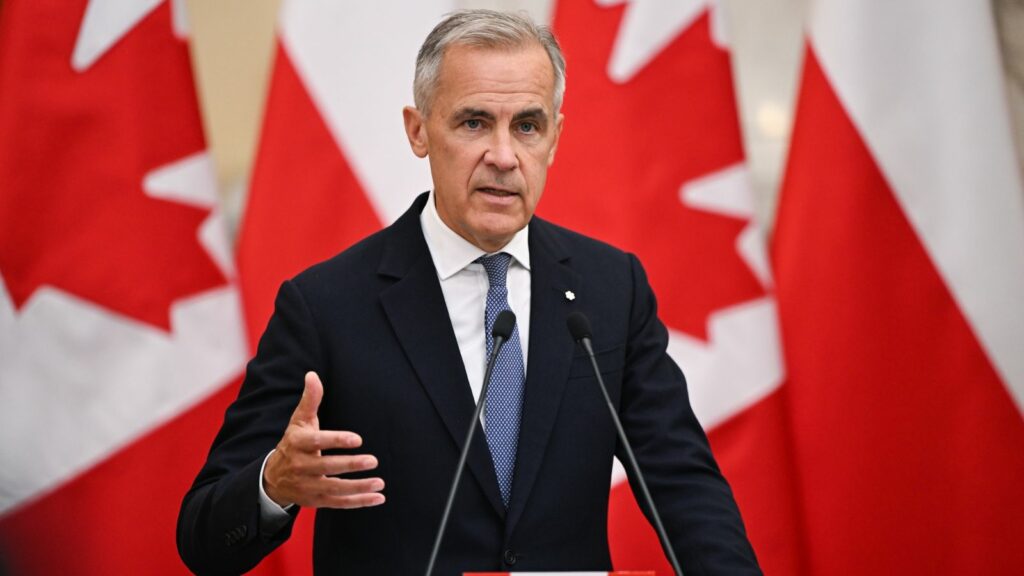
Canadians appear more interested in seeing economic decisions made than returning to the ballot box. A new national survey finds that 73% of respondents want Prime Minister Mark Carney to proceed with major economic reforms without calling another federal election, even as his government proposes significant changes to infrastructure approvals, environmental reviews and labour relations.
The findings, released October 17, 2026, arrive amid continued trade tensions with the United States, weakening employment figures and growing pressure on Ottawa to demonstrate results.
But the numbers contain an important distinction. Wanting the government to act without another election does not necessarily mean approving every reform it proposes. With Carney already holding a narrow parliamentary majority, the debate is increasingly about how quickly Canada should change—and which safeguards must remain in place.
Nearly Three-Quarters Prefer Action Over Another Election
The Canada Pulse Insights survey, conducted among 1,531 Canadian adults between October 1 and 8, found that 73% preferred Carney to advance his economic agenda without asking voters for another mandate. The remaining respondents, roughly one-quarter, favoured an election because they considered the proposed changes substantial enough to require renewed public approval. The poll was published by CityNews on October 17, giving Ottawa a fresh measure of public sentiment as Parliament prepares to return from its Thanksgiving constituency break.
Pollster John Wright, chief executive of Canada Pulse Insights, interpreted the finding as evidence of limited public interest in another federal campaign. The economic measures described in the reporting include faster infrastructure development, changes to environmental reviews, adjustments to labour strike rules and deeper European trade relations. Importantly, the 73% figure measures the preference for proceeding without an election. It should not be read as proof that 73% separately endorse every policy, particularly those involving environmental oversight or workers’ rights.
Support Extends Across Every Region, Including Alberta
One of the most striking findings is how widely the preference for avoiding an election extends across Canada. British Columbia recorded the highest support at 83%, followed by Quebec at 77%, Atlantic Canada at 73% and Ontario at 71%. Support was somewhat lower in Saskatchewan and Manitoba, measured together at 67%, and Alberta at 65%. Even in the lowest-supporting region, almost two-thirds of respondents preferred letting Carney proceed without seeking a fresh mandate.
The 18-percentage-point difference between British Columbia and Alberta illustrates that the appetite for action is not equally strong everywhere. Regional economic interests, party loyalties and views about federal authority can all influence how voters evaluate Ottawa. In Alberta, for example, the same survey found the Conservatives leading Liberal voting intentions, yet most respondents still opposed another immediate federal election. That is an important distinction: citizens can disagree with the governing party while believing that changing governments through another election is not presently necessary. Regional samples are also smaller than the national sample, making precise comparisons less certain.
Conservative Voters Are Divided on Calling an Election
The sharpest partisan disagreement appears among Conservative supporters. According to the survey, 53% of Conservative voters believed Carney should call an election, while 47% preferred that he proceed with his economic plans. That six-point division means the opposition’s supporters were far from unanimous on the question. Nearly half were prepared to let a Liberal prime minister continue with substantial economic changes without asking Canadians to return to the polls.
This should not be mistaken for a sudden wave of Conservative support for Liberal policies. A person might oppose Carney’s approach to government spending, energy or labour relations while still wanting Parliament to complete its work. Others may believe the proposed changes depart sufficiently from what was presented during the 2025 campaign to justify a new vote. Both positions are consistent with the survey’s results. For Conservative Leader Pierre Poilievre, the figures demonstrate a political challenge: criticizing government decisions remains possible, but demanding another national election may not be equally attractive to all potential Conservative voters.
Liberals Lead Conservatives by 12 Points in a Hypothetical Election
The poll also asked how Canadians would vote if another federal election were held. Among decided voters, the Liberals led with 46%, compared with 34% for the Conservatives. The New Democratic Party received 9%, the Bloc Québécois 6% and the Green Party 3%. Approximately one in ten eligible voters remained undecided. The 12-point Liberal advantage suggests Carney would enter a hypothetical campaign from a favourable position, although national voting intention cannot directly predict individual riding results.
The survey revealed movement between the two major parties as well. Fifteen percent of respondents who said they voted Conservative in the 2025 election now indicated that they would support the Liberals. Only 2% of previous Liberal voters reported an intention to switch allegiance. Those findings point to potentially meaningful differences in voter retention, but they are self-reported intentions rather than actual ballots. They also do not establish that a campaign would produce the same outcome. Candidate choices, local issues and political events could alter those preferences considerably before election day.
Independent Polling Confirms the Lead but Reveals Economic Anxiety
A separate national survey published by Abacus Data on October 14 reinforces the broad electoral picture. Conducted among 3,197 adults between October 2 and 13, it also placed the Liberals at 46% and Conservatives at 34%, with the NDP at 9%. Agreement between two independently conducted surveys strengthens confidence that the Liberals held a substantial national lead during early October. However, Abacus did not measure precisely the same question about whether Carney should seek another election mandate.
Its findings also complicate the impression of overwhelming government satisfaction. Abacus reported federal government approval at 57%, down three points, while 47% believed Canada was moving in the right direction and 42% believed it was on the wrong track. The rising cost of living was identified as a major national issue by 64% of respondents, compared with 40% who identified Donald Trump and his administration. The combination suggests that electoral support and economic confidence can move differently. Canadians may prefer the current government while remaining dissatisfied with their financial circumstances and expecting stronger results.
Fast-Tracking Major Projects Is Central to Carney’s Plan
Infrastructure development is a major part of the economic agenda at issue. Carney’s government established the Major Projects Office to coordinate and accelerate nationally significant investments, including mines, energy infrastructure and transportation corridors. By October 1, Ottawa said 28 initiatives had been referred to the office. One of the most prominent was Pacific Link, the proposed West Coast oil pipeline that the government designated a project of national interest. The project is intended to expand Canadian oil exports to Asian markets and reduce dependence on American buyers.
The proposed pipeline illustrates both the appeal and complexity of moving faster. Ottawa has projected that it could eventually carry an additional one million barrels of oil daily to export markets, but that capacity is a future objective, not existing production. Financing, construction, regulatory conditions and consultations remain important requirements. For workers and businesses, faster infrastructure decisions could create opportunities for construction, equipment purchases and long-term investment. For communities along potential routes, speed must also be balanced against environmental impacts and meaningful participation. The poll does not establish that respondents favour every individual project.
Faster Environmental Reviews Are Already Generating Opposition
Carney’s proposed regulatory changes are taking legislative shape through Bill C-39, the Building Canada Strong Act. Introduced on September 21, the legislation aims to coordinate federal environmental assessments and permits, reduce duplication and establish a one-year period for federal decisions once project proponents submit complete applications and required studies. The government’s approach emphasizes a single coordinated review rather than several disconnected approval processes. Ottawa maintains that environmental standards and its legal obligations to Indigenous Peoples will continue to apply.
Not everyone agrees that the proposed safeguards are sufficient. Environmental Defence, Ecojustice, Équiterre, the David Suzuki Foundation and other organizations have called for more extensive parliamentary scrutiny. Their concern is that concentrating decision-making authority and accelerating reviews could weaken environmental accountability if important impacts are not adequately examined. The organizations have requested specialized committee examination rather than relying solely on a special legislative committee reviewing the broader bill. This debate demonstrates why the 73% poll result requires careful interpretation. Canadians may want investment decisions made promptly without agreeing on how environmental laws should change.
Changes to Strike Rules Have Become a Major Labour Dispute
Labour relations represent another significant part of the proposed economic overhaul. Bill C-39 would introduce earlier bargaining assistance, expand mediation options and clarify when Ottawa could intervene in exceptional labour disputes affecting the national interest. According to the government’s background materials, approximately 95% of disputes in federally regulated sectors are resolved without work stoppages through the existing mediation and conciliation framework. The government argues that additional tools could help prevent the remaining disputes from disrupting transportation, supply chains and essential economic activity.
Several unions are considerably less enthusiastic. Teamsters Canada has warned that the legislation’s treatment of Section 107 of the Canada Labour Code could make government intervention more predictable and weaken employers’ incentives to bargain. The National Union of Public and General Employees has raised similar concerns about the right to strike. Ottawa maintains that the proposal recognizes that right and requires additional procedures, including special mediation, before extraordinary intervention. The competing arguments underscore an unresolved question: whether reducing economic disruption can be achieved without undermining collective bargaining. The national poll did not separately measure support for those specific provisions.
Closer European Trade Ties Offer a Way Beyond U.S. Dependence
Canada’s relationship with Europe is another element of Carney’s economic strategy. The country already trades with the European Union under the Comprehensive Economic and Trade Agreement, provisionally applied since September 2017. The agreement initially eliminated tariffs on approximately 98% of tariff lines, creating broader access for manufacturers, agricultural producers and service providers. European Council figures show that bilateral goods and services trade exceeded €130 billion in 2025, making Europe an established commercial partner rather than an entirely new market.
The federal government wants to take that relationship further as U.S. trade restrictions complicate Canada’s traditional export model. During a September 16 meeting, Carney and European Commission President Ursula von der Leyen discussed deeper cooperation involving critical minerals, defence production, artificial intelligence, energy security and digital trade. Ottawa’s wider objective is to double non-U.S. exports over the next decade. Achieving that goal requires businesses to develop customers, supply chains and transportation connections, none of which can be created by a political announcement alone. Stronger European ties may reduce future vulnerability, but they cannot instantly replace the U.S. market.
Carney Already Holds a Parliamentary Majority
Another federal election is not a legal prerequisite for the government to introduce significant economic legislation. Canadians last voted in a general election on April 28, 2025, when the Liberals won 169 seats and formed a minority government. Subsequent parliamentary defections and by-election victories changed the balance. In April 2026, the Liberals secured a majority with 174 seats. By October 17, they held 173 of the House of Commons’ 343 seats, still above the 172-seat majority threshold, although the Liberal Speaker normally votes only to break ties.
The government must nevertheless navigate parliamentary procedures, and individual proposals remain open to amendments and opposition. On October 8, Bill C-39 passed second reading by 296 votes to 26, with Conservative MPs joining Liberal MPs in supporting its referral to committee. Bloc Québécois, NDP and Green MPs voted against it. That division illustrates an important political reality: parties can support further consideration of a bill without approving all its provisions. The measure has not yet become law, and committee scrutiny remains part of the process. Public opinion cannot replace those parliamentary obligations.
Jobs, Prices and Delivery Will Determine Whether Support Lasts
Carney’s strongest challenge may be translating political patience into visible economic improvements. Statistics Canada’s September Labour Force Survey recorded a decline of approximately 68,000 jobs, following another drop in August. The unemployment rate increased to 6.5%, while employment among workers aged 15 to 24 fell by 48,000. Manufacturing also recorded job losses. Those figures illustrate why promises about future projects and export markets matter to households concerned about employment opportunities today.
Affordability adds another test. Canada’s Consumer Price Index increased 3.0% year over year in August, while transportation prices rose 7.5%. September inflation figures are scheduled for release on October 19, providing another indicator of pressure on household budgets. Even where economic reforms could support long-term investment, their benefits may take years to reach workers and consumers. The 73% finding suggests considerable tolerance for moving ahead without another campaign, but it is not a permanent endorsement. Carney’s government will ultimately be judged on whether faster approvals produce completed projects, whether trade diversification generates business, and whether households experience a more secure economy.
