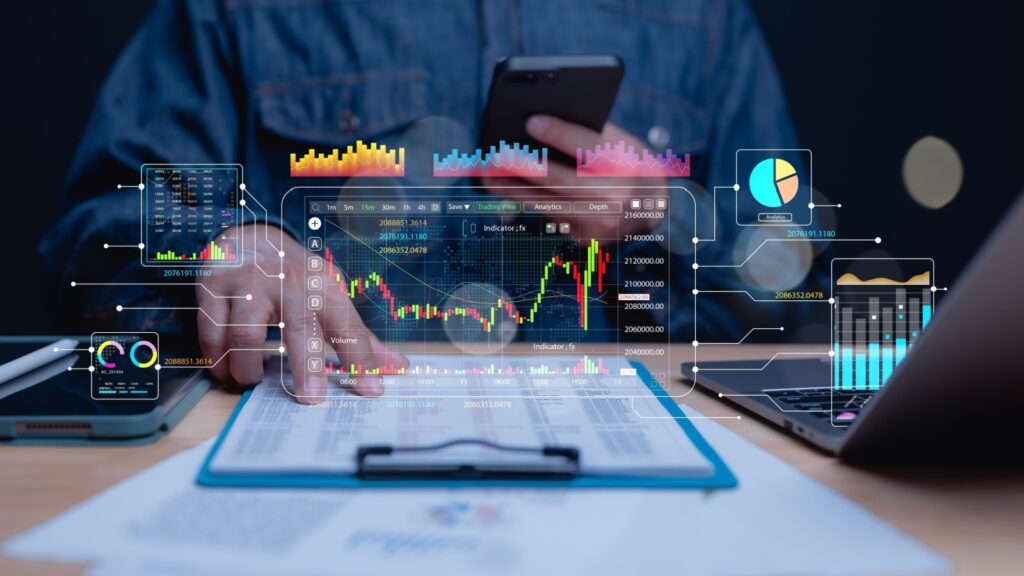
AI trading is entering a new phase. For years, advanced market automation mostly lived behind institutional walls, handled by quant desks and specialized firms with deeper tools and faster systems. Now that same idea is moving closer to everyday investors, powered by better language models, quicker data processing, and platforms that can translate plain-English prompts into real market actions.
What makes AI trading harder to ignore is not just speed. It is the way modern tools are starting to connect research, signal detection, risk checks, and execution in one flow. That changes how markets are watched and how decisions get made. It also raises a more important question: when software gets better at reading the market, what still belongs in human hands?
AI Trading Is Moving Closer to the Front End
For a long time, automation in markets was mostly invisible. It helped route orders, scan prices, and optimize back-end processes, but it rarely felt personal. That is changing fast. AI is now showing up where investors actually spend time: market summaries, screeners, alerts, watchlists, trade setup tools, and conditional workflows that react when certain events happen.
On a busy inflation morning, for example, the difference is easy to picture. Instead of bouncing between headlines, charts, and brokerage tabs, a trader can increasingly rely on software to summarize the news, flag exposed positions, and surface a few possible responses. The promise is not perfect prediction. The real value is faster organization, cleaner context, and fewer missed signals.
Public.com Is Pushing the Retail Version Forward
Public.com looks like one of the retail platforms taking AI trading more seriously than most. It has gone beyond using AI as a simple research tool and is building it into things like market briefings, AI-generated investing products, and agents that let users describe strategies in normal language and automate parts of the process.
What makes that interesting is that it feels less like an extra feature and more like part of the platform itself. Public.com seems to be tying research, decision-making, and execution more closely together, while still keeping users in control. Agents have to be approved before they go live, and they can be edited, paused, or stopped later. That makes the product feel more grounded than a lot of the early AI investing tools that still come across as experiments.
The Real Edge May Be Workflow Compression
The next wave of AI trading may feel smarter largely because it compresses the work around a trade. A tool that can read the market, summarize the day’s biggest catalysts, compare them against a portfolio, and then tee up a response is reducing friction at every step. In fast markets, that kind of compression can feel almost as powerful as a better forecast.
This is why the strongest use cases may not be the flashiest ones. Daily briefings, hedging triggers, exposure monitoring, options checks, and rule-based execution are not glamorous. But they are the kinds of tasks that wear people down when done manually. AI trading becomes more useful when it removes repetition and sharpens discipline, not when it pretends to be a crystal ball.
Smarter Systems Still Need Human Boundaries
The biggest mistake in AI trading may be assuming that speed equals judgment. It does not. A bad model, weak inputs, or a confident-sounding summary can still lead to poor decisions, only faster. Regulators have already made clear that AI does not erase responsibility, and investor alerts increasingly warn that AI-generated investment information can sound authoritative while still being wrong or misleading.
That is why the next winners in this space may not be the platforms with the loudest demos, but the ones with the clearest controls. Audit trails, human approval, pause buttons, risk limits, and transparent prompts may sound less exciting than automation itself, but they are what separate useful AI investing tools from expensive overconfidence.
Why This Wave Will Be Harder to Ignore
AI trading is becoming harder to ignore because it is moving from novelty to habit. Once investors get used to instant market briefings, plain-language strategy building, and automated alerts that actually fit how markets move, older interfaces start to feel fragmented. What once looked futuristic begins to feel like basic infrastructure.
Human judgment is not disappearing. It is moving up a level. The next job is less about manually chasing every headline and more about deciding which rules deserve trust, which systems deserve capital, and when no trade is the smartest trade of all. That is why this next wave feels different: it is not just faster technology, but a more natural way of interacting with the market.
