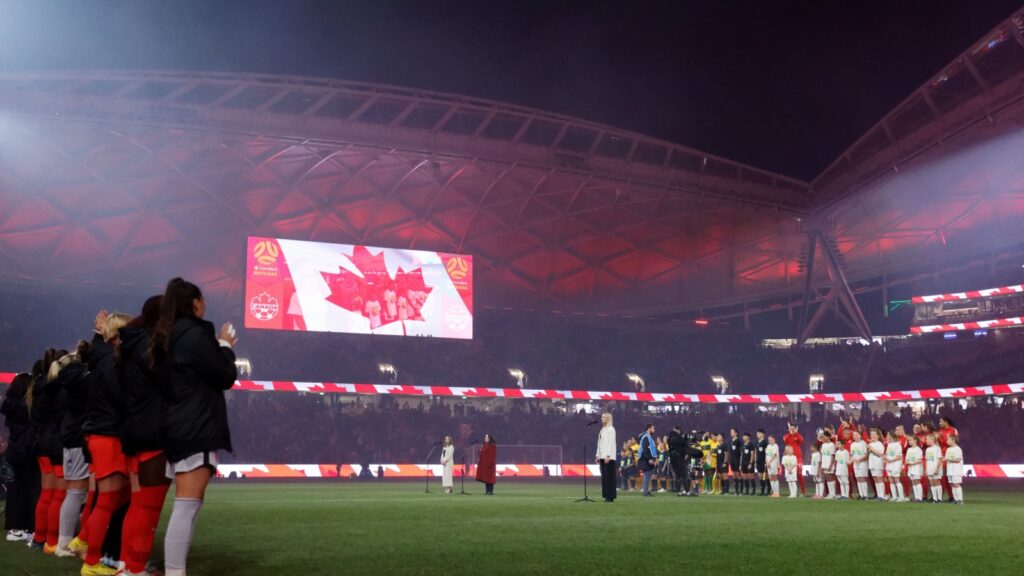
Canada’s first trip beyond the group stage at a men’s World Cup will begin against an opponent making the same historic leap. After finishing second in Group B, Canada will meet South Africa, the runner-up in Group A, on Sunday, June 28, at SoFi Stadium in Inglewood, California.
The matchup brings together two teams that collected four points from three group games but arrived there in very different ways. Canada mixed a record-breaking victory with a costly defeat, while South Africa recovered from a turbulent opener to qualify on the final night. One country will reach the Round of 16 for the first time; the other will see a landmark campaign end in Los Angeles.
A Historic Matchup in Los Angeles
Canada and South Africa will meet at noon Pacific time, or 3 p.m. Eastern, in the first Round of 32 match for either men’s national team. The setting will be SoFi Stadium in Inglewood, the venue FIFA refers to as Los Angeles Stadium during the tournament. Canadian viewers can watch on CTV, TSN and RDS. Unlike the group stage, there is no safety net: a tied score after 90 minutes would lead to extra time and, if necessary, a penalty shootout.
The pairing is also unusual because the countries have rarely crossed paths. Their senior men’s teams have met only once, with South Africa winning a 2007 friendly 2-0. Nearly two decades later, the stakes are dramatically higher. The expanded 48-team format created a new Round of 32, but qualification still required both teams to finish among the top two in their groups. Canada and South Africa each went 1-1-1, making this less a meeting between a favourite and an outsider than a contest between two emerging sides facing unfamiliar pressure.
Canada’s Uneven but Historic Group-Stage Run
Canada’s group stage produced three national milestones in less than two weeks. A 1-1 draw with Bosnia and Herzegovina delivered the country’s first point at a men’s World Cup, with substitute Cyle Larin equalizing in the 78th minute. Six days later, Canada overwhelmed Qatar 6-0 in Vancouver for its first World Cup victory. Jonathan David scored a hat trick, while Larin and Nathan Saliba also found the net and an own goal completed the rout.
That performance placed Canada in position to win Group B, but the final match exposed how quickly momentum can turn. Switzerland scored twice early in the second half and held on for a 2-1 victory, despite Promise David giving Canada hope with a late goal. Canada finished second with four points, eight goals scored and three conceded. The numbers are still historic, yet the Swiss loss carried a practical cost: instead of remaining in Vancouver for a July 2 knockout game, the team must travel to California and play four days later. The challenge now is to preserve the confidence created by the Qatar win without ignoring the warning delivered by Switzerland.
South Africa Earned Its Place the Hard Way
South Africa’s route was defined by recovery. Bafana Bafana opened the tournament with a 2-0 loss to Mexico in Mexico City, a match in which Sphephelo Sithole and Themba Zwane were sent off. The response came against Czechia in Atlanta. After conceding in the sixth minute, South Africa equalized through a Teboho Mokoena penalty and held on for a 1-1 draw that kept its campaign alive heading into the final group game.
A victory over South Korea was then required to guarantee progress, and South Africa delivered under pressure. Thapelo Maseko scored in the 63rd minute in Monterrey, while a disciplined defensive performance protected the 1-0 lead through the closing stages. The result lifted South Africa to four points and second place behind Mexico, ahead of South Korea and Czechia. Across three matches, the team scored only twice, but both goals directly earned points. That efficiency matters in knockout football, where one well-timed run or set-piece delivery can outweigh long stretches of possession. South Africa did not advance through spectacle; it advanced by surviving setbacks and making decisive moments count.
Two Nations Carrying Different World Cup Memories
For Canada, the breakthrough comes in its third men’s World Cup appearance. The 1986 team lost all three matches in Mexico without scoring. Canada returned 36 years later in Qatar, where Alphonso Davies scored the nation’s first World Cup goal, but defeats to Belgium, Croatia and Morocco again ended the campaign in the group stage. The 2026 team has now added a first point, a first victory and a first knockout berth within a single tournament.
South Africa is appearing at the World Cup for the fourth time. Its previous teams competed in 1998, 2002 and 2010, exiting in the group stage on each occasion. The 2010 side became the first host nation eliminated before the knockouts, although it ended with a memorable 2-1 victory over France. The current team has finally moved the country beyond that ceiling, 28 years after its tournament debut. That shared history gives Sunday’s match a rare emotional balance. Neither side is defending an old legacy of deep World Cup runs; both are trying to create one, and players from both squads know the result will become a reference point for the next generation.
Canada’s Biggest Question Is How It Responds
Jesse Marsch’s team has shown two different attacking faces. Against Qatar, Canada pressed aggressively, moved the ball quickly and punished mistakes with six goals. Against Switzerland, it struggled to create clear chances until falling two goals behind. Marsch said afterward that the players became hesitant in an important moment and must learn to remain assertive against strong opposition. South Africa’s compact shape will test whether Canada can create openings patiently without becoming predictable or vulnerable to counterattacks.
Personnel makes that task more complicated. Midfielder Ismaël Koné suffered a broken leg against Qatar and is out for the tournament. Stephen Eustáquio missed the Switzerland match with muscle tightness, while captain Alphonso Davies had not been fit enough to appear through the group stage. Jonathan David remains the central attacking figure after his hat trick, but the contributions of Larin, Promise David and Saliba have shown that Canada cannot rely on one scorer. A moving tribute to Koné at BC Place, where supporters displayed his No. 8 and applauded him as he appeared in a wheelchair, also revealed the emotional weight the squad is carrying into the knockout round.
South Africa’s Discipline and Counterattack Pose a Real Threat
South Africa’s strength is not built around dominating the ball. Under veteran coach Hugo Broos, the team has repeatedly shown that it can stay compact, absorb pressure and attack quickly when space appears. That approach was clearest against South Korea, which had more possession but could not break through. Maseko’s winning goal came from South Africa taking advantage of one of its most important attacking moments, while captain and goalkeeper Ronwen Williams helped manage the final stages.
Canada will also have to account for midfielder Teboho Mokoena, whose penalty rescued the draw against Czechia, and forward Lyle Foster, the squad’s leading central striker. South Africa will be without experienced attacker Themba Zwane, whose red card against Mexico resulted in a three-match suspension that extends through the Round of 32. Even with that absence, the team’s domestic core offers familiarity: most of the squad plays in South Africa, with major contributions from players connected to Mamelodi Sundowns and Orlando Pirates. The danger for Canada is clear. Pushing too many players forward could create exactly the transition opportunities South Africa prefers.
The Four-Day Turnaround Changes the Preparation
Canada’s defeat to Switzerland did more than alter the opponent. It compressed the schedule and removed home advantage. The team played in Vancouver on June 24 and now has to recover, travel to Southern California and prepare for a noon local kickoff on June 28. South Africa faces a similar turnaround after completing its group stage in Monterrey. With so little time, training is likely to focus less on fitness and more on recovery, video work, set pieces and a limited number of tactical adjustments.
The move from a packed Canadian venue to a neutral stadium also changes the atmosphere. Canada benefited from enormous crowds in Toronto and Vancouver, including more than 52,000 spectators for the Qatar match. The neutral venue is likely to produce a more mixed crowd, while South African supporters will be celebrating their country’s first knockout appearance. Early control may therefore matter as much emotionally as tactically. A fast Canadian start could settle nerves and draw the crowd in; an early South African goal could make the match feel increasingly tense. In a short-turnaround knockout game, composure may be the most valuable form of freshness.
The Stakes Extend Beyond One Result
The winner will advance to a Round of 16 match in Houston on July 4. Under FIFA’s bracket, the Canada–South Africa survivor will face the winner of Match 75, which pairs the Group F winner with Morocco, the runner-up from Group C. The losing team will be eliminated immediately. That structure means Sunday’s game is not simply a reward for escaping the group stage; it is a direct path into the final 16 of the largest World Cup ever held.
For Canada, victory would deepen the impact of a home tournament even though the match itself is being played outside the country. For South Africa, it would extend a revival under Broos, who returned the team to the World Cup after a 16-year absence and is set to retire from coaching after the tournament. The broader significance is easy to see in both countries: young supporters are watching their national teams enter territory that previous generations never reached. Only one side will continue, but the matchup already guarantees a new name in the Round of 16 and a defining chapter in either Canadian or South African soccer history.
