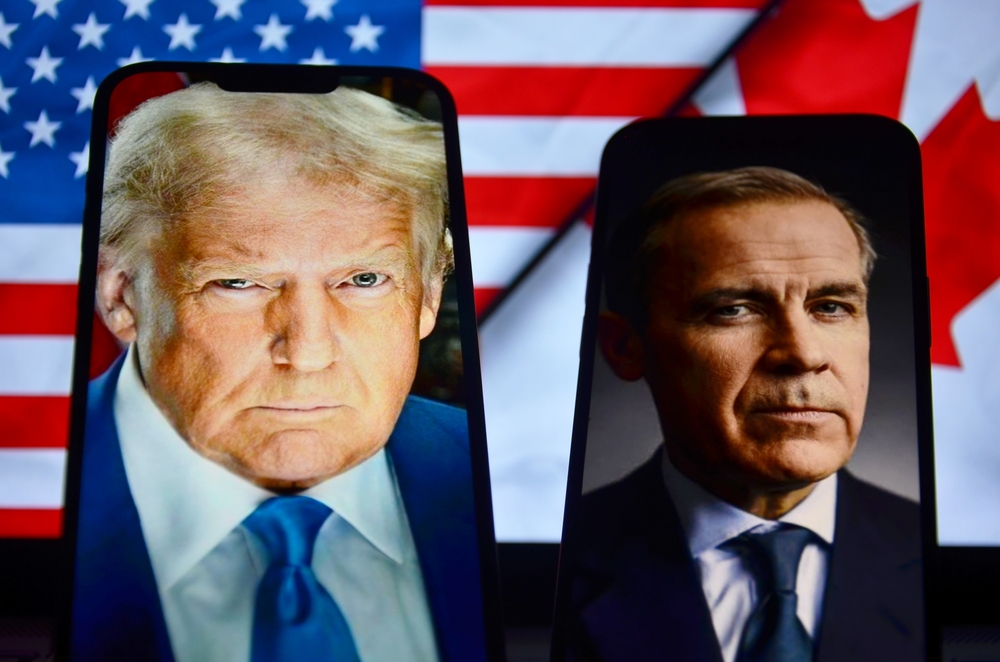
Something unusual has happened in one of the world’s closest economic relationships: public anger has become part of the trade equation.
Canada and the United States entered August seemingly close to an agreement that could have eased some of the tariffs disrupting cross-border commerce. Instead, negotiations collapsed, Washington imposed 50% tariffs on roughly $20 billion worth of Canadian goods, and Ottawa prepared dollar-for-dollar retaliation. Behind the disputes over automobiles, metals, dairy, alcohol and Canadian cultural rules sits a broader problem. Canadian attitudes toward the United States have hardened dramatically, making concessions to Washington increasingly difficult for any Canadian government to defend at home. Even as Washington softened one contentious position on August 27, the two governments remained without an open negotiating channel.
The Political Constraint Is Now as Important as the Tariff Math
Robert Lighthizer knows how difficult Canada-U.S. trade negotiations can become. He served as U.S. trade representative during Donald Trump’s first administration and was one of the central figures in the bitter renegotiation of NAFTA that eventually produced the United States-Mexico-Canada Agreement. His successor in Trump’s current administration, Jamieson Greer, also worked closely with Lighthizer during that period. Those earlier negotiations featured threats, tariffs and public disagreements, yet the political environment ultimately allowed all three governments to accept compromises and declare victory.
That environment looks considerably different in 2026. Canadian leaders are no longer calculating only whether a proposal makes economic sense. They must also determine whether accepting it will be interpreted domestically as surrendering to Washington. That distinction matters because almost every concession now carries a political meaning beyond trade. A change to an auto quota can become a test of sovereignty. A compromise involving Canadian cultural policy can become a dispute over national identity. Even a commercially rational bargain can become politically toxic if voters believe the United States obtained it through threats.
Canadian Opinion Has Hardened Well Beyond Normal Trade Friction
Recent polling shows just how little room Ottawa has to make another conciliatory move. An August Leger poll found 56% of Canadians wanted the federal government to take a hard line in negotiations and make no further concessions. Only 31% favoured greater flexibility if it was necessary to secure an agreement. The appetite for retaliation was even stronger: 74% supported a special tax on electricity exports to the United States, while 70% backed restrictions on American-owned companies bidding on Canadian government contracts and the same proportion supported taxes on Canadian oil and natural gas exports.
Other measures point to a broader deterioration in the relationship. Earlier in 2026, a Nanos poll found 55% of Canadians considered the United States the country posing the greatest security threat to Canada, far ahead of China or Russia. Pew Research has also found an extraordinary reversal in perceptions: Canadians now view China more favourably than the United States, something that would have appeared almost unimaginable during much of the postwar era. That does not mean Canadians universally dislike Americans themselves. It does demonstrate how deeply confidence in Washington has eroded.
The Breakdown Had Concrete Economic Causes
Public sentiment did not single-handedly destroy the negotiations. There were serious disagreements involving billions of dollars and some of North America’s most politically sensitive industries. Before talks collapsed, negotiators had reportedly discussed reducing the U.S. tariff on Canadian automobiles and light trucks from 25% to 15%, while cutting tariffs on steel and aluminum from 50% to 25%. Canada was also under pressure over market access for American products, including alcohol and dairy. Disagreements persisted over medium- and heavy-duty trucks and other sector-specific measures.
The two governments have offered sharply different accounts of what happened next. Prime Minister Mark Carney said Washington introduced unacceptable last-minute conditions and questioned whether an agreement could be relied upon. U.S. officials have countered that Canada changed its own positions and walked away from a favourable package. That dispute is important because it shows why deteriorating public trust matters. When each new negotiating demand is interpreted through years of tariffs, threats and political confrontation, ordinary bargaining becomes harder. Neither government wants to appear to reward what its supporters consider bad-faith behaviour.
The Two Economies Are Still Too Connected to Ignore Each Other
For all the political hostility, geography has not changed. U.S. government figures put total U.S.-Canada trade in goods and services at approximately $872.3 billion in 2025. American goods exports to Canada reached about $333.6 billion while goods imports from Canada totalled roughly $381.9 billion. Canada has successfully started diversifying some trade, but the United States still purchased more than 70% of Canadian merchandise exports in 2025. Few major economies remain as dependent on a single foreign market.
Dependence also runs north to south. Canada supplies enormous quantities of crude oil to American refineries and is a critical source of imported aluminum, potash and electricity. The U.S. Chamber of Commerce estimates that roughly 13 million American jobs depend on trade supported by USMCA. Nowhere is that integration more visible than the auto industry. A component produced in Ontario can cross the border, enter a vehicle assembled in Michigan and move through several stages of the continental supply chain before a finished vehicle reaches a dealership. A tariff imposed at the border therefore does not neatly punish only the other country.
The Boycott Has Moved From Political Rhetoric Into Everyday Behaviour
Perhaps the clearest evidence that the dispute has reached beyond politicians is found at the border itself. Statistics Canada reported that Canadian-resident return trips from the United States dropped 25.4% in 2025 compared with 2024, the deepest sustained non-pandemic decline in the agency’s historical series. Canadian leisure travel to the United States dropped by millions of visits, while spending by Canadian travellers in the U.S. fell approximately $3.3 billion to $18.8 billion.
There have recently been signs of a modest recovery, but the comparison needs context. Canadian return trips from the United States increased year-over-year in July 2026 because they were being compared with an already depressed 2025 period. Compared with July 2024, Canadian automobile returns from the U.S. were still down 28.9% and air returns were 26.8% lower. The same shift has been visible in “Buy Canadian” campaigns and provincial restrictions on American alcohol. These are unusually tangible expressions of political frustration. Consumer behaviour is effectively reinforcing the message voters are sending to Ottawa: returning to business as usual with Washington is not yet politically easy.
Carney Has Political Incentives to Resist — but the Clock Is Running
For Prime Minister Carney, standing up to Washington currently carries less political risk than appearing to concede. Reuters has reported that his decision to break off negotiations has support from much of the Canadian public, while provincial leaders who favour aggressive countermeasures have found receptive audiences. The Leger numbers help explain why. When a majority believes Canada has already conceded enough, accepting an agreement containing visibly one-sided terms could create an immediate political backlash.
The danger is that this advantage may not last indefinitely. Trade wars produce economic costs that can eventually overwhelm national solidarity. Canadian exporters are already confronting new duties, while industries such as steel, aluminum and automobiles face especially significant uncertainty. Reuters has reported estimates suggesting a prolonged escalation could put tens of thousands of Canadian jobs at risk. Factory closures, weaker investment or rising unemployment would change the political calculation quickly. Carney therefore faces an awkward deadline: he must demonstrate that Canada will not be pressured into an unacceptable agreement while still finding a path back to negotiations before economic damage becomes substantially worse.
French Language and Canadian Culture Became Trade Red Lines
One of the most revealing disputes had little to do with traditional tariffs. Canada said late-stage U.S. demands raised concerns about policies involving the discoverability of Canadian content on streaming platforms, bilingual labelling and protections for French language and culture. For Ottawa, particularly when Quebec is involved, these are not simply technical trade regulations. They touch questions of identity and sovereignty that Canadian governments have defended through multiple generations of trade negotiations.
There was an important sign of movement on August 27. Canada-U.S. Trade Minister Dominic LeBlanc said Washington was withdrawing its positions on discoverability and labelling and had confirmed that measures promoting French and Canadian culture would not become targets of future U.S. trade actions. LeBlanc welcomed the change and said additional constructive clarifications could create the possibility of a mutually beneficial agreement. It is arguably the clearest opening since talks collapsed. Yet the breakthrough remains limited: Reuters reported the same day that there was still no open communication channel between the Trump administration and the Canadian government. The political thaw has started before the formal negotiations have.
A Deal Is Still Possible, but Trust Has Become Part of the Price
There are strong reasons for both governments to eventually find an off-ramp. Canada’s retaliatory tariffs are scheduled to take effect September 8, while Trump has threatened much larger tariffs on Canadian vehicles and auto parts beginning January 1, 2027. Neither country benefits from allowing those measures to spread through deeply integrated supply chains. Trade specialists cited by the Associated Press have argued that a compromise remains possible, potentially with the help of trusted intermediaries who can reopen political communication away from the public confrontation.
But the next agreement will have to accomplish something the original USMCA negotiations did not face to the same degree: rebuilding confidence that the bargain will last. Canadian anger toward Washington is not the only reason a deal has proved elusive. Disagreements over tariffs, autos, market access, cultural rules and national sovereignty are all real. Public hostility nevertheless raises the political price of every compromise. Ottawa needs an agreement it can describe as protecting Canadian independence rather than rewarding American pressure. Washington needs enough concessions to call the outcome a victory. Until both conditions can coexist, even an economically sensible deal may remain politically out of reach.
