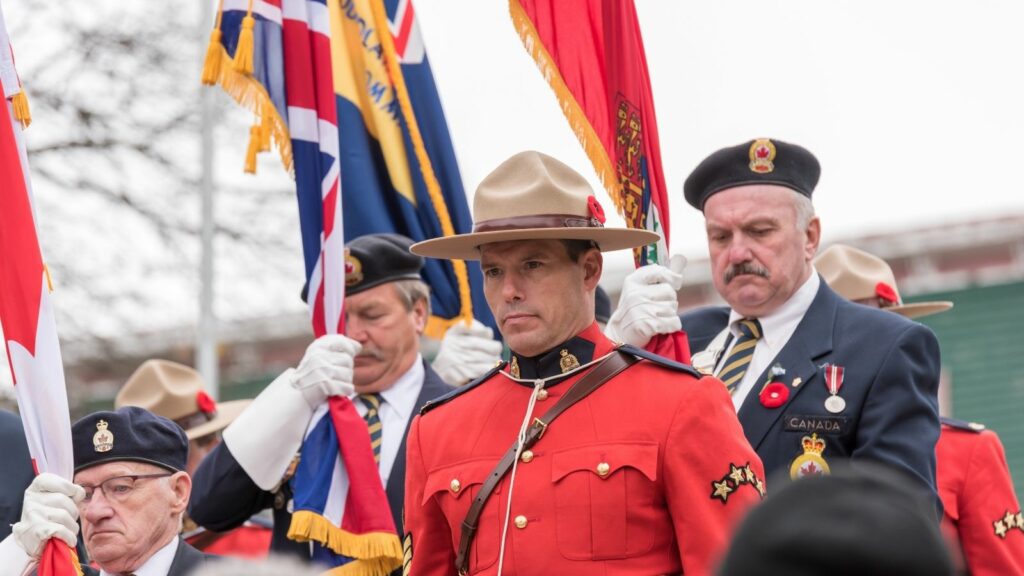
Canadians appear increasingly comfortable with the leadership and internal workings of the RCMP, but that confidence does not translate neatly into a belief that policing is equally fair for everyone. New national polling finds 70% of Canadians express confidence in RCMP operations and leadership, an improvement from three years earlier. Yet only 54% believe police officers in their own communities treat every person fairly.
That 16-point gap captures an important distinction. Canadians can believe a national institution is competently managed while remaining uncertain about what happens during individual encounters on the street. Regional and demographic differences make that divide even sharper, especially among Indigenous respondents. The numbers offer encouragement for the RCMP, but they also show why rebuilding trust involves more than improving an organization’s overall reputation.
Confidence in RCMP Leadership Has Strengthened
Research Co. found that 70% of Canadian adults have confidence in the internal operations and leadership of the RCMP, six percentage points higher than when the firm asked a comparable question in June 2023. The result puts the national police service slightly ahead of several other major justice institutions measured at the same time. Confidence stood at 66% for respondents’ municipal police forces and 65% for the Supreme Court of Canada, while provincial criminal courts received a lower rating of 57%. That makes the RCMP result notable at a time when confidence in public institutions is frequently contested.
The finding comes from an online poll of 1,002 Canadian adults conducted between August 17 and August 19, 2026. Results were weighted to reflect census distributions for age, gender and region, with a reported margin of error of plus or minus 3.1 percentage points, 19 times out of 20. The improvement since 2023 therefore appears substantial enough to warrant attention, although polling measures perception rather than operational performance. Public confidence can respond to leadership, visibility, communication, major investigations and personal experiences in very different ways.
Fair Treatment Remains the Weakest Measure
When Canadians were asked about police officers operating in their own communities, the strongest ratings involved accessibility and basic service. Seventy per cent described officers as approachable. Sixty-six per cent said officers respond promptly to calls, and the same proportion said officers can be trusted. A smaller 58% regarded local police as a source of pride. At the bottom of the five measures was fairness: just 54% said officers treat every person fairly, although that figure was four points higher than in the comparable 2023 poll.
Those results help explain why high confidence in RCMP leadership can coexist with more guarded views about policing on the ground. An institution can be seen as professionally run while residents still question whether individual treatment is consistent across neighbourhoods and groups. Fairness also demands something different from response speed or approachability. A person may consider an officer polite and efficient while still wondering whether another person, under different circumstances, would receive the same treatment. That makes perceptions of fairness an especially demanding test of police legitimacy.
Geography Changes the Picture Considerably
Confidence in RCMP leadership varies meaningfully across Canada. Research Co. recorded the highest result in Saskatchewan and Manitoba, grouped together at 76%. British Columbia and Ontario were both at 72%, followed by Alberta at 69% and Quebec at 68%. Atlantic Canada stood apart at 56%. Regional changes since the firm’s 2023 polling were also uneven, including a 19-point increase in Saskatchewan and Manitoba and a nine-point increase in British Columbia, while Atlantic Canada’s rating moved four points lower.
Regional differences become even more striking when the question switches from leadership to fair treatment. Only 46% of respondents in Alberta and 46% in Atlantic Canada said officers in their communities treat every person fairly. The figure was 53% in British Columbia, 54% in Saskatchewan and Manitoba, 56% in Quebec and 57% in Ontario. Alberta therefore presents an especially interesting contrast: confidence in RCMP leadership remains relatively strong at 69%, while fewer than half say local police treat everybody fairly. The two measures clearly capture different dimensions of public sentiment.
The Indigenous Fairness Gap Is Much Larger
The most consequential divide in the polling emerges when respondents are examined by heritage. Only 38% of Canadians of Indigenous descent said police officers operating in their communities treat every person fairly. By comparison, Research Co. reported agreement among 53% of Canadians of European heritage, 57% of East Asian heritage and 58% of South Asian heritage. Subgroup results should be interpreted carefully because individual groups contain fewer respondents than the full 1,002-person sample, but the scale of the Indigenous gap fits a longer-running pattern found in federal research.
Statistics Canada has previously documented substantially weaker police confidence among Indigenous Canadians. Data from the 2022 Canadian Social Survey showed 48% of Indigenous respondents reporting a good or great deal of confidence in police, compared with 63% among non-Indigenous people. Earlier federal work using the 2020 General Social Survey likewise found Indigenous people were more likely than non-Indigenous, non-racialized respondents to report little or no confidence in police. Those datasets use different questions and methodologies from Research Co., so their percentages should not be treated as direct trend lines. Together, however, they underline how consistently Indigenous experiences stand apart.
National Trust Can Hide Different Personal Experiences
Broader Statistics Canada findings reinforce the idea that confidence in police is not evenly distributed. Its Canadian Social Survey data for late 2022 found 62% of Canadians overall reported a good or great deal of confidence in police. The figure was 64% among non-Indigenous, non-racialized people and 58% among racialized groups, falling to 48% among Black respondents and 48% among Indigenous respondents. Immigrants reported higher police confidence than non-immigrants, at 65% versus 61%. These figures predate the new Research Co. polling and measure confidence somewhat differently, but the demographic variation is important.
Earlier Statistics Canada research also found that Indigenous people were more likely to give poor ratings to several elements of police performance, including fair treatment and response to calls. Even after accounting for factors such as recent encounters with police, Indigenous identity remained associated with lower confidence in some federal analyses. For police organizations, that means improving a national approval number cannot be the only benchmark. A 70% leadership rating may demonstrate institutional resilience, while significantly weaker perceptions among particular communities point toward a separate challenge involving everyday encounters, consistency and legitimacy.
Cameras and Race-Based Data Are Part of the Response
The RCMP has been expanding measures intended to increase transparency and provide more evidence about police interactions. Its national body-worn camera deployment began in November 2024, and the force reported that 79% of frontline members were wearing cameras by July 2026. Approximately 10,000 cameras are ultimately expected to be deployed, with national completion targeted for fall 2027. The RCMP is also implementing a race-based data initiative designed to examine outcomes involving Indigenous, Black and other racialized people, including interactions such as arrests, wellness checks and use-of-force incidents.
Those changes matter, but technology by itself cannot guarantee greater confidence. A systematic review of 30 body-camera studies found that cameras appeared to reduce complaints against officers, yet their effects on use of force and many other behaviours were inconsistent. The researchers also found insufficient evidence to conclude that cameras automatically strengthen police-community relationships. That is an important qualification for interpreting the new Canadian numbers. The RCMP’s improving leadership rating is meaningful, but the 54% fairness result suggests the more difficult test will be whether transparency, data collection, policy changes and individual encounters eventually produce confidence that is more evenly shared across communities.
