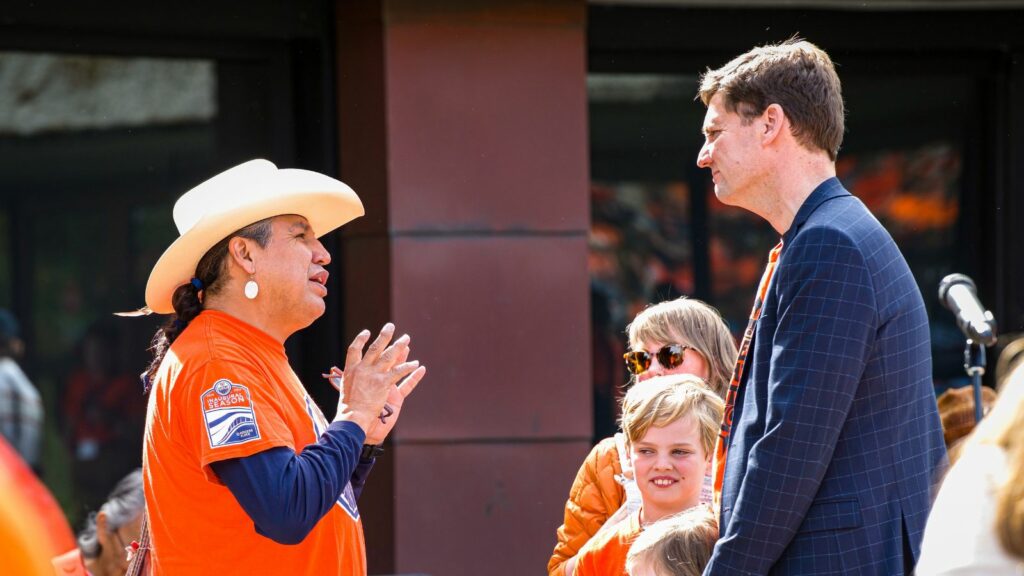
British Columbia’s political map is shifting quickly, but Premier David Eby is drawing a clear boundary around the governing NDP. After nine MLAs left the B.C. Conservative caucus in less than three weeks, Eby said his party would not actively recruit the defectors, arguing that substantial policy and values differences remain. He singled out disagreements over Canada’s relationship with the United States and the Trump administration, while also pointing to First Nations issues and human-rights protections. The declaration comes as Conservative Leader Kerry-Lynne Findlay tries to contain a caucus revolt only months after winning the leadership. It also lands just as five former Conservative MLAs move to form a new provincial party, creating a fresh centre-right force before the legislature returns in October and sharpening the stakes around Findlay’s September 26 Abbotsford-Mission byelection.
Eby Draws a Line Around NDP Membership
Eby’s message was less about closing a door on individual legislators than defining what would be required to enter the NDP caucus. Speaking Thursday, the premier said there was a “fairly significant gap” between his party’s positions and those of the MLAs who recently left the Conservatives. He specifically identified Canada-U.S. relations, the Trump administration, First Nations policy and human-rights protections as areas of disagreement.
That distinction matters because defections can tempt governing parties to expand opportunistically. Eby instead presented caucus membership as a values test rather than a recruitment contest. His comments also insulated the NDP from accusations that it was engineering the Conservative breakdown for partisan gain. Nine MLAs had left Findlay’s caucus in weeks, but Eby’s position was that instability on the opposition benches did not automatically make those legislators natural New Democrats. The government, in his telling, would not treat the turmoil as an open invitation.
Nine Departures Turn Disagreement Into a Caucus Crisis
The scale of the Conservative exodus is difficult to dismiss as routine internal friction. The nine MLAs who left under Findlay are Peter Milobar, Ian Paton, Rosalyn Bird, Teresa Wat, Brennan Day, Bruce Banman, Áʼa:líya Warbus, Donegal Wilson and Scott McInnis. Their departures unfolded rapidly from mid-August into early September, with Wilson and McInnis becoming the eighth and ninth to leave on September 2.
The group is politically diverse, but its members repeatedly cited concerns about Findlay’s leadership, communication, staffing, ideology or electability. Several emphasized that leaving the caucus did not mean abandoning conservative beliefs. McInnis said he remained committed to free enterprise and responsible fiscal management, while Banman argued that a successful party needed a broader political tent. That combination makes the rupture especially consequential: it is not simply a migration from right to left, but a fight over what kind of conservative coalition can compete province-wide going forward.
Trump and Washington Have Become a Political Dividing Line
Eby’s reference to Donald Trump carries weight because cross-border relations have become a defining file for his government. Since Trump’s tariff campaign intensified, British Columbia has restricted purchases from American suppliers, removed certain U.S. liquor products and pushed businesses to diversify into Canadian and overseas markets. In August, Eby also backed a tougher Canadian response to renewed U.S. tariff pressure.
That record helps explain why the premier treated U.S. relations as a meaningful ideological dividing line rather than a secondary dispute. For the NDP, resistance to Trump’s trade tactics has been framed as an economic-sovereignty issue affecting workers, exporters and costs. Eby did not spell out every former Conservative MLA’s personal view of Trump, and the defectors are not a single ideological bloc. His point was broader: the governing caucus has a clear posture toward Washington, and he sees too little alignment with the departing Conservatives to justify recruitment now.
First Nations and Human Rights Reveal Deeper Policy Gaps
The premier also pointed to First Nations policy and human-rights protections, areas where the NDP and B.C. Conservatives have fought in the legislature. British Columbia’s Declaration on the Rights of Indigenous Peoples Act requires the province to work toward aligning laws with the United Nations declaration. Conservative critics, including McInnis while he held the Indigenous-relations portfolio, challenged aspects of the NDP’s approach to land and decision-making.
Human-rights policy has produced another sharp divide. In March, the legislature debated a government motion affirming support for the B.C. Human Rights Code and the tribunal that enforces it. The debate exposed disagreement over protected grounds and the scope of the law, after many Conservative MLAs had earlier supported first reading of a bill seeking to repeal the code. These are not procedural quarrels. They touch legal rights, reconciliation and government’s role, helping explain why Eby described the distance between the camps as substantial.
Amelia Boultbee Shows Eby Is Not Ruling Out Every Former Conservative
Eby’s refusal to court the nine defectors immediately raised an obvious comparison: Amelia Boultbee. The Penticton-Summerland MLA was elected as a Conservative in 2024, left that caucus in October 2025 and joined the NDP on July 3, 2026 after months as an Independent. At the time, Boultbee said she believed Eby’s team was better positioned to address housing, health care and economic uncertainty.
Her move also had a direct Trump dimension. Boultbee criticized what she described as “Donald Trump-style populism” inside the Conservatives and said the party had moved away from the approach she originally supported. Eby cited her case while explaining his current stance, saying the NDP had time to get to know Boultbee and concluded their values aligned. The implication is that a former Conservative label is not an automatic barrier, but neither is abandoning the Conservative caucus enough. Compatibility, in Eby’s telling, must be demonstrated over time.
Findlay’s Narrow Leadership Victory Is Facing an Early Stress Test
The crisis is especially damaging for Findlay because it erupted almost immediately after her leadership victory. Elections BC records confirm the Conservatives selected her on May 30, 2026. Official party results show the contest went to four rounds, with Findlay defeating Caroline Elliott by a narrow margin. CityNews reported the final result as roughly 51 per cent to 49 per cent, leaving little room to assume the party had emerged fully united.
Findlay has responded by saying she intends to lead with determination and humility, while acknowledging that the expanded party has faced challenges and disagreements. She has also insisted the Conservatives’ platform remains intact. Yet the defections have turned internal disagreements into a public test of authority. Several departing MLAs said communication had broken down or the party was narrowing ideologically. For a leader without a provincial seat, rebuilding trust must happen inside caucus, among members and before voters.
Staffing Allegations and RCMP Interest Raise the Stakes
The latest departures added an ethical and organizational layer to what was already an ideological dispute. Donegal Wilson and Scott McInnis left on September 2, both citing concerns about Findlay’s leadership and reported links between senior party appointees and Alberta separatist circles. Their statements framed those links as allegations or reported connections, not established findings, but the issue became another symbol of mistrust inside the caucus.
The same day, Findlay’s chief of staff, Chris Delaney, resigned. Former Conservative MLA Ian Paton has alleged that Delaney offered him an adviser position if he resigned his Delta South seat so Findlay could pursue a byelection. Findlay has denied offering jobs in exchange for resignations and called claims she acted illegally “preposterous.” The RCMP said it was aware of related material, while Paton said police had arranged to interview him. No criminal finding against Findlay has been established, a distinction that remains crucial.
Five Defectors Are Now Building a New Provincial Party
The defections are now producing something more durable than a collection of Independents. On September 4, Rosalyn Bird, Bruce Banman and Áʼa:líya Warbus announced they were joining a new, not-yet-named provincial party being organized by Peter Milobar and Ian Paton. The five MLAs say they intend to sit with official third-party status when the legislature returns on October 5, with Milobar serving as interim leader.
That development changes the strategic landscape around Eby’s refusal to recruit the defectors. Five of the nine now have another political home under construction, allowing them to challenge both the NDP government and their former Conservative caucus. The group says it wants to focus on the economy, health care, affordability, taxation, land rights, resource development and fiscal policy. A leadership vote is expected before the fall sitting. The question is whether Findlay can stop departures and whether B.C.’s centre-right vote is entering lasting fragmentation politically.
Abbotsford-Mission Will Put the Turmoil Before Voters
The immediate electoral test arrives in Abbotsford-Mission on September 26. Elections BC says the byelection was triggered by Reann Gasper’s resignation and will be the province’s first provincial byelection since the 2024 general election. Findlay is seeking the seat for the Conservatives, while the NDP has nominated former agriculture minister Pam Alexis, who represented the riding from 2020 until her defeat in 2024.
The riding offers a useful benchmark. In the 2024 election, Gasper won 13,523 votes, or 55.38 per cent, while Alexis received 10,894, or 44.62 per cent—a Conservative margin of 2,629 votes. That makes the contest more than a route into the legislature for Findlay. It is a test of whether the party can hold territory it carried before the leadership turmoil and the emergence of a new five-MLA party. Eby’s decision not to recruit defectors keeps the NDP’s message cleaner: let voters judge the competing alternatives.
