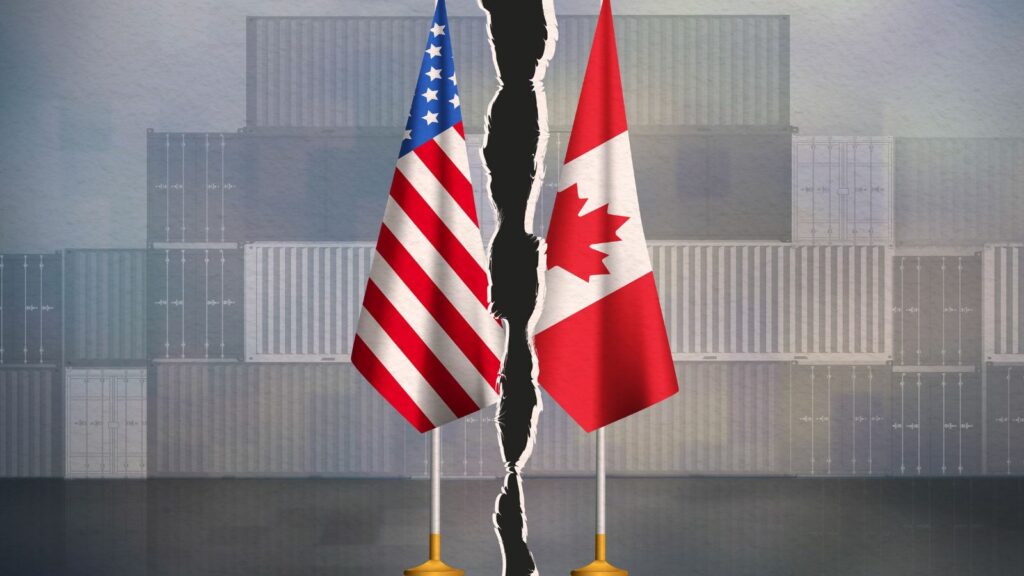
Canada’s relationship with the United States has moved into territory that would have seemed improbable only a short time ago. Léger’s late-August findings show that 41% of Canadians now describe the U.S. as an enemy country, while 22% call it an ally and another 22% see it as neutral. At the same time, 78% expect Canada’s new tariffs on selected U.S. goods to raise prices for Canadian consumers, yet 66% still support imposing them even when higher prices are explicitly acknowledged.
The numbers capture a striking tension. Economic ties remain enormous, but political trust has deteriorated sharply. The trade fight is now reaching beyond customs schedules and government negotiations into household finances, job anxiety, national pride and basic assumptions about Canada’s closest economic relationship.
The Word “Enemy” Marks a Sharp Break
The most striking number is not a majority, but it is a clear plurality: 41% of respondents classified the United States as an enemy country. Just 22% chose ally, 22% chose neutral and 16% were unsure. That represents a 15-point increase in the “enemy” response from June 2025, when Léger recorded 26%. The shift is especially pronounced in Quebec, where 49% used the label, and among Canadians aged 55 and older, where the figure reached 51%. Among people aged 18 to 34, opinion was much more divided: 31% said enemy and 31% said neutral.
That distinction matters because “enemy” is unusually strong language for two countries whose economies, families and communities have long been closely connected. The result should not be read as evidence that Canadians want military confrontation or hostility toward individual Americans; Léger asked respondents to choose among ally, neutral or enemy as descriptions of the country. Still, the movement in the measure is unmistakable. A relationship once treated as almost automatic is increasingly being judged through the lens of tariffs, political pressure and sovereignty.
Much of the Anger Is Tied to Trump
The deterioration in views of the United States is not necessarily permanent. Léger found that 64% of Canadians said their impression of the U.S. would change if Donald Trump were no longer president. Only 21% said it would not, while 14% were unsure. The response was even stronger among Quebecers, at 72%, and among women, at 71%. That pattern suggests many Canadians are separating the current American administration from the country itself, even while their overall view of the United States has become much harsher.
That distinction may be important for the long-term relationship. Public attitudes formed during an extended trade conflict can outlast the policy that triggered them, but the Léger numbers leave room for a future reset. They also help explain why the 41% “enemy” figure should be read carefully: it reflects a moment of acute political tension rather than proof of an irreversible break. Even so, repairing confidence could require more than a change in leadership. Businesses making investment decisions and households changing travel or buying habits can carry uncertainty forward after the rhetoric itself fades.
Cost of Living Still Outranks the Trade Fight
For all the attention on Washington, everyday affordability remains the biggest issue in Léger’s results. Asked to name Canada’s most important issue, 35% selected inflation and rising costs, while 24% chose tariffs, Trump or U.S. aggression. Healthcare followed at 10% and housing affordability at 9%. The generational split is revealing. Inflation and rising prices led among both 18-to-34-year-olds at 41% and those aged 35 to 54 at 42%, while tariffs and U.S. aggression ranked first among respondents 55 and older at 36%.
That creates a difficult political balancing act. Canadians can support a forceful response to U.S. trade measures while still worrying about what that response may cost at the cash register. Younger households, in particular, may experience the dispute less as an abstract question of sovereignty and more as another pressure layered onto rent, groceries and other recurring expenses. Older Canadians appear more focused on the bilateral confrontation itself. The two concerns are not contradictory; they show how a trade war can become both a national-security issue and a kitchen-table issue at the same time.
78% Expect Tariffs to Reach the Checkout
The headline price finding is unusually broad: 78% of Canadians said they expect the new tariffs on selected U.S. products to lead to higher prices for consumers. Only 9% said prices would not rise, and 13% were unsure. The expectation is widespread across the country, reaching 83% in British Columbia and 82% among respondents aged 55 and older. Importantly, that 78% figure is a belief about what will happen; it is not a measurement of how much the forthcoming tariff round will actually increase the cost of living.
There is, however, recent Canadian evidence that tariffs can reach retail shelves. Bank of Canada researchers examined daily online prices for more than 110,000 products at seven major retailers during Canada’s 2025 counter-tariffs. They found that tariffed goods rose about 6% relative to a control group after three months—roughly one-quarter of the 25% tariff rate. The researchers estimated that the episode added about 0.3 percentage points to consumer price inflation. The experience shows why shoppers can feel tariff policy even when businesses absorb part of the cost.
Support for Retaliation Survives the Price Warning
Canadians are not simply choosing lower prices over retaliation. Léger found that 74% agreed with the federal government’s decision to impose new tariffs on certain U.S. products, compared with 13% who disagreed and 13% who were unsure. Support was strongest among Canadians aged 55 and older, at 83%, followed by British Columbia at 80% and Quebec at 78%. When the question explicitly stated that tariffs could increase the price of some products in Canada, support fell—but only to 66%. Opposition rose to 21%, while 13% remained unsure.
A related question makes the trade-off even clearer. Half of Canadians opposed allowing more U.S. dairy and other food products into Canada in exchange for lower consumer prices; 31% supported the idea and 19% were unsure. Opposition reached 61% in Quebec and among people 55 and older. Together, the results point to an economic nationalism that is not cost-blind but is willing to accept some expense. For many respondents, the calculation appears to include bargaining power, domestic protection and sovereignty alongside the sticker price.
The Pocketbook Risk Feels Personal
The trade dispute is no longer being viewed only through corporate earnings or export statistics. Léger found that 87% of Canadians expect the new tariffs to have at least some impact on their personal financial situation. Nearly two-thirds, 63%, expect a major or moderate impact. The detailed responses were 24% major, 40% moderate, 24% small, 3% no impact and 10% unsure, with rounding accounting for totals that do not add perfectly. Those figures suggest that the trade fight has entered household planning even before the next Canadian counter-tariff package takes effect.
The burden will not be identical for every household. A tariff is applied to imported goods, but its final effect can be divided among foreign producers, importers, retailers and consumers depending on competition, margins and the ability to switch suppliers. Canada’s 2025 experience showed only partial pass-through to retail prices rather than a one-for-one increase. Even so, expectations can influence behaviour before prices fully adjust. Families may postpone purchases, businesses may seek alternative suppliers, and retailers may reconsider inventories if they believe the dispute will last.
Trade Dependence Makes the Anger Complicated
Canada can become more distrustful of the United States politically without becoming economically detached from it overnight. Statistics Canada reported that 71.7% of Canadian merchandise exports went to the U.S. in 2025, down from 75.9% in 2024. Exports to the United States fell 5.8% that year, while Canada still recorded an $81.6-billion merchandise trade surplus with its neighbour. Those figures explain why a political rupture carries such large economic consequences: the relationship is not merely diplomatic, but embedded in supply chains, energy flows and industrial production.
There are signs of diversification. In July 2026, Canadian merchandise exports to countries other than the United States rose 7.4% to a record $25.6 billion, accounting for 33.7% of total exports that month. At the same time, exports to the U.S. fell 6.6%, the sharpest monthly percentage decline since April 2025. One month does not amount to decoupling, and Statistics Canada attributed much of the U.S. decline to lower crude-oil and gold exports. Still, the numbers show that firms are operating in a trade map that is becoming less exclusively American.
Ottawa’s Next Tariff Round Is Large and Targeted
The public-opinion numbers are landing just before another concrete escalation. The United States imposed a 50% tariff on $27.6 billion of Canadian goods effective August 22, according to the federal government. Canada has announced that, beginning September 8, it will apply counter-tariffs of 15%, 25% and 50% on $27.6 billion of selected U.S. imports, with rates designed to match corresponding American measures. Ottawa says the targeted sectors include steel, dairy, appliances, agricultural equipment, pulp and paper, plastics and electronics, while existing counter-tariffs on U.S. autos will continue.
The scale helps explain why price expectations are so high. Tariffs are taxes on imports; they raise the landed cost of affected goods unless that cost is absorbed elsewhere in the supply chain. Ottawa has paired its response with a $7.5-billion package of new and enhanced support for workers and businesses, on top of nearly $25 billion in previously announced assistance. That spending underscores the government’s own recognition that retaliation can carry domestic costs even when it is intended to defend Canadian industries.
Recession and Job Anxiety Add Another Layer
Trade anxiety is colliding with a broader sense of economic vulnerability. Léger found that 46% of Canadians believe the country is already in a recession, while 34% said it is not and 20% were unsure. Among employed respondents, 38% said they were concerned about losing their job within the next 12 months. The fear was highest in Ontario, at 49%, and among employed people aged 18 to 34, at 46%. By comparison, 27% of employed respondents aged 55 and older expressed the same concern.
Recent trade data provide context without proving that tariffs are the cause of those fears. Statistics Canada reported that exports to the United States fell 6.6% in July, while imports from the U.S. rose 1.8%. Canada’s merchandise trade surplus with the United States consequently narrowed from $10.3 billion in June to $5.9 billion in July. Statistics Canada attributed the export drop mainly to lower shipments of crude oil and gold, so it would be misleading to label the entire change a tariff effect. The broader point is that workers are watching an already volatile trade environment.
Canadian Pride Is Rising Alongside Distrust
The same period that has produced harsher views of the United States has also coincided with stronger expressions of Canadian identity. Léger found that 83% of respondents were proud to be Canadian, unchanged from June 2025, but the share saying they were “very proud” rose to 56% from 45%. Separately, 41% said they had become more proud of being Canadian or living in Canada during the previous two to three months, up seven points from June 2025. Among those who felt more proud, 72% said statements by Trump about Canada were a reason.
The sovereignty question is even more decisive. Eighty-five per cent said they would not want Canada to become the 51st U.S. state, while 9% said they would; rejection reached 90% among women, 89% in Quebec and 93% among respondents aged 55 and older. Taken together, the findings show why this trade fight is becoming more than a dispute over tariff schedules. It is increasingly tied to national identity, economic independence and the boundaries Canadians want maintained in their relationship with the United States.
