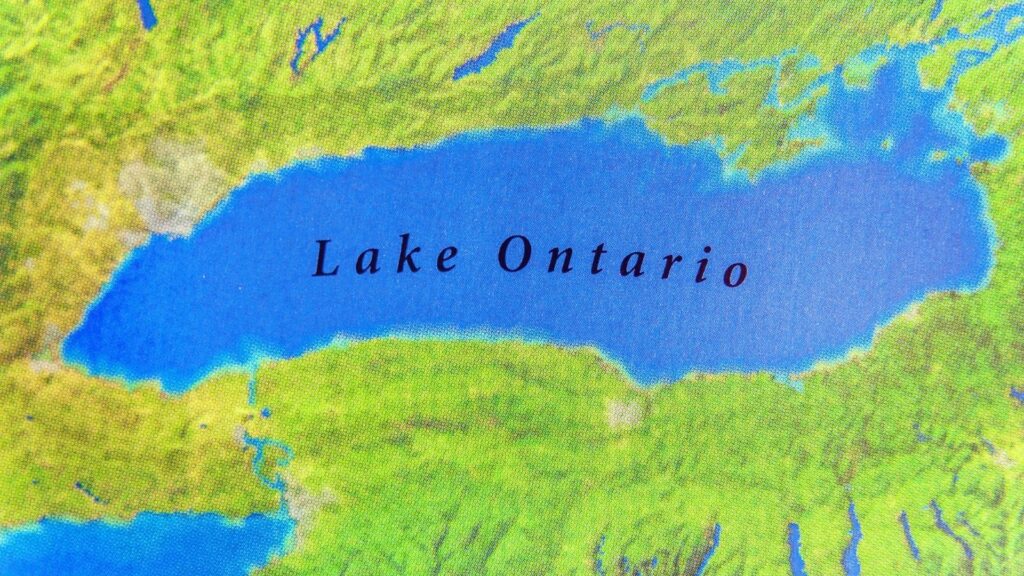
A dispute over what to call one of North America’s Great Lakes might appear symbolic, but it is unfolding alongside a much more consequential fracture in Canada-U.S. relations. The Associated Press says it will continue calling Lake Ontario by its long-established name rather than adopting President Donald Trump’s “Lake America” designation, arguing that a global news organization must use geography recognizable to audiences beyond the United States.
The decision comes as tariff tensions are moving from political rhetoric into corporate calculations. Canadian businesses are reconsidering suppliers, export markets, pricing and investment exposure while governments add tariffs, import restrictions and procurement barriers. The naming fight is not causing those economic shifts, but both developments illustrate how rapidly assumptions about a once-predictable cross-border relationship are being rewritten.
AP Draws a Clear Editorial Line on Lake Ontario
The Associated Press has told its journalists to continue referring to the body of water as Lake Ontario, rather than automatically adopting “Lake America,” the name ordered by Trump for U.S. federal use. Its reasoning is largely practical. AP distributes reporting globally, so its geographical terminology must remain understandable to readers in multiple countries. Canada has not accepted the American name change, leaving two governments using different terminology for the same international body of water.
AP’s guidance does not instruct reporters to pretend Trump’s decision never happened. When the U.S. designation is relevant, journalists can explain that Trump ordered federal agencies to recognize the lake as Lake America. That distinction matters. The agency is separating acknowledgment of an American government action from adoption of that government’s terminology as the universal geographic name. Because no single national government controls the naming of an international body of water shared across borders, AP concluded that the historically familiar Lake Ontario remains the clearer global reference.
Trump’s Executive Order Changes U.S. Federal Usage
Trump formally signed Executive Order 14422 on August 27, directing the U.S. Department of the Interior and Board on Geographic Names to recognize Lake Ontario as “Lake America.” The administration said the change was intended to honour American contributions to the Great Lakes, highlighting the lake’s role in shipping, recreation and the broader regional economy. The order also instructed officials to update the U.S. Geographic Names Information System and federal maps, contracts, documents and communications.
That gives the change meaningful reach inside the U.S. federal government, but it does not give Washington unilateral control over what Canada, international organizations, private companies or news organizations call the lake. The executive order itself identifies the waterway as bounded by New York on one side and Ontario on the other, illustrating the international nature of the feature. In practical terms, Washington can determine the terminology used by its own departments. Whether the designation becomes common language outside government depends on governments, companies, publishers and the public choosing to adopt it.
The Ontario Name Predates Both Modern Countries
The dispute is particularly sensitive because “Ontario” is not a recently invented Canadian designation. Government of Canada historical material traces the word to the Iroquoian language family, with European records using versions of the name during the 17th century. Canadian government references place the earliest recorded use around 1641, long before either Canadian Confederation in 1867 or the establishment of the modern United States.
The province itself eventually took its name from the lake. That history gives the terminology cultural significance that goes beyond ordinary mapmaking. Indigenous origins also complicate efforts to frame the debate simply as a contest between Canadian and American nationalism. The name already existed before the international border that now divides the Great Lakes region. AP specifically cited the lake’s centuries-long naming history when explaining its guidance, reinforcing its argument that global usage and historical recognition matter when a geographic feature crosses national boundaries.
Google and Apple Chose a Different Approach
Major technology companies have treated the issue differently from AP. Google changed the name displayed to American users of Google Maps after the federal geographic database was altered. The company said U.S. users would see “Lake America,” Canadians would continue to see “Lake Ontario,” and users elsewhere would be presented with both names. Its approach reflects an existing policy of adjusting geographical labels depending on the country from which a user accesses the service.
Apple later made a comparable change, showing Lake America to users in the United States while maintaining the Lake Ontario designation outside the country. These decisions demonstrate how digital geography can increasingly become location-dependent. Two people looking at the same physical lake can receive different official labels on their phones depending on which side of the border they are standing. For technology platforms serving billions of searches and navigation requests, a naming decision that once might have been confined to government maps can now become visible to consumers almost immediately.
MapQuest Turned Resistance Into an Unexpected Business Moment
MapQuest went in the opposite direction. The veteran online mapping service publicly declared that it would not replace Lake Ontario with Lake America. The response produced something few would have predicted for a platform that became famous during the era of printing driving directions from desktop computers: a sudden surge in attention and downloads. MapQuest climbed to the top of Apple’s free-app rankings, with reporting indicating more than 1.5 million downloads in less than a week.
Public opinion helps explain why the decision resonated. A Reuters/Ipsos survey of 1,023 American adults found 63% opposed renaming Lake Ontario, while only 14% supported it. Opposition was not confined to Democrats; more Republicans in the poll opposed the move than supported it. MapQuest’s experience is therefore more than an amusing technology comeback. It shows how a politically charged policy decision can create unexpected market opportunities when companies differentiate themselves around familiarity, trust or national sentiment. Even map labels can influence consumer behaviour when they become symbols of a larger political dispute.
AP Has Faced This Naming Fight Before
AP’s Lake Ontario decision follows almost exactly the framework it established after Trump ordered the Gulf of Mexico renamed the Gulf of America in 2025. At that time, AP said it would continue using Gulf of Mexico because the body of water touches both the United States and Mexico and the U.S. government could not compel other countries to accept the new terminology. It nevertheless acknowledged Trump’s preferred designation when that context was relevant.
The agency took a different position when Trump restored the name Mount McKinley for the Alaska peak previously federally known as Denali. Because the mountain lies entirely within U.S. territory and the federal government has authority over its official designation, AP adopted Mount McKinley. The distinction shows that its policy is not simply to reject Trump-era geographic changes. The dispute became especially consequential in 2025 when the White House restricted AP access to presidential events over the Gulf terminology, turning what looked like a stylebook disagreement into a larger conflict over editorial independence and government access.
The Trade Fight Is Moving Well Beyond Symbolism
The lake dispute is unfolding during a much more financially significant confrontation. Canada imposed new counter-tariffs effective September 8 covering C$27.6 billion worth of American imports after the United States imposed 50% duties on a comparable value of Canadian goods. Canadian rates range from 15% to 50%, with targeted categories including steel, dairy products, appliances, agricultural equipment, pulp and paper, plastics and electronics.
Washington has since moved beyond tariffs alone. On September 8, the Trump administration announced new restrictions that will exclude certain Canadian products from the U.S. market beginning September 29, including measures affecting dairy products, alcoholic beverages and motorcycles. Trump also directed the General Services Administration and U.S. trade officials to begin removing Canadian-origin products from federal procurement schedules. The White House said roughly $50 billion in Canadian goods could be affected by that procurement action. For companies, the risk is therefore expanding from higher border taxes to the possibility of losing market access or government customers altogether.
Businesses Are Already Changing How They Operate
Statistics Canada’s latest survey shows tariff uncertainty is no longer theoretical for corporate planners. In the third quarter of 2026, 32.2% of Canadian businesses said they expected U.S. tariffs to negatively affect their operations over the next 12 months. Manufacturing businesses were substantially more exposed, with 49.7% expecting negative effects. Transportation and warehousing came close behind at 47.3%, while wholesale trade stood at 45.1%.
Costs are already moving through the economy. Statistics Canada found 27.4% of businesses had passed tariff-related cost increases to customers during the previous year, while 30.4% said they were at least somewhat likely to do so during the next 12 months. Individual companies are also changing strategy. Recent reporting has documented Canadian firms replacing U.S. suppliers with domestic or alternative sources, limiting American exports and pursuing European opportunities. Those changes may begin as defensive responses, but once companies establish new suppliers and customers, some shifts can become permanent even if tariffs are later reduced.
Canada’s Trade Numbers Show Diversification Gaining Ground
Canada remains deeply tied to the American market, but the latest merchandise data show a noticeable change in direction. Statistics Canada reported that exports to the United States fell 6.6% in July, the sharpest percentage decline since April 2025. Imports from the United States increased 1.8%, causing Canada’s monthly merchandise trade surplus with its southern neighbour to fall from C$10.3 billion in June to C$5.9 billion.
At the same time, exports to countries other than the United States increased 7.4% and reached a record C$25.6 billion. Non-U.S. destinations accounted for 33.7% of Canadian merchandise exports during the month. That does not mean Canada can quickly replace the scale, proximity and deeply integrated supply chains of the American market. Total Canadian exports actually fell 2.3% in July, and the country’s overall merchandise trade surplus narrowed to C$769 million. But the simultaneous decline in U.S.-bound shipments and record exports elsewhere offers measurable evidence that diversification is already occurring rather than remaining only a political slogan.
Political Uncertainty Is Becoming a Business Cost of Its Own
The most important change may be how executives assess risk. A manufacturer considering a new factory once could reasonably assume that Canada-U.S. trade rules would remain broadly predictable for years. Now businesses must consider not only tariff rates but possible import bans, federal purchasing restrictions, political retaliation and sudden changes in market access. Bombardier illustrates how complicated that exposure can become. Trump has threatened its U.S. access even though the Canadian aircraft maker is connected to roughly 2,800 American suppliers across 47 states and employs more than 1,200 people in Kansas alone.
That interconnectedness is exactly why uncertainty can influence investment before a tariff actually appears on an invoice. Companies may add suppliers in another country, keep more inventory, delay expansion or seek customers outside North America simply because the range of possible policy outcomes has widened. AP’s decision to keep saying Lake Ontario does not cause those choices. The geographic dispute and the economic restructuring are better understood as separate manifestations of the same deterioration in predictability—a relationship once defined by integration increasingly being filtered through politics, sovereignty and contingency planning.
