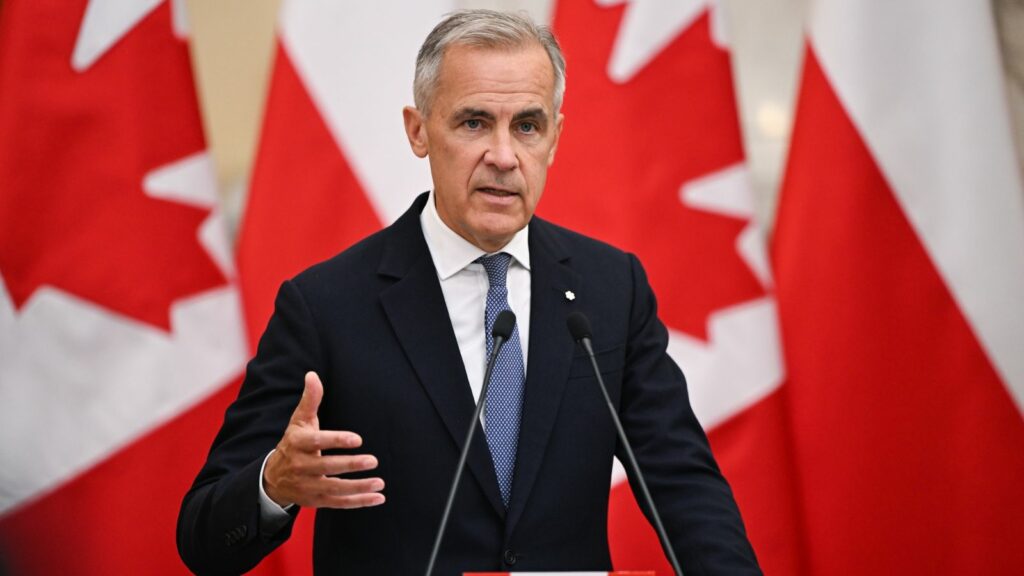
Prime Minister Mark Carney’s warning that antisemitism in Canada has reached levels not seen since the war puts an unusually stark description on a problem that police statistics, Jewish organizations and governments have been tracking for years. The comment also sharpens the political stakes for a Liberal government pointing to tougher hate-crime measures as evidence that Ottawa is moving beyond condemnation.
The challenge is larger than passing legislation. Canada is confronting threats against synagogues, Jewish schools and community institutions while debating how criminal law should distinguish between protected expression, protest and conduct driven by hatred or intimidation. Carney’s language signals that Ottawa wants the issue treated as a national public-safety concern, but the effectiveness of the response will ultimately depend on enforcement, prosecutions and whether targeted communities actually feel safer.
Carney’s Language Raises the Political Stakes
Describing contemporary antisemitism as reaching levels not seen since the war carries enormous historical weight. The reference inevitably evokes the Second World War and the Holocaust, when six million Jews were murdered by Nazi Germany and its collaborators. Carney’s point is therefore more than a warning about unpleasant rhetoric. It presents antisemitism as an urgent threat to public safety and democratic life, demanding a response from governments, police and institutions rather than being treated simply as another political disagreement.
At the same time, the statement should not be interpreted as a literal statistical comparison across eight decades. Canada does not possess a continuous, directly comparable hate-crime dataset stretching from the 1940s to the present. Modern police-reported hate-crime statistics measure a much narrower period and are affected by reporting practices, public awareness and changes in policing. Carney’s wording is best understood as a political and historical judgment about the severity and visibility of antisemitism, not a precise statistical claim covering the entire postwar era.
Police Data Show Why Ottawa Is Alarmed
The most concrete national evidence comes from Statistics Canada. Police reported 4,777 hate crimes in 2023, a 32% increase from the previous year. Incidents targeting Jewish people rose particularly sharply, reaching roughly 900 cases, up 71% from 2022. Jewish Canadians account for only a small share of the national population, making the concentration of reported incidents especially striking and helping explain why federal leaders increasingly describe antisemitism as a public-safety issue rather than only a social problem.
Those figures also come with an important limitation. Police-reported statistics capture only incidents brought to police attention and subsequently classified as hate crimes. Statistics Canada has repeatedly cautioned that many hate-motivated incidents never appear in official crime data. That means a vandalized synagogue, a threatening message sent to a Jewish student or harassment on public transit may affect community life even when no charge is ultimately laid. The official numbers therefore provide a serious baseline, but they do not measure the entire problem.
The Liberals Are Pointing to Criminal-Law Changes
The Liberal response has increasingly centred on strengthening the Criminal Code and giving authorities clearer tools to address hate-motivated intimidation and violence. Ottawa has pursued measures aimed at conduct around vulnerable community spaces, hate-motivated offences and the public promotion or display of material associated with hatred. The political message is straightforward: existing condemnation is not enough when people fear entering a synagogue, mosque, school or cultural centre because of threats or targeted demonstrations.
That approach builds on laws Canada already has. The Criminal Code contains offences dealing with advocating genocide, the public incitement of hatred and the wilful promotion of hatred, along with sentencing provisions allowing hate motivation to be treated as an aggravating factor. The newer federal push is designed to close perceived gaps and make intervention easier in situations involving intimidation or obstruction. Supporters argue those tools have become more necessary as tensions generated by international conflicts increasingly spill into Canadian streets and institutions.
Existing Hate Laws Already Set a High Legal Bar
Canadian hate-speech law is narrower than ordinary political disagreement or offensive expression. Criminal prosecutions for promoting hatred generally require conduct meeting demanding legal tests, reflecting the Charter’s protection of freedom of expression. Courts have distinguished hatred from merely unpopular, harsh or insulting speech, emphasizing extreme forms of vilification and detestation. That distinction is central to the debate because governments attempting to strengthen hate laws must still design them to withstand constitutional scrutiny.
The same principle matters when protests involve Israel, Gaza or Canadian foreign policy. Criticism of the Israeli government, Zionism, military operations or Ottawa’s Middle East policy is not automatically antisemitic or criminal. Conversely, political language does not become immune from scrutiny merely because it appears at a protest. Threats against Jewish people, deliberate intimidation, glorification of violence or targeting individuals because they are Jewish raise very different legal and safety questions. Effective legislation has to preserve that distinction rather than collapsing political criticism and hatred into the same category.
Jewish Institutions Have Faced Intensifying Security Pressure
For Jewish communities, the debate is not confined to parliamentary language. Synagogues, schools and community centres across Canada have spent years increasing security through guards, cameras, barriers and controlled entrances. Ottawa has operated federal security-funding programs that help communities vulnerable to hate-motivated crime pay for measures such as surveillance equipment, security assessments, training and physical improvements. Those programs reflect an uncomfortable reality: attending school or religious services can now involve security procedures more commonly associated with government buildings.
The human effect is difficult to capture in crime statistics. Parents may wonder whether a Jewish school needs additional guards. Congregations may adjust events or restrict building access after threats. Community organizations can face significant costs simply to maintain activities that once required little security planning. Those experiences help explain why Carney’s rhetoric is resonating beyond partisan politics. New criminal offences may punish conduct after it occurs, but communities are also looking for prevention, faster police responses and reassurance that visibly Jewish institutions can operate without extraordinary precautions.
October 7 Changed the Scale of the Debate
The Hamas-led attack on Israel on October 7, 2023, and the devastating war in Gaza that followed transformed political tensions far beyond the Middle East. In Canada, demonstrations, counter-protests and campus disputes became frequent, while Jewish and Muslim communities both reported increased hostility and fear. Police services in major cities recorded sharp increases in hate-related incidents during the months that followed, making the domestic consequences of the conflict a persistent issue for governments and law-enforcement agencies.
The challenge for political leaders is to respond without treating communities as opposing blocs. Antisemitism and anti-Muslim hatred can increase at the same time, and protecting one group does not require minimizing threats faced by another. Federal policy is most credible when it applies consistent standards: threats, violence, vandalism and intimidation should be condemned regardless of the identity of the victim. Carney’s focus on antisemitism reflects an exceptionally serious trend, but the wider policy test is whether Canada can protect vulnerable communities while maintaining space for peaceful political disagreement.
Tougher Laws Will Matter Only If They Can Be Enforced
Passing a new offence is only the beginning of the criminal-justice process. Police must determine whether evidence meets the legal threshold, prosecutors must assess whether a charge has a reasonable prospect of conviction and courts must apply constitutional protections. Hate cases can be particularly difficult because investigators sometimes need to establish motive or intent in addition to proving the underlying conduct. Online material, anonymous threats and rapidly organized demonstrations add another layer of complexity.
That creates a risk familiar to governments: announcing stronger laws can produce immediate political impact while practical results arrive slowly. If police services lack specialized investigators, prosecutors are overloaded or cases take years to reach court, communities may see little difference in their daily lives. Training also matters because officers need to distinguish criminal intimidation from lawful protest and offensive but protected expression. The strongest test of Ottawa’s approach will therefore be operational—whether authorities can intervene earlier and prosecute serious cases effectively without turning broadly worded provisions into constitutionally vulnerable tools.
Civil-Liberties Concerns Will Shape the Fight
Expanding hate legislation almost inevitably produces concern among civil-liberties organizations, legal scholars and advocacy groups. Their central question is not whether antisemitism should be confronted but how far criminal law should extend. Vague definitions can chill lawful expression, particularly during emotionally charged protests where slogans, symbols and historical references may be interpreted differently by opposing groups. A law designed around extreme cases can become controversial if ordinary political speech risks being pulled into its reach.
Canadian courts have historically tried to balance these competing principles by recognizing that freedom of expression protects even deeply offensive speech while permitting carefully targeted restrictions on extreme hate propaganda. That balance will remain essential as Parliament considers stronger protections around religious and cultural institutions. Ottawa will need to demonstrate that any new offences focus on identifiable harms such as threats, intimidation, obstruction or deliberate promotion of hatred. Precision is not merely a civil-liberties preference; it also makes legislation more likely to survive Charter challenges.
The Issue Has Become a Test of Federal Leadership
Carney’s intervention also reflects the political pressure facing the federal government. Jewish organizations have repeatedly asked governments, universities, police services and political parties to respond more forcefully to antisemitism. When a prime minister uses historically charged language, expectations rise accordingly. The government can no longer rely on statements of concern alone; its legislative record, security programs and dealings with police and prosecutors become part of the assessment.
Opposition parties can also challenge the Liberals from different directions. Some may argue Ottawa waited too long or that proposed measures remain too weak. Others may warn that governments are moving too aggressively into areas protected by freedom of expression. Those competing pressures make antisemitism policy unusually difficult politically. A government seeking stronger enforcement must avoid promising that legislation can eliminate hatred, while critics must confront the reality that Jewish Canadians have experienced a measurable rise in police-reported incidents. The debate is therefore likely to extend well beyond any single bill.
Safety, Rather Than Political Messaging, Will Be the Real Measure
For communities facing threats, success will not be measured by how forcefully politicians describe the problem. It will be measured by whether children can attend Jewish schools without extraordinary security fears, whether worshippers can enter synagogues without intimidation and whether police respond quickly when threats emerge. A reduction in hate crimes would matter, but so would improved reporting, faster investigations and confidence that authorities take incidents seriously before violence occurs.
That is the larger challenge contained in Carney’s warning. Calling antisemitism historically severe can focus national attention, but it also creates an obligation to show measurable results. Stronger laws may be part of that response, alongside security funding, education, intelligence work, community partnerships and consistent enforcement of existing offences. Canada has legal tools for combating hatred while protecting democratic expression. The question now is whether governments can make those protections work in practice at a moment when fear, international conflict and domestic political polarization are placing them under unusual strain.
