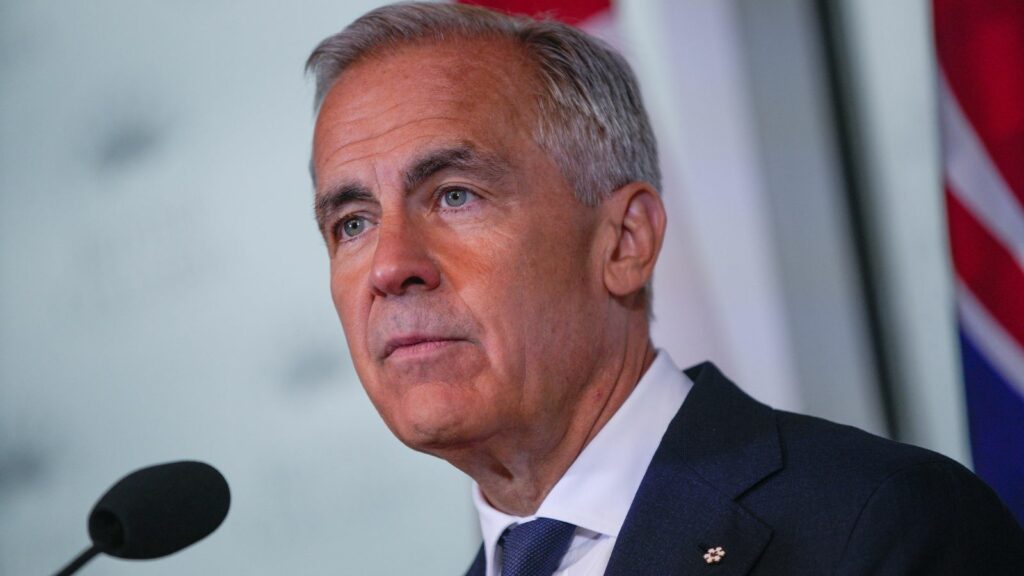
Canada is trying to turn global uncertainty into an investment pitch. As Prime Minister Mark Carney hosts some of the world’s most influential money managers in Toronto, the firms represented at the Canada Investment Summit collectively oversee roughly $120 trillion in assets. Ottawa does not expect anything close to that sum to land in Canada. Its much more concrete ambition is to catalyze about $1 trillion in new investment over five years.
The timing is deliberate. President Donald Trump is using tariffs, market access and onshoring incentives to encourage companies to build more inside the United States, raising the stakes for Canadian factories, resource projects and technology investments. Carney’s counteroffer is essentially that Canada can provide something increasingly valuable in a volatile world: resources, infrastructure opportunities, global market access and predictable rules.
The $120-Trillion Number Is About Influence, Not a Giant Cheque
The headline number surrounding the Toronto summit is extraordinary, but it needs context. The investors assembled for the two-day gathering collectively oversee approximately $120 trillion in assets around the world. That includes capital invested across public markets, private equity, infrastructure, real estate, credit and other asset classes. Those assets are certainly not sitting in cash waiting to be allocated to Canada. Ottawa’s opportunity is to persuade a comparatively tiny share of that global pool to move toward Canadian projects.
That distinction still leaves Canada with a potentially powerful audience. The federal government organized the summit with CPP Investments and PSP Investments, two large Canadian institutional investors whose networks reach major asset managers and pension funds around the world. BlackRock CEO Larry Fink and Blackstone President Jon Gray are among the high-profile financial executives connected to the event. The summit’s stated target is to help catalyze $1 trillion in investment over five years — a fraction of the capital represented in Toronto, but enough to reshape several Canadian industries if projects actually proceed.
Trump Is Changing the Economics of Where Companies Build
Canada’s sales pitch is unfolding while Washington is making the opposite pitch with much sharper tools. The Trump administration has increasingly linked tariff relief, access to the American market and other economic advantages to investment inside the United States. Washington has established onshoring programs in areas such as primary aluminum and unmanned aircraft, offering tariff advantages to companies that commit to building, refurbishing or expanding U.S. production facilities.
Canada has felt that pressure directly. Trump has threatened Canadian companies with restricted market access while pushing manufacturers to relocate production south of the border. Bombardier, for example, was publicly told that continued U.S. market access could depend on building aircraft in America. Washington has also promoted automakers’ decisions to increase U.S. production as evidence that its tariff strategy is redirecting investment. For a multinational deciding where its next plant goes, that means Canadian policymakers are no longer competing solely on taxes, workers or electricity costs. They are competing against the gravitational pull of the enormous U.S. market backed by an increasingly interventionist trade policy.
Carney Is Selling Canada as the Predictable Alternative
Carney’s answer is not simply to imitate Washington’s tariff strategy. Ottawa is presenting predictability itself as an economic asset. Canadian officials point to the country’s AAA sovereign credit rating, relatively strong public finances, banking stability, natural resources and extensive trade relationships when making the case that long-duration investments can be made with greater confidence in Canada. Carney has repeatedly emphasized trust, reliability and the rule of law as advantages for investors making decisions that could stretch across several decades.
Canada also has a market-access argument that extends beyond its population of roughly 40 million people. Ottawa says its 16 free-trade agreements with 51 countries provide preferential access to markets containing about 1.5 billion consumers and representing roughly two-thirds of global economic output. That becomes more important as Canada attempts to reduce its extraordinary reliance on the United States. A factory, mine or technology facility built in Canada can potentially be presented not simply as a Canadian asset, but as a platform connected to Europe, the Asia-Pacific and other major markets while still retaining extensive links to the U.S.
Investors Are Being Shown Projects, Not Just PowerPoint Ambitions
The Toronto gathering is intended to move beyond a generic invitation to “invest in Canada.” More than 160 projects have been assembled for investors across areas including critical minerals, energy, advanced manufacturing, ports, transportation, digital infrastructure and technology. Matching particular projects with institutions capable of financing them is important because a pension fund looking for a multi-decade infrastructure asset has very different requirements from a private-equity group considering an industrial company.
One of the largest announcements surrounding the summit came from Bell Canada and Saskatchewan. Bell signed a non-binding memorandum of understanding that creates a path to expanding its Saskatchewan AI infrastructure by another 900 megawatts, potentially producing a 1.2-gigawatt hub. The project is expected to represent more than $50 billion in total capital investment if fully developed. Importantly, that enormous number remains dependent on customer commitments, commercial agreements, permitting and other approvals. That caveat captures the broader challenge facing the summit: announcing an investment opportunity is considerably easier than financing, permitting and constructing it.
Ottawa Knows Speed and Certainty Have Become Part of the Competition
Canadian governments have spent years hearing complaints that potentially attractive projects can be undermined by lengthy approval processes, regulatory uncertainty and difficulty predicting final costs. Ottawa is now trying to make administrative speed part of its investment strategy. Finance Minister François-Philippe Champagne announced that the Canada Revenue Agency will prioritize advance income tax ruling requests connected to Canadian investments worth at least $1 billion.
The change matters because advance rulings provide binding guidance on how tax law will apply to a proposed transaction before investors commit their capital. For a multibillion-dollar infrastructure project, reducing uncertainty before financing closes can materially affect investment decisions. Ottawa is simultaneously using its Major Projects Office to push large nation-building projects through development. The federal summit material says the office is advancing 27 projects and broader strategies representing more than $192 billion in potential investment and more than 330,000 jobs. Those figures are not the same as completed investment, but they illustrate Carney’s attempt to build a much larger pipeline of projects capable of absorbing institutional capital.
Canada Has Capital Coming In — But Needs More of the Productive Kind
Canada is not starting from a position of zero investor interest. Statistics Canada reported that the stock of foreign direct investment in the country climbed 6.9% in 2025 to roughly $1.60 trillion. Net foreign direct investment flows during the year totalled about $93.2 billion. Those are substantial numbers and help explain why Ottawa argues Canada remains internationally competitive for capital.
The composition tells a more complicated story. Invest in Canada data show that mergers and acquisitions accounted for about 47% of 2025 FDI flows, while reinvested earnings represented another 36%. A remaining 17% category included greenfield investment and other flows. Buying an existing Canadian company can bring important benefits, but the economic challenge facing Ottawa is particularly focused on investment that creates new productive capacity: factories, mines, ports, electricity generation, machinery and technology. Statistics Canada has linked Canada’s long-term productivity weakness partly to insufficient capital investment. Since 2000, Canadian labour productivity has increased at an average annual rate of about 0.8%, compared with 1.9% in the United States, although Canadian business productivity rebounded 1% in the second quarter of 2026.
Canadian Banks Are Trying to Put Domestic Money Behind the Pitch
Foreign investors are only one piece of the strategy. Canada also needs its own financial institutions to finance the projects being promoted abroad. TD Bank used the summit period to announce a five-year commitment of $150 billion in new lending, underwriting, advisory services and other financing activities tied to areas including energy, critical minerals, defence, aerospace, artificial intelligence and infrastructure. Scotiabank separately announced more than $100 billion in financing, underwriting and investment support for Canadian companies and projects.
Those figures should not be mistaken for immediate direct investment. A bank financing commitment may include loans, bond underwriting, advisory mandates and other activities rather than money being placed directly into a project as equity. Even so, the announcements matter because megaprojects normally depend on layers of capital from developers, banks, pension plans, governments and outside institutional investors. CPP Investments and PSP Investments helping convene the summit reinforces that model. Canada already has unusually large pools of sophisticated institutional money; the economic-policy challenge is creating enough competitive domestic assets to convince those institutions that investing more at home can generate returns comparable with opportunities abroad.
The Real Scorecard Will Come After Investors Leave Toronto
A successful summit cannot ultimately be measured by the combined assets of the people in the room. It will be measured by projects reaching financial close, construction starting, equipment being ordered and permanent productive capacity appearing in Canadian communities. That standard matters because the Bank of Canada has repeatedly identified trade uncertainty as a drag on investment. Canadian companies have postponed or reconsidered expansion plans as U.S. tariffs and weaker export demand complicate long-term decisions, even though the Bank’s latest business survey found overall investment intentions remaining relatively strong.
There are political complications as well. Protesters gathered around the Toronto summit to object to greater investment in areas including fossil fuels, defence and artificial intelligence, while critics have raised concerns about privatization and the environmental or social consequences of accelerating large projects. Those debates will not disappear simply because global investors are interested. Carney’s bigger challenge is therefore balancing speed with legitimacy while turning Canada’s resources, energy, technology and infrastructure opportunities into assets investors actually want to finance. With Trump openly trying to redirect industrial capital into the United States, Canada no longer has the luxury of assuming investment will arrive automatically.
