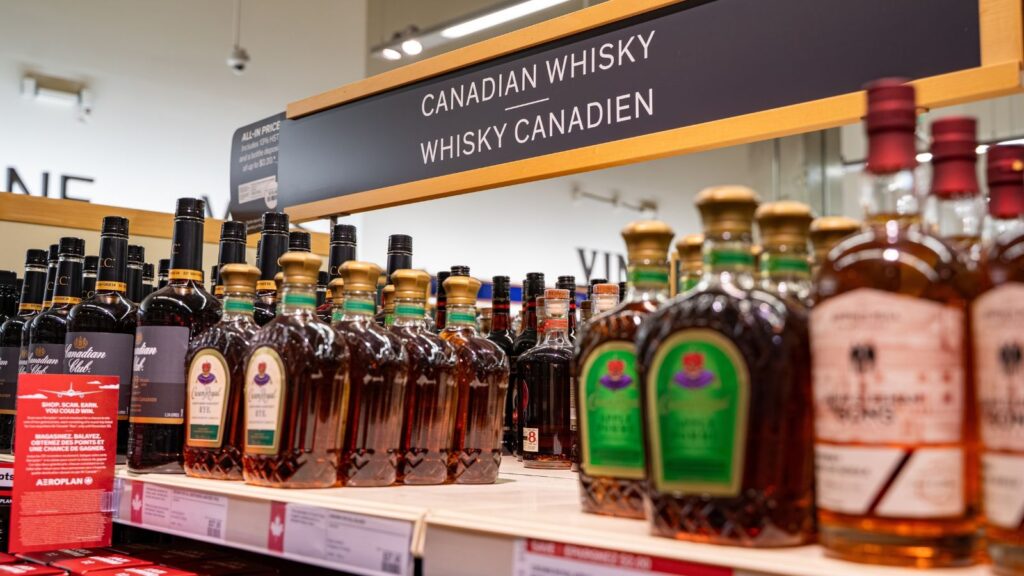
Canada’s distillers are discovering that losing access to their most important foreign customer does not automatically make the domestic market an easy fallback. On September 29, new U.S. restrictions shut many bottled Canadian alcoholic beverages out of the American market, hitting an industry that had built a strikingly large share of its export business around U.S. buyers. Yet producers hoping to redirect bottles toward Canadian customers face another problem: Canada still does not function as a seamless national alcohol market. Provincial liquor systems, listing requirements, fees and different regulatory processes can complicate sales across provincial borders. Recent reforms have opened new direct-to-consumer channels, but those changes do not automatically provide access to liquor-store shelves. For smaller distillers especially, the result is an uncomfortable squeeze between a suddenly restricted export market and a domestic system that remains fragmented.
The U.S. Door Has Closed on Many Bottled Canadian Spirits
The immediate problem arrived at 12:01 a.m. Eastern time on September 29, when a U.S. proclamation excluding specified Canadian alcoholic beverages from importation took effect. Alcohol was part of a broader set of restrictions covering close to US$1 billion worth of Canadian imports based on 2025 trade figures. An American Action Forum estimate cited by the Associated Press put the affected total at roughly US$967 million, with alcoholic beverages representing about 87% of that amount. The import prohibition followed an earlier 50% U.S. duty on specified Canadian goods that had already made some shipments considerably less attractive to American buyers.
The restriction is significant, but it is not a blanket prohibition on every Canadian spirit moving south. Reuters reported that many bulk, unbottled alcoholic products can still enter the United States. That distinction matters enormously. A large whisky producer with an international bottling network may have options that a craft distillery simply does not. A small operation that distills, bottles, labels and packages everything at its Canadian facility cannot easily rearrange an entire production system just to preserve access to American consumers. For those businesses, the United States has effectively become much harder—and in some cases impossible—to serve with their existing products.
Canadian Spirits Became Deeply Dependent on American Buyers
The disruption is magnified by how concentrated Canadian spirits exports have become. Spirits Canada, the industry association, says Canada exported about $948.6 million worth of spirits to the United States in 2025. The organization estimates that the American market represented approximately 93% of Canada’s total spirits export value that year, while roughly 48% of Canadian spirits production was tied to U.S. demand. Even allowing for the fact that these are industry estimates, the numbers illustrate how difficult it would be to replace the American market quickly.
That dependence developed for understandable commercial reasons. The United States offers a population many times larger than Canada’s, geographic proximity, established distribution networks and decades of relatively integrated cross-border trade. Canadian whisky in particular has a long history in American liquor stores and bars. Building equivalent sales in Europe, Asia or other regions is possible, but establishing distributors, regulatory approvals and brand recognition takes time. The domestic market cannot necessarily absorb the difference either. Statistics Canada recorded $6.7 billion in Canadian spirits sales during the 2024/2025 fiscal year, but sales were already down 3.2% from the previous year. Producers are therefore trying to redirect supply into a market that is substantial but hardly unlimited.
Small Distillers Have Far Fewer Ways Around the Ban
Large multinational drinks companies may be able to adjust supply chains. Reuters reported that owners of prominent Canadian whisky brands could potentially move more product across the border in bulk and bottle it in the United States. The Associated Press similarly noted that bulk shipments provide a possible workaround for brands with the facilities and commercial scale to use them. That does not make the new restrictions painless, but it creates an option unavailable to many independent distillers whose identity and economics revolve around producing and bottling locally.
The contrast becomes much clearer at individual businesses. Glenora Distillery owner Lauchie MacLean told Reuters that U.S. states including New York, California and Illinois normally account for roughly one-third of his Nova Scotia distillery’s sales. A planned single-malt shipment was left sitting at the distillery after the American buyer backed away amid the earlier 50% tariffs. In Ontario, Wolfhead Distillery near the Michigan border told the Associated Press that prospective American business involving several flavoured spirits had been put on hold. For operations of that size, replacing an established importer or distributor is not simply a matter of finding a different customer. It can mean rebuilding a major piece of the company’s sales strategy.
Selling Across Canada Still Means Navigating Multiple Systems
Turning inward sounds straightforward until a producer tries to do it. Alcohol regulation in Canada remains heavily provincial, with individual governments and liquor authorities setting rules for distribution, wholesale access, listings and retail sales. The precise model varies: some provinces rely heavily on government-owned stores, while others combine public wholesaling with private or mixed retail systems. For a distiller, that means success at home does not automatically translate into national distribution. Entering another province can involve a new regulatory authority, different paperwork, a separate listing process and another set of commercial conditions.
Those differences are more than an abstract internal-trade debate. Reuters spoke with producers who said obtaining meaningful shelf space outside their home provinces remains difficult. The U.S. Commerce Department’s current Canada trade-barrier guide likewise identifies provincial liquor-board practices including listing restrictions, markups, pricing policies and distribution rules as factors affecting market access. Federal officials classify restrictions on cross-border alcohol purchases as one of Canada’s longstanding internal-trade problems. In practical terms, a Saskatchewan gin, Nova Scotia whisky or British Columbia wine may be Canadian-made, but gaining a national customer base can still resemble entering several separate markets rather than one unified market.
Direct-to-Consumer Reform Is Progress—but It Does Not Guarantee Shelf Space
There has been meaningful movement. On July 21, 2026, nine provinces signed an operating agreement designed to expand direct-to-consumer alcohol sales. The participating jurisdictions include Alberta, British Columbia, Saskatchewan, Manitoba, Ontario, New Brunswick, Nova Scotia, Prince Edward Island and Newfoundland and Labrador. The framework is intended to let eligible consumers purchase Canadian wine, beer and spirits directly from licensed producers in another participating province rather than requiring every purchase to pass through traditional provincial retail channels.
The limitation is important: direct shipping and retail distribution are not the same thing. The operating agreement does not itself rewrite the way provincial wholesalers, liquor boards or retailers decide what appears on store shelves. Provinces also retain their own implementation processes. Alberta, for example, requires out-of-province producers to receive authorization, report shipments and remit applicable fees. British Columbia has said it is targeting February 2027 for its broader direct-to-consumer system covering all alcohol types. For a small distillery with loyal online customers, the reforms can create valuable new sales. But direct shipping alone is unlikely to replace a large export market or the visibility produced by being stocked in hundreds of retail locations.
Ontario’s Local Push Shows the Tension Inside “Buy Canadian”
Ontario provides a revealing example of how national and provincial priorities can overlap without being identical. The LCBO’s “We’re All In on Ontario” campaign is promoting more than 4,600 Ontario-made beverages through prominent store placement, tastings and “Buy Ontario” branding. Supporting local producers makes economic sense from Ontario’s perspective, particularly during a period of international trade disruption. Yet for a distillery in Saskatchewan or Nova Scotia trying to compensate for lost American sales, a strong province-first retail strategy can make Canada’s biggest provincial market harder to penetrate.
Reuters noted the symbolism: signs promoting Canadian products had previously been prominent, while the current campaign places Ontario production at the centre of the message. That does not mean products from other provinces have been banned or excluded. It does, however, illustrate the structural challenge facing national internal trade. Each provincial government has reasons to support businesses and jobs inside its own borders. A producer looking for replacement sales, meanwhile, sees Canada’s population as one potential customer base. The tension between those two perspectives becomes much more important when a major foreign market suddenly disappears.
Red Tape Can Turn a Canadian Sale Into a Losing Proposition
For smaller producers, regulatory friction matters because every additional cost is spread across relatively few bottles. Black Fox Farm and Distillery in Saskatchewan offered a particularly sharp example. Owner John Cote told Reuters that his business recently sold whisky at an event in Ontario but ultimately lost money on every bottle because of bureaucratic costs. He also described waiting about three weeks for the necessary permission. The bottles made it to Canadian customers, but the economics of the transaction undermined the point of expanding into another province.
Administrative requirements are not necessarily arbitrary. Alcohol systems handle taxation, age restrictions, product regulation and responsible distribution, and provinces retain authority over many of those areas. The problem for a small producer is duplication and complexity. Alberta’s direct-to-consumer program, for example, still requires participating out-of-province manufacturers to become authorized, file monthly shipment information and pay the appropriate fees. Larger companies can spread compliance staff and administrative expenses across large sales volumes. A craft distillery cannot. When producers are suddenly being asked to replace substantial U.S. revenue, even modest delays or added costs can determine whether selling into another Canadian province is commercially worthwhile.
Ottawa Has Removed Federal Barriers, but It Cannot Erase Provincial Rules
The federal government has already changed much of what falls directly under its jurisdiction. In 2019, Ottawa amended the Importation of Intoxicating Liquors Act, eliminating the federal requirement that alcohol moving from one province to another be sold and consigned through a provincial liquor authority. In June 2025, the federal government also removed its remaining exceptions under the Canadian Free Trade Agreement. The Free Trade and Labour Mobility in Canada Act subsequently came into force on January 1, 2026, allowing comparable provincial or territorial requirements to satisfy certain federal rules governing internal trade.
None of those steps automatically cancels provincial alcohol laws. Ottawa’s own guidance explicitly notes that businesses must continue following relevant provincial and territorial requirements because the federal legislation applies only to federal rules. That distinction explains why alcohol remains such a persistent test case for internal trade. Ottawa can remove federal obstacles, encourage cooperation and negotiate national frameworks, but decisions involving provincial liquor authorities, local licensing and retail systems still require provincial participation. The July direct-to-consumer agreement demonstrates that provinces can coordinate when they choose to, while the continuing fight over retail access shows how much of the system remains decentralized.
Alcohol Has Become a Two-Way Pressure Point in the Trade Dispute
The American restrictions did not appear in isolation. Beginning in 2025, Canadian provinces removed or stopped purchasing large amounts of American alcohol in response to U.S. trade measures. The White House subsequently argued that those provincial policies discriminated against American alcoholic beverages and used Section 338 of the Tariff Act of 1930 to impose additional duties. A 50% U.S. duty on specified Canadian alcohol products ultimately took effect in August 2026 before the September 29 import prohibition tightened the restrictions further. Canadian officials, in turn, have described the U.S. measures as unjustified.
Producers on both sides have felt the fallout. The U.S.-based Toasts Not Tariffs Coalition reported that American spirits exports to Canada fell sharply after provinces began removing U.S. products from shelves, while American wine exports also dropped dramatically. Canadian producers now face the reverse problem in their overwhelmingly important export market. The result is a particularly visible example of how retaliatory trade measures can move through an integrated supply chain: provincial decisions affect American distillers, Washington responds against Canadian producers, and Canadian businesses then search for replacement customers inside a domestic market that still contains its own regulatory divisions.
Canada’s Home Market Is Valuable—but It Cannot Replace the U.S. Overnight
There is genuine domestic potential. Canadians purchased $25.8 billion worth of alcoholic beverages in the 2024/2025 fiscal year, including about $6.7 billion in spirits, according to Statistics Canada. Canadian-made products accounted for 60.6% of total alcohol sales, but the domestic share was considerably lower for spirits at 46.7%. Those numbers suggest Canadian distillers have room to capture more spending at home. At the same time, overall alcohol volumes have been declining, meaning the solution cannot simply be to assume Canadian consumers will drink enough additional spirits to absorb export production.
The larger issue is how quickly producers can reach those customers. Direct-to-consumer agreements can help specialty distillers develop national followings, and federal barriers are substantially lower than they were several years ago. Retail and wholesale access, however, remain heavily influenced by provincial systems. For a company that previously relied on American distributors, losing that market can leave inventory, production capacity and cash tied up while new channels are developed. The U.S. ban has therefore exposed something Canadian distillers already understood: diversifying away from one foreign customer is difficult when selling across Canada itself still involves crossing a collection of regulatory borders.
