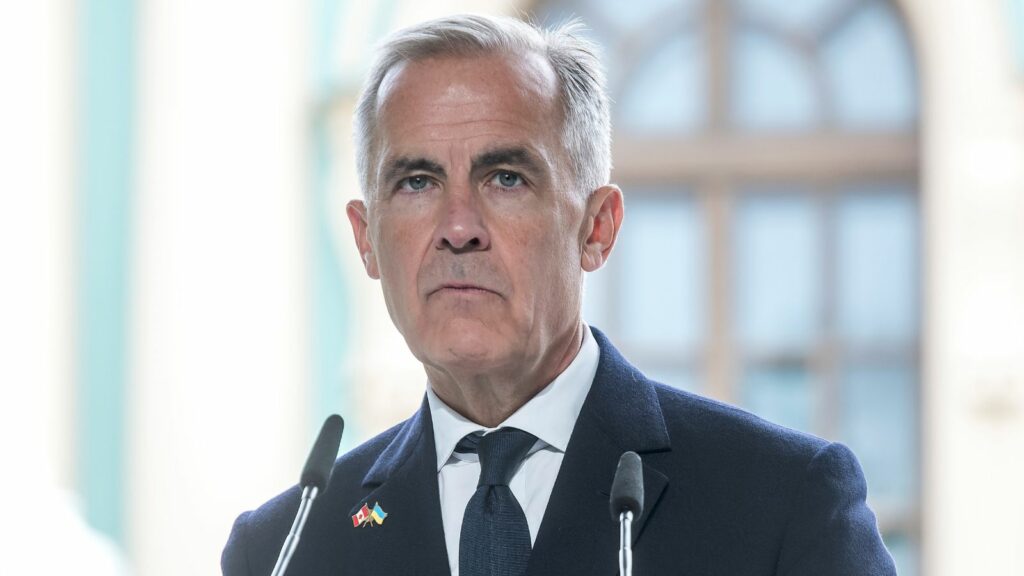
Canada’s increasingly strained relationship with the United States is drawing unusually strong support from one of Europe’s most influential countries. France’s new ambassador to Canada has described Washington’s demands as “extremely radical” while praising Prime Minister Mark Carney for refusing to compromise on Canadian interests.
In an interview published October 11, 2026, French Ambassador Hélène Farnaud-Defromont said Canada has earned admiration in Europe for its handling of negotiations with U.S. President Donald Trump.
Her comments come as Ottawa accelerates efforts to strengthen its economic, defence and technological partnerships beyond Washington.
With another Canada–European Union summit approaching, France is positioning itself as a central partner in Carney’s effort to make Canada less vulnerable to American political and economic pressure.
France’s Ambassador Says Canada’s Response Deserves European Admiration
French Ambassador Hélène Farnaud-Defromont delivered an unusually direct assessment of American trade demands during an October 9 interview with The Canadian Press at the French Embassy in Ottawa. Speaking in French, she described Washington’s demands as “extremely radical” and called Prime Minister Mark Carney’s response “exemplary.” The ambassador, who began her Canadian posting in September, praised the Canadian government’s willingness to defend its economic interests without abandoning a measured diplomatic approach. Her remarks reflected France’s growing concern about the unpredictability of American trade policy and the difficulties facing countries that have traditionally depended on Washington as a reliable partner.
Farnaud-Defromont said France wants to become one of Canada’s closest European allies across virtually every major policy area. She identified defence, aerospace, energy, artificial intelligence and quantum technology as promising fields for deeper cooperation. Her comments went beyond routine diplomatic expressions of goodwill, conveying a desire to accelerate practical cooperation during a period of considerable international uncertainty. Although the interview did not announce a new bilateral treaty, it offered a clear indication of how France views Canada’s response to the Trump administration and why Paris wants its relationship with Ottawa to become more strategically important.
Carney’s Decision to Walk Away From U.S. Trade Talks Changed the Diplomatic Landscape
The ambassador’s praise follows one of the most consequential developments in recent Canada–U.S. trade relations. On August 21, Carney suspended negotiations with Washington after concluding that American proposals had become unacceptable. The prime minister said last-minute changes to the proposed agreement were economically damaging, unfair and inconsistent with Canada’s long-term interests. His decision came as the Trump administration prepared to impose a 50% tariff on approximately C$28 billion worth of Canadian goods. Rather than accept the proposed arrangement, Ottawa announced plans for equivalent retaliatory tariffs and additional support for affected Canadian businesses and workers.
In a subsequent address on August 22, Carney explained that Canada had been willing to negotiate compromises involving steel, aluminum, automobiles and certain administrative trade measures. However, he rejected demands that would weaken Canadian sovereignty or place essential industries at a structural disadvantage. Washington has disputed Canada’s characterization of the negotiations and maintains that it offered favourable terms. The full negotiating proposals have not been made public, making it important to distinguish Carney’s account from independently established details of every American demand. Nevertheless, the breakdown demonstrated that Ottawa was prepared to accept continued trade uncertainty rather than sign an agreement it considered harmful.
French Language and Cultural Sovereignty Became Important Canadian Red Lines
The disagreement between Ottawa and Washington extended beyond traditional issues involving tariffs and manufacturing. Carney specifically identified the protection of Canada’s French language and cultural identity as matters that could not be surrendered during trade negotiations. He also criticized American pressure involving the taxation and regulation of major technology companies. For Canada, these questions concern the government’s ability to establish domestic policies without allowing foreign commercial interests to dictate the rules. They are particularly sensitive because Canadian institutions have long maintained protections for cultural production, broadcasting and the country’s two official languages.
Those concerns help explain why the French ambassador’s comments carry significance beyond ordinary trade diplomacy. France has its own longstanding interest in protecting French-language culture, supporting domestic creative industries and maintaining national authority over digital policy. Both governments see cultural sovereignty as connected to wider questions of political independence. Their positions are not necessarily identical, and closer cooperation will not eliminate disagreements over commercial regulations. Still, the shared emphasis on language and the ability to regulate technology provides an additional foundation for the relationship. It also helps explain why Carney’s September address to European lawmakers resonated with French officials.
France Has Its Own Reservations About Trump’s Trade Strategy
France’s sympathy for Canada’s position is informed by Europe’s difficult experience negotiating with Washington. In July 2025, the European Union and the United States reached a framework agreement establishing a 15% tariff ceiling on many European products entering the American market, alongside selected exemptions. The arrangement also involved European commitments to eliminate tariffs on American industrial goods. Supporters argued that the agreement prevented a larger trade confrontation and provided companies with greater predictability. However, French President Emmanuel Macron criticized the imbalance, warning that Europe needed to demonstrate greater strength and protect its economic independence.
Macron’s objections reflected a broader debate among European governments about how to respond to American tariff pressure. Some leaders preferred compromise to protect export industries, while others believed accepting unequal terms risked encouraging further demands. The French ambassador’s remarks place Canada’s negotiating approach within that wider European discussion. However, the EU’s decision to maintain its agreement with Washington also demonstrates that France’s position does not represent a unanimous European rejection of American trade policy. European countries remain deeply connected to the U.S. economy and must balance diplomatic principles against commercial realities. Canada faces a similar challenge as it considers how to diversify without sacrificing established economic relationships.
Carney and Macron Are Turning Their Political Alignment Into Practical Cooperation
Relations between the two governments gained momentum during Carney’s September 20 meeting with President Emmanuel Macron in Saint-Pierre-et-Miquelon, the French territory situated near Newfoundland. It marked the first official visit by a Canadian prime minister to the archipelago. The location carried considerable symbolism, emphasizing that France is not only a European power but also a geographical neighbour of Canada. During their meeting, the leaders discussed strengthening economic resilience, protecting sovereignty and developing closer cooperation across strategically important industries.
One of their most concrete commitments involved space infrastructure. Carney and Macron directed their space agencies, defence ministries and relevant industries to explore shared capabilities, including launch systems and ground-based satellite reception and control facilities. They also welcomed a business partnership between the Canadian Chamber of Commerce and CCI France, designed to encourage trade diversification and commercial cooperation. Other discussions covered defence, aerospace, wildfire management, artificial intelligence and energy security. These initiatives remain at different stages of development, and not every announced priority represents a finalized investment or construction project. Nevertheless, they give the diplomatic relationship practical objectives that businesses, researchers and government agencies can pursue.
Carney Wants a New European Alliance Without Seeking Full EU Membership
Carney’s September 17 address to the European Parliament in Strasbourg provided the clearest explanation of his broader European strategy. He proposed a substantially deeper partnership between Canada and the European Union, built around complementary economic strengths and shared security interests. The prime minister argued that countries increasingly need reliable access to critical minerals, energy, artificial intelligence, defence equipment and secure communications. Instead of relying too heavily on a single powerful trading partner, he proposed building an international network capable of resisting economic and political coercion.
European Commission President Ursula von der Leyen had raised the possibility of creating a new form of associate membership for Canada, attracting considerable attention on both sides of the Atlantic. However, such a status does not currently exist as a formal category of EU membership, and Carney has clarified that Canada is not seeking full membership in the bloc. He has instead emphasized a specially designed alliance that could allow both sides to cooperate more closely without becoming part of the same political system. Proposals include easier digital trade, stronger research partnerships and more opportunities for young Canadians and Europeans to study or work abroad. The scope of any agreement remains subject to negotiation.
Defence Cooperation Is Already Producing Opportunities for Canadian Companies
Defence has become one of the clearest examples of Canada’s expanding European relationships. During Carney’s June 12 visit to Paris, Canada and France announced a General Security of Information Agreement intended to facilitate the exchange of classified information. Once implemented, the agreement is expected to improve cooperation involving defence procurement, cybersecurity, aerospace, maritime systems and advanced technology. Such arrangements matter because companies seeking sensitive defence contracts often need access to protected information before they can compete effectively or participate in international production partnerships.
Canada has also moved closer to the EU’s defence procurement system. In February 2026, it became the first non-European country to join the Security Action for Europe initiative, known as SAFE, which supports large-scale European military procurement through a €150 billion lending instrument. The commercial benefits are already beginning to emerge. In June, Ottawa announced that Montréal-based Marconi Technologies had secured a contract exceeding C$10 million to provide Canadian-made tactical radios to Poland’s Cyber Command. The project is expected to involve nearly 100 Canadian companies, with deliveries extending through 2030. Although these arrangements will not replace Canada’s existing NATO and American defence relationships, they provide additional markets for Canadian manufacturers and technology specialists.
Aerospace, Artificial Intelligence and Quantum Research Offer New Opportunities
The economic relationship between Canada and France is already producing tangible results in advanced manufacturing. During their June discussions, Carney and Macron highlighted France’s purchase of two additional DHC 515 firefighting aircraft manufactured by De Havilland Aircraft of Canada in Calgary. The aircraft are intended to strengthen France’s ability to respond to increasingly severe wildfire conditions while supporting Canadian aerospace manufacturing. For Canadian workers, such transactions illustrate how stronger European relationships can translate into demand for specialized products rather than remaining solely diplomatic commitments.
The governments are also pursuing cooperation in emerging technologies. On May 29, Canadian minister Evan Solomon and French minister Anne Le Hénanff signed a joint statement supporting deeper research collaboration in quantum science and technology. The agreement includes plans to encourage exchanges between researchers, develop specialized talent and strengthen opportunities for commercialization. Artificial intelligence is another priority, with both countries emphasizing secure and responsible development. At their September meeting, Carney and Macron also identified energy security and shared space infrastructure as areas requiring further attention. These commitments could generate opportunities for Canadian universities, entrepreneurs and established technology firms, although their long-term economic value will depend on investment, implementation and commercial adoption.
Canada’s Trade Numbers Explain Why Diversification Matters
Despite Ottawa’s growing international ambitions, the United States remains Canada’s dominant export market. Statistics Canada reported that approximately 71.7% of Canadian merchandise exports went to the United States in 2025, down from 75.9% in 2024. Exports to countries outside the U.S. increased by 17.2% during the same year, suggesting that Canadian companies were already finding additional opportunities abroad. However, the figures also reveal the scale of the challenge. A country sending more than seven-tenths of its goods exports to one destination cannot substantially rebalance its trade relationships overnight.
France provides a useful example of both the opportunities and the limitations. Bilateral merchandise trade between Canada and France totalled approximately C$15.2 billion in 2025, including C$5 billion in Canadian exports and C$10.2 billion in imports. France ranks as Canada’s third-largest merchandise export market within the European Union. Across the EU as a whole, bilateral trade in goods and services reached approximately C$178 billion in 2025. The numbers demonstrate that Europe is already an important commercial partner, but also that there is considerable room for expansion. Growing European sales could reduce Canada’s exposure to future American restrictions, although building new supply chains and customer relationships requires sustained investment and time.
France Still Has an Unresolved Dispute Over Canada’s European Trade Agreement
Despite the ambassador’s enthusiasm for stronger bilateral ties, France has not completed ratification of the Comprehensive Economic and Trade Agreement between Canada and the European Union, commonly known as CETA. The agreement was signed in October 2016 and has been provisionally applied since September 21, 2017. This allows most of its trade provisions to operate while member states complete their domestic approval procedures. France’s National Assembly approved ratification in July 2019, but the French Senate rejected the relevant ratification provision on March 21, 2024. France remains among 10 EU countries that have not fully ratified the agreement.
French agricultural concerns have played an important role in the dispute. Farmers and their political representatives have questioned whether Canadian products compete under sufficiently comparable production and regulatory standards. Supporters of CETA argue that the agreement benefits exporters and already includes safeguards for sensitive agricultural sectors. The disagreement illustrates an important limitation of diplomatic goodwill: even close allies can have substantial differences over trade policy. France can advocate stronger relations with Canada while continuing to face domestic resistance to aspects of an existing agreement. For Carney, that means European diversification will involve its own negotiations and political compromises rather than offering an entirely frictionless alternative to Washington.
The Montréal Summit Will Test Whether European Support Leads to Concrete Results
The next major opportunity to advance Carney’s European strategy is the Canada–EU summit scheduled for October 29–30, 2026, in Montréal. Carney is expected to host European Council President António Costa and European Commission President Ursula von der Leyen. The summit follows a series of high-level meetings and agreements involving defence, technology, critical minerals and economic security. France’s ambassador has emphasized the urgency of moving beyond broad diplomatic language toward practical commitments. Her message reflects concern that an ambitious partnership could lose momentum if governments spend too long negotiating terminology instead of establishing workable arrangements.
The most meaningful outcomes would be concrete measures that make it easier for Canadian and European businesses to invest, cooperate and sell products across the Atlantic. Progress on defence procurement, energy infrastructure, technological research and critical-mineral supply chains would provide evidence that the partnership is developing beyond political symbolism. However, the summit’s final agreements have not yet been announced, and no major breakthrough should be assumed in advance. Carney is also not proposing to sever Canada’s relationship with the United States, which remains indispensable to the Canadian economy and continental security. The strategy is better understood as an effort to create additional options. France’s unusually strong endorsement suggests that Ottawa may have a willing partner in that effort, but the coming months will determine whether diplomatic support produces lasting economic results.
