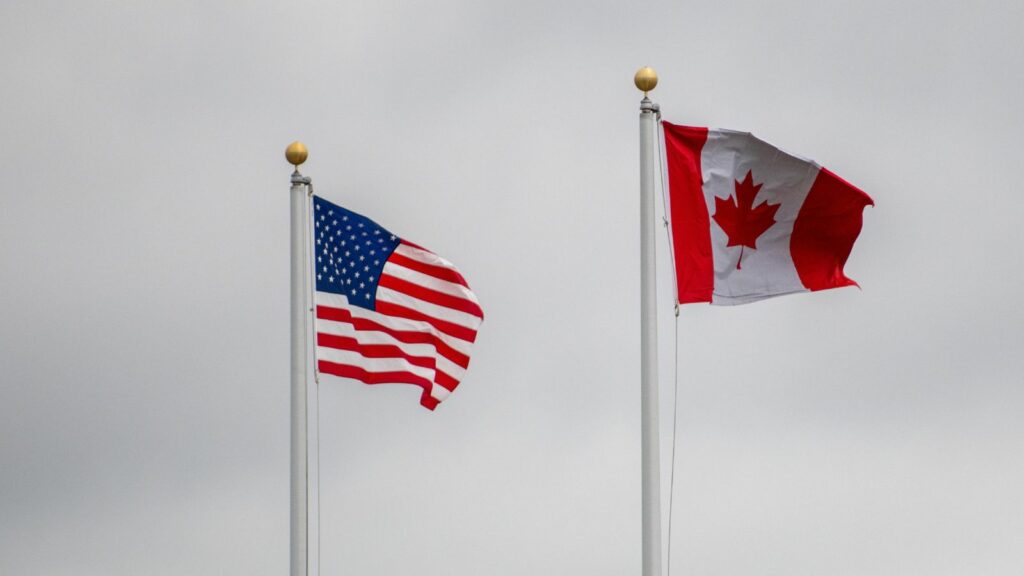
A prominent Republican running for the U.S. Senate has broken with President Donald Trump’s trade policies, calling for an immediate end to the escalating tariff dispute with Canada.
Michigan Senate candidate Mike Rogers delivered the message in a campaign advertisement released October 7, 2026, declaring that Canadians are not America’s enemies and warning that the ongoing trade confrontation is hurting families and businesses.
His remarks represent a notable shift for a Republican who previously defended Trump’s tariffs as part of an America First economic strategy.
The disagreement is particularly significant in Michigan, where automobile manufacturers, suppliers and thousands of businesses depend on trade with Canada. With the November 3 midterm elections approaching, Rogers’ position also reflects growing political pressure over tariffs, inflation and manufacturing jobs.
The question is whether his change in tone can influence Washington’s trade policy—or simply help his increasingly competitive election campaign.
Mike Rogers Delivers His Message From a Michigan Sports Bar
Rather than delivering a conventional political speech, Mike Rogers chose a familiar Michigan setting for his October 7 campaign advertisement. The 30-second video shows the former congressman sitting in a sports bar, holding a bottle of Labatt beer and referring to the Detroit Red Wings hockey team. The Canadian beer and Michigan’s longstanding hockey culture provide the backdrop for a message about the relationship between two closely connected economies.
Rogers then delivers the central declaration: “Here in Michigan, we know that Canada is not our enemy.” He follows it with a demand to end the tariff war immediately. Notably, the advertisement does not mention Trump by name, even though the president’s trade policies are the obvious subject. Rogers instead focuses on affordability, promising to work with both political parties to reduce prices for Michigan residents. The campaign strategy is deliberately local, presenting the dispute not as an abstract diplomatic disagreement but as something that affects ordinary families buying groceries, automobiles and household necessities.
The Republican Previously Supported Trump’s Tariff Strategy
Rogers’ latest position represents a meaningful departure from his earlier public statements. As recently as September, he defended Trump’s tariffs as part of the administration’s America First agenda. In an August statement, Rogers described tariffs as necessary while arguing that they should not be treated as a universal solution for every economic problem. His campaign had generally supported the president’s confrontational approach toward trading partners, including Canada.
The shift became more pronounced as the November election approached. Rogers’ October advertisement makes ending the Canadian tariff dispute an immediate priority rather than merely suggesting adjustments to particular measures. However, it does not establish that he opposes all tariffs or rejects Trump’s wider trade agenda. His distinction is increasingly between targeted trade enforcement and a prolonged confrontation that could damage Michigan’s economy. The timing has attracted criticism because the Republican is also distancing himself from Trump on the war with Iran, another issue associated with rising household expenses. Rogers maintains that protecting Michigan families requires practical solutions, even when that means disagreeing with the president.
Canada Is Michigan’s Largest Export Market by a Wide Margin
Michigan’s economic relationship with Canada helps explain why the trade dispute has become such an important political issue. According to the Office of the United States Trade Representative, Michigan exported approximately US$23.2 billion in goods to Canada during 2025. That represented about 39% of the state’s total merchandise exports, making Canada its largest international market. Mexico ranked second, receiving approximately US$16.6 billion in Michigan goods.
The relationship supports more than major automobile companies. Michigan exports transportation equipment, machinery, chemicals, electrical components and other manufactured products that move through extensive international supply chains. Federal trade statistics estimate that the state’s worldwide goods exports supported approximately 230,000 jobs in 2023, the latest year for which that employment estimate was available. That figure covers exports to all destinations, not Canada alone, but it demonstrates the importance of international commerce to Michigan’s workforce. When trade barriers make exports more expensive, the consequences can spread from factory floors to trucking companies, warehouses and small businesses. For politicians seeking votes in manufacturing communities, maintaining reliable access to Canadian customers is therefore a substantial economic concern.
The Windsor-Detroit Border Is Central to North American Manufacturing
Few places illustrate the close connection between Canadian and American manufacturing better than the corridor linking Windsor, Ontario, with Detroit, Michigan. The region connects automotive assembly facilities, parts manufacturers, logistics companies and industrial suppliers operating on both sides of the Detroit River. Components produced in one country can be shipped across the border for additional manufacturing before reaching another factory or final assembly facility.
The scale of the relationship is considerable. According to a July 2026 Canada Border Services Agency report, the Windsor-Detroit corridor carries approximately 30% of Canada-U.S. trade transported by truck, with more than C$274 million in daily trade moving through the gateway. The region includes the Ambassador Bridge, the Windsor-Detroit Tunnel and the newer Gordie Howe International Bridge infrastructure. These connections are essential to businesses that rely on predictable deliveries and carefully coordinated production schedules. Tariffs introduce additional costs into that system, potentially making cross-border sourcing less attractive. For workers in Detroit, Windsor and surrounding communities, the border is not simply a line between countries. It is part of the industrial network supporting their employment and economic security.
Trump’s Latest Tariffs Have Intensified the Canada-U.S. Dispute
The current confrontation escalated after the Trump administration announced additional tariffs on selected Canadian goods in July, with measures taking effect in August. Washington imposed duties reaching 50% on targeted Canadian imports under Section 338 of the Tariff Act of 1930. The Canadian government estimated that the new measures affected approximately C$27.6 billion worth of exports to the United States. They followed earlier trade restrictions affecting several major industries.
The White House has defended its approach by arguing that Canada maintains unfair trade practices, particularly involving dairy products and motor vehicles. The administration contends that additional tariffs are necessary to address discriminatory treatment and encourage fairer access for American exporters. Canadian officials reject the characterization that the country has treated the United States unfairly and argue that the new measures undermine longstanding commercial arrangements. Importantly, the 50% rate does not apply universally to every Canadian product entering the American market. Different goods face different rules, exceptions and trade requirements. Nevertheless, the threat of additional costs has created uncertainty for manufacturers deciding where to purchase materials, invest capital and produce goods for North American customers.
Michigan Business Leaders Warn That Tariffs Hurt Both Countries
Business organizations in Michigan have repeatedly warned that escalating tariffs could damage the region’s economy. In an August 2026 statement, Detroit Regional Chamber president Sandy Baruah argued that prolonged trade tensions would impose economic costs on both sides of the border. He emphasized that Michigan and southwestern Ontario have spent generations building integrated industries that depend on cooperation rather than separation.
The chamber has also highlighted the role of steel and aluminum in automobile manufacturing. Michigan companies need these materials to manufacture vehicles, components and industrial equipment, while Canadian producers depend on access to American customers. Tariffs can increase costs for the businesses purchasing imported materials, forcing them to accept smaller profit margins, negotiate higher prices or reconsider their supply chains. In September, Baruah compared Michigan’s commercial relationship with Canada to its connections with neighbouring American states such as Ohio and Indiana. His broader argument is that economic integration developed over decades cannot easily be replaced. Although tariffs may offer protection to certain domestic producers, companies that rely on imported inputs can experience the opposite effect. This helps explain why some Michigan business leaders have opposed measures presented as protecting American manufacturing.
Canada’s Retaliatory Tariffs Are Creating Additional Pressure
Canada has responded to Washington’s measures with tariffs of its own, turning the dispute into a confrontation affecting businesses in both countries. Beginning September 8, Ottawa imposed counter-tariffs of 15%, 25% and 50% on selected American-origin goods. The measures target approximately C$27.6 billion in U.S. imports and cover categories including steel, aluminum, dairy products, appliances, agricultural equipment, paper products and electronics.
Canada’s Department of Finance says the rates were designed to correspond with American tariffs affecting comparable products. The federal government also announced a C$7.5 billion package of new and expanded measures to assist workers and businesses affected by the trade dispute. For Michigan exporters, however, Canadian counter-tariffs introduce another potential obstacle. A manufacturer attempting to maintain sales in Ontario may find its products less competitive when additional import charges are applied. Canadian companies buying American equipment can face similar difficulties. These measures are intended to pressure Washington toward a negotiated settlement, but they can also create costs for businesses and consumers while negotiations remain unresolved. The result is an economically complicated situation in which both governments claim to be defending domestic interests.
Trump Responds by Blaming Canada Rather Than Rogers
President Trump addressed Rogers’ advertisement during remarks at the White House on October 7. Instead of publicly criticizing the Republican candidate, Trump interpreted the message as a demand for Canada to negotiate a better agreement with the United States. He argued that Rogers wanted Ottawa to make a deal, rather than suggesting that Washington should abandon its negotiating position.
Trump continued defending his broader trade approach, accusing Canada of taking advantage of the United States for years. He specifically criticized Canadian dairy tariffs and argued that his administration was determined to secure better terms for American producers. Those accusations represent Trump’s interpretation of the bilateral relationship and remain disputed by Canadian officials. His response was politically significant because Rogers is running with Trump’s endorsement in an important Senate contest. A direct confrontation between the president and his party’s candidate could create additional difficulties for Republicans hoping to win Michigan. By reframing the advertisement as pressure on Canada, Trump avoided acknowledging a fundamental disagreement while maintaining his existing negotiating position. Rogers, meanwhile, continued arguing that the tariff dispute needed to be resolved.
Democratic Rival Abdul El-Sayed Questions Rogers’ Sudden Reversal
Rogers’ Democratic opponent, Abdul El-Sayed, has responded sharply to the change in position. The former Michigan public health official argues that Rogers supported Trump’s tariffs when they were introduced and is now attempting to distance himself from their economic consequences. Following the October 7 advertisement, El-Sayed accused the Republican of changing his position because his political standing had weakened.
El-Sayed has consistently made the cost of living a major campaign issue, criticizing the administration’s tariffs and broader economic policies. He argues that trade restrictions have created uncertainty for businesses and increased expenses for Michigan families. However, his own position is more nuanced than a blanket rejection of tariffs. During the October 8 Senate debate, El-Sayed said targeted tariffs can have a role when they support a coordinated industrial strategy. His principal objection is to the administration’s unpredictable use of trade barriers. This creates an important distinction between the candidates: both now criticize the existing dispute with Canada, but they disagree about political responsibility and how trade enforcement should be designed. For voters, the competing arguments raise questions about consistency, economic credibility and which candidate can deliver meaningful results.
The Michigan Senate Election Could Help Determine Control of Congress
The political stakes extend well beyond the Canadian border. Rogers and El-Sayed are competing for the Senate seat being vacated by retiring Democratic Senator Gary Peters. The November 3 election is among the closely watched contests that could determine which party controls the U.S. Senate. Democrats need a net gain of four seats to secure a majority, making the outcome in Michigan particularly important to their national strategy.
Rogers previously represented Michigan in the U.S. House of Representatives and narrowly lost a Senate election to Democrat Elissa Slotkin in 2024 by fewer than 20,000 votes. El-Sayed, meanwhile, won a closely contested Democratic primary in August 2026. Both candidates are now seeking support beyond their traditional party bases. Michigan has voted for presidential candidates from both major parties in recent elections, making independent voters potentially influential. The tariff dispute offers Rogers an opportunity to present himself as willing to challenge Trump when Michigan’s economic interests are at stake. For El-Sayed, it provides an opportunity to argue that Republican support for the president helped create the problem. That political tension makes trade policy a central issue in a race with national consequences.
The First Senate Debate Exposes the Limits of Their Disagreement
The candidates confronted the Canada tariff issue directly during their first televised Senate debate in Grand Rapids on October 8. Rogers was questioned about his earlier support for tariffs and his subsequent demand to end the current dispute. He responded that he had contacted the White House and spoken with the U.S. commerce secretary about reaching an agreement with Canada. He also indicated that American tariffs on Canada had become too high and should be eliminated.
El-Sayed criticized the administration’s approach as disruptive and expensive for Michigan residents. However, neither candidate ruled out using tariffs under all circumstances. The Democrat suggested that carefully designed measures could complement an industrial policy, while Rogers maintained that negotiations should secure favourable terms for American businesses. The debate became combative, with frequent interruptions and personal attacks, demonstrating how difficult it may be to find common ground despite overlapping concerns about affordability. Rogers subsequently explained that he had originally expected the Canadian dispute to be resolved quickly. Because that had not happened, he argued that Washington needed to bring the negotiations to a conclusion.
Growing Republican Unease Is Becoming a Wider Political Trend
Rogers is not the only Republican candidate attempting to establish some distance from the president ahead of the midterm elections. A Reuters review published October 7 found that roughly two-thirds of Republican candidates in competitive congressional races had either disagreed with Trump on selected policies or tried to distinguish their campaigns from his administration. The pattern reflects concerns about how economic dissatisfaction could influence voters in closely contested states and districts.
For Rogers, the change has involved more than Canadian trade. In September, he also called for a rapid end to the war with Iran, linking the conflict to higher fuel and household costs. His willingness to challenge the administration on these issues does not mean he has abandoned Trump’s wider political agenda. Instead, the campaign appears to be emphasizing areas where local economic interests and national policy may conflict. Political-science professor Matthew Lebo of Western University has observed that Michigan’s competitive electoral history gives candidates incentives to appeal beyond their traditional supporters. Rogers’ decision to speak openly about Canada may therefore reflect both genuine economic concerns and the political realities of seeking statewide office.
A Trade Agreement Remains Uncertain Despite Calls for Resolution
Rogers’ appeal comes during a period of broader uncertainty surrounding the Canada-United States-Mexico Agreement, known in Canada as CUSMA. During the agreement’s scheduled joint review on July 1, 2026, Washington declined to renew the pact in its existing form. However, the trade agreement remains in force while the participating countries continue discussions. The unresolved review adds another layer of uncertainty for manufacturers whose investment decisions depend on predictable North American trading rules.
The latest diplomatic signals suggest that an immediate breakthrough is not guaranteed. On October 8, U.S. Trade Representative Jamieson Greer said Washington was maintaining its position in talks with Canada, although senior officials continued communicating. Rogers believes the relationship can be repaired through negotiations and has suggested that his connections with the administration could help achieve that outcome if elected. Nevertheless, a Senate candidate has no direct authority to remove presidential tariffs or conclude an international trade agreement. Any meaningful resolution would require decisions by the governments involved. For Michigan businesses and Canadian exporters, the priority remains restoring stable market access and establishing rules that companies can rely on.
Rogers’ declaration that Canada is not America’s enemy has captured attention precisely because the two economies are so closely connected. The message may help shape Michigan’s election, but its larger significance will depend on whether political pressure produces a lasting improvement in trade relations. Until then, manufacturers, workers and consumers on both sides of the border remain exposed to the consequences of an unresolved dispute.
