Donald Trump has added another familiar geographic feature to his renaming wish list: an entire ocean. During an October 10 campaign rally in Tennessee, the U.S. president joked about calling the Atlantic or Pacific the “Trump Ocean” or the “Ocean of the Americas,” reviving a naming debate that has already strained relations with Canada.
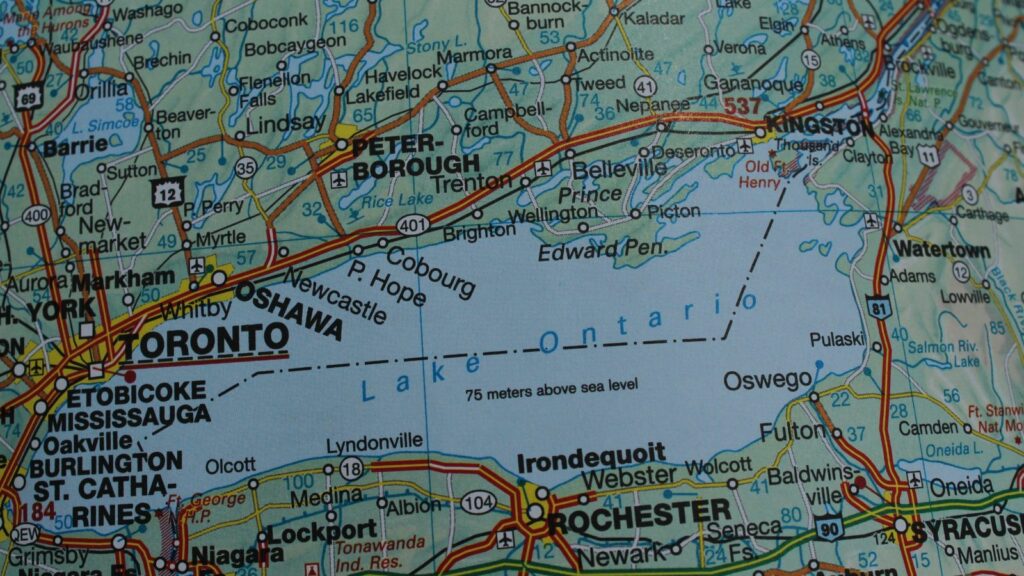
The remarks came weeks after Trump ordered Lake Ontario renamed “Lake America” for U.S. federal purposes, a move Canadian leaders rejected. The ocean suggestion has not become a formal policy, but the earlier lake dispute shows how presidential statements about geography can reach government records, digital maps and diplomatic conversations.
It also highlights the difference between changing an American label and changing a name accepted around the world.
Trump Brings the Ocean-Naming Idea to a Tennessee Rally
Speaking in Clarksville, Tennessee, on October 10, Trump revisited his administration’s changes to geographic names and suggested the project was not finished. He told supporters the country already had a gulf and a lake with new U.S. designations but still needed a river and an ocean. The possibilities, he said, included the Atlantic or Pacific, with “Trump Ocean” and “Ocean of the Americas” floated as alternatives. The crowd responded with laughter and applause, according to contemporary reporting and a White House press-pool account of the speech.
The comments were delivered during a campaign appearance ahead of the November 3 midterm elections, not at a signing ceremony or a government announcement. Trump was promoting Republican candidates and discussing manufacturing, tariffs and foreign affairs when the subject turned to names. Importantly, the ocean idea was not entirely new: while unveiling the Lake Ontario order in August, he had already mused about renaming the Atlantic or Pacific, perhaps even both. Saturday’s remarks revived that earlier thought with the more personalized suggestion of an ocean bearing his own name.
The Lake America Dispute Began With an Executive Order
On August 27, 2026, Trump signed Executive Order 14422 directing the U.S. government to replace the name Lake Ontario with “Lake America” in its federal geographic records. The order instructed the secretary of the interior and the U.S. Board on Geographic Names to make the change within 30 days and update the Geographic Names Information System. It also directed federal agencies to use the new designation on maps, documents and communications. Unlike the recent ocean comments, this was a specific written instruction to government officials.
Lake Ontario is one of the five Great Lakes, stretching between Ontario and New York and connecting through the St. Lawrence River to the Atlantic. Roughly half its surface lies on each side of the international boundary. The U.S. order did not move that boundary, transfer any water or require Canada to accept the American label. Its reach was principally federal naming practice. That distinction matters because the lake remains a shared natural resource, however differently it may appear on official maps produced by the two countries.
Canadian Leaders Refuse to Give Up the Name Lake Ontario
Prime Minister Mark Carney responded to the August order by emphasizing that Lake Ontario’s name has been used for centuries and has Indigenous roots. He insisted Canadians would continue using the familiar name, while Ontario Premier Doug Ford publicly rejected Washington’s choice. Ford also promoted a lakeside sign affirming Lake Ontario’s identity. Opposition was not limited to Canadian officials: New York Governor Kathy Hochul said her state would not adopt the new designation, despite sharing the shoreline with Ontario.
The dispute also touched an older history than either modern country. Grand Chief Pierre Picard of the Wendat Nation in Quebec condemned the renaming and argued that it disregarded Indigenous heritage. Canada’s own geographical names database continues to list “Lake Ontario” as the official name, underscoring the distinction between the two governments’ decisions. For communities that live beside the lake, the argument is therefore about more than typography. It concerns the weight given to longstanding usage, cultural history and the right of a neighbouring country to describe a shared place in its own terms.
The Name Fight Unfolded During a Serious Trade Breakdown
The lake order arrived just days after a collapse in Canada-U.S. trade talks. In August, Washington imposed new tariffs of 50% on a range of Canadian products valued at roughly US$20 billion, and Ottawa announced retaliatory measures. The two governments disagreed over why their negotiations had failed. Trump linked his proposed renaming directly to the economic dispute, saying in an earlier social-media message that he did not expect much future business with Ontario. The lake became an unlikely backdrop to arguments about tariffs and cross-border commercial relationships.
The economic stakes were considerably more substantial than the dispute over terminology. Ontario manufacturers and exporters face decisions about orders, investment and employment when tariffs increase the cost of shipping goods south. American businesses also depend on Canadian customers, components and supplies. By October, the countries were still communicating, but U.S. Trade Representative Jamieson Greer said Washington was holding to its negotiating position. This context helps explain why Canada’s reaction to “Lake America” was unusually firm: the words appeared amid an active confrontation over trade, rather than as an isolated proposal to update a map.
The Gulf of America Provided a Real Precedent
Trump’s naming campaign began earlier. On January 20, 2025, he signed Executive Order 14172, which instructed federal officials to adopt “Gulf of America” for the U.S. continental-shelf area previously referred to as part of the Gulf of Mexico. The Department of the Interior followed with a secretary’s order in February, and the U.S. Geological Survey added the designation to its official naming database. Trump also proclaimed February 9, 2025, “Gulf of America Day.” Those steps show that the administration has previously turned political language about geography into official American government usage.
The change did not require Mexico, Cuba or international bodies to stop saying Gulf of Mexico. It nevertheless triggered a dispute over terminology, including friction with the Associated Press when the news organization continued using the longstanding name. For ordinary travellers, the gulf remained in the same place, with the same coastlines and shipping routes. The controversy concerned which name appeared in official communications and on public-facing services. When Trump spoke in Tennessee about acquiring an ocean name, the gulf decision supplied both a precedent for executive action and a warning that an apparently symbolic change can produce real disagreement.
Renaming an Entire Ocean Would Be a Much Bigger Undertaking
The Atlantic and Pacific are not comparable to a single lake, even one spanning an international border. The Pacific is the world’s largest and deepest ocean basin, covering more than 155 million square kilometres—over 30% of Earth’s surface—according to the U.S. National Oceanic and Atmospheric Administration. The Atlantic is the second-largest ocean basin. Both border numerous countries, carry international shipping and connect communities whose histories and languages long predate modern American political debates. Canada itself faces the Atlantic to the east and the Pacific to the west, giving Canadians an immediate stake in how those names are used.
An American administration could potentially change the terminology its own agencies employ, but that would not establish an internationally accepted replacement for either ocean. Hydrographic organizations use established geographic terms to make nautical documents consistent, and other governments maintain their own naming practices. A different label in Washington would not erase names from schoolbooks, foreign atlases or national hydrographic charts elsewhere. Nor would choosing “Trump Ocean” give the United States control over waters belonging to other countries. The sheer scale of the proposed change makes the distinction between a domestic naming decision and worldwide recognition impossible to ignore.
U.S. Geographic Naming Authority Has Clear Limits
The United States already has a system for deciding which geographic names federal agencies use. The U.S. Board on Geographic Names was created in 1890 and reorganized under federal law in 1947 to standardize government terminology. Working with the interior secretary, it maintains official naming practices, while the U.S. Geological Survey operates the Geographic Names Information System for domestic features. Those mechanisms were used for Lake America. A president’s directive can affect federal maps, databases and communications, but an American administrative decision is not automatically binding on foreign governments.
Canada maintains a separate system through the Geographical Names Board of Canada and official provincial and federal records. That independence helps explain how one lake can have different labels on opposite sides of the border. Naming authority is also distinct from jurisdiction at sea. NOAA identifies American maritime zones, including a territorial sea generally extending 12 nautical miles and an exclusive economic zone extending up to 200 nautical miles from relevant baselines. These legal limits are not enlarged by changing an ocean’s name. Any future ocean directive would therefore raise questions about federal terminology, not alter international maritime boundaries by itself.
Digital Maps Have Already Turned the Lake Dispute Into Daily Reality
The Lake America order did not remain confined to government paperwork. Google Maps began displaying “Lake America” to users in the United States at the end of August, and Apple Maps followed in early September. Canadian users of both services continued seeing Lake Ontario, while users in other countries could see both names. The approach means two people searching for the same stretch of water may encounter different labels based on where they access a mapping service. It is a practical illustration of how official naming choices can shape what appears on millions of screens.
Not every company adopted the new label. MapQuest continued using Lake Ontario, and downloads of its mobile app surged in early September, reaching the top of free-app rankings in both Canada and the United States, according to the Associated Press. The disagreement also encouraged some consumers to investigate alternative map services and their privacy practices. There is no evidence that this digital response has changed the lake’s physical geography. But it shows why a proposed ocean rename is more than a throwaway line: if an official order followed, technology companies would again face decisions about what names to show and where.
Rivers, New Mexico and the Strait of Hormuz Have Also Come Up
Trump’s October 10 remarks went beyond the Atlantic and Pacific. During the same appearance, he mused about calling the Strait of Hormuz the “Trump Strait,” a suggestion made amid his discussion of the conflict involving Iran. He also told the crowd he wanted a major river to rename, although he said he would leave the Hudson and Mississippi rivers alone. The Hudson, he explained, already carried the name of an explorer he admired. The remarks mixed humour, personal branding and references to geographic features whose existing names carry long histories.
Another recent proposal concerned New Mexico. In September, Trump circulated the idea of calling the state “New America,” prompting objections from its elected leaders. Unlike a federal decision about a lake’s name, changing a state’s legal name would require a process beyond a unilateral presidential directive; New Mexico’s name appears in its state constitution. The various suggestions therefore do not all stand on the same legal footing. One has already become a federal name change, another concerns a state’s constitutional identity, and the ocean and strait ideas remain rhetorical proposals without announced implementation orders.
The Shared Great Lakes Still Depend on Cross-Border Cooperation
For residents around Lake Ontario, the most important facts about the water have not changed. The lake supports drinking-water supplies, boating, commercial navigation, shoreline communities and ecosystems on both sides of the border. Its outflow into the St. Lawrence River is managed under arrangements involving both countries, including the International Joint Commission established by the Boundary Waters Treaty of 1909. The commission’s Lake Ontario–St. Lawrence River regulation framework, known as Plan 2014, takes account of water levels, wetland health, hydropower production, navigation and flood risks.
Those responsibilities involve practical decisions that cannot be settled with a new label. A marina owner concerned about fluctuating water levels, for example, needs reliable forecasts and coordinated management, regardless of what an American map calls the lake. The same is true of municipal water systems, shipping companies and shoreline homeowners. Neither the August executive order nor Trump’s October rally remarks announced changes to those cooperative arrangements. The naming controversy is consequential as a symbol of political relations, but it should not be mistaken for a renegotiation of the treaty or an attempt that has legally transferred control of shared waters.
The Next Question Is Whether the Joke Becomes an Order
For now, “Trump Ocean” is a suggestion made on the campaign trail, not an official replacement for the Atlantic or Pacific. Trump’s comments drew attention because earlier remarks about Lake Ontario did lead to a signed executive order, a federal database change and revised commercial maps. Yet there is no comparable announced order for either ocean in the October 10 reporting. The president did not identify which ocean would be selected, how broadly the new name would apply or what procedure his administration would use. Those unanswered questions separate a rally flourish from an actionable government policy.
The political response to Lake America also suggests that further renaming efforts would face scrutiny. A Reuters/Ipsos poll released in September found 63% of surveyed Americans opposed changing Lake Ontario’s name, while 14% supported it. The Tennessee speech took place as Republicans prepared for November’s midterms, with tariffs and the cost of living among the issues facing voters. For Canada, the immediate position remains clear: Lake Ontario is still its official name. Whether another American geographic label is formally changed will depend on decisions made after the rally, not on applause for a remark from the stage.
