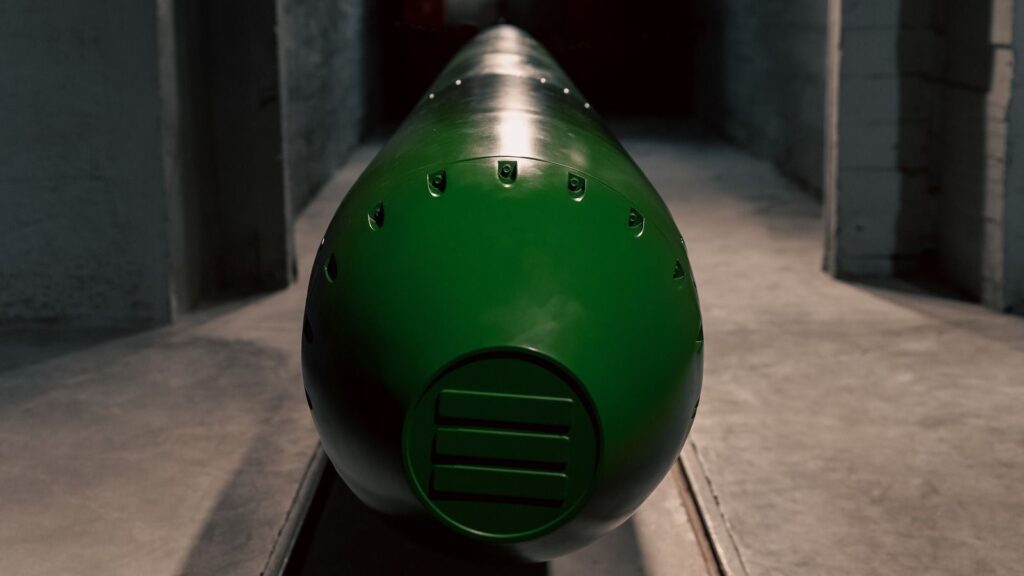
A significant change to American military export regulations is creating new possibilities for underwater drone manufacturers just as Canada moves to strengthen its own defence industry.
Effective October 19, 2026, the U.S. State Department relaxed restrictions on certain uncrewed underwater vehicles, transferring eligible technologies out of the country’s most restrictive military export-control system. The decision could make some international sales and technology partnerships easier, although important security restrictions remain.
For Canada, the development arrives during a major shift in defence policy. Prime Minister Mark Carney’s government wants more military equipment designed, manufactured and maintained domestically, reducing dependence on foreign suppliers while preserving essential alliances.
The intersection of these policies raises an important question: can Canada build a stronger independent defence industry while continuing to benefit from American technology and military cooperation?
Washington Eases Restrictions on Selected Underwater Drones
The U.S. State Department’s regulatory change took effect on October 19, following publication in the Federal Register on September 18. The interim final rule modifies Category XX of the United States Munitions List, removing certain uncrewed underwater vehicles from controls administered under the International Traffic in Arms Regulations, commonly known as ITAR. The affected vehicles move under the Export Administration Regulations overseen by the U.S. Department of Commerce, provided they are not controlled elsewhere on the Munitions List. The change reduces regulatory burdens without eliminating government oversight.
American officials determined that the affected systems no longer provide the kind of critical military or intelligence advantage that justifies the more restrictive classification. The Department of Defense agreed with that assessment. Previously, qualifying underwater vehicles could face stringent licensing requirements even when their capabilities overlapped with commercial equipment used for scientific or industrial purposes. The revised approach is intended to concentrate the strictest controls on more sensitive technologies. For manufacturers and international customers, it creates a potentially simpler regulatory environment, although actual export permissions will still depend on the equipment and destination.
The New Rules Draw a Line at 8,000 Pounds
The change is more specific than a general exemption for underwater drones. It focuses on certain untethered vehicles weighing more than 3,000 pounds but no more than 8,000 pounds, approximately 1,361 to 3,629 kilograms. Previously, qualifying vehicles designed to operate autonomously for more than 24 hours or travel more than 70 nautical miles were covered by particular military export controls. The revised rules also consider how a vehicle navigates, distinguishing relatively straightforward automated movement from more advanced route-planning capabilities.
Vehicles within that weight range can remain on the Munitions List when specially designed for extended autonomous operation and sophisticated navigation beyond fixed waypoints, station-keeping or standard collision avoidance. Larger qualifying vehicles exceeding 8,000 pounds remain subject to the relevant controls, while equipment with anti-recovery features, such as self-destruction mechanisms, may fall under separate restrictions. The distinction matters because two underwater drones of similar size can face different export requirements depending on their capabilities. Manufacturers must therefore examine technical specifications carefully rather than assume that an entire product category has been deregulated.
Easing Export Controls Does Not Eliminate Security Restrictions
Moving equipment from ITAR jurisdiction to the Commerce Department’s Export Administration Regulations generally reduces the regulatory burden for eligible products. However, that does not mean manufacturers can sell underwater drones anywhere without government approval. Export licensing can still depend on the destination country, the technology involved and the intended customer or use. Washington’s decision simplifies the treatment of selected systems while preserving oversight of equipment that could pose military or intelligence risks. The change also does not automatically alter Canada’s separate export-control obligations.
Canada already has a special relationship with American defence export regulations. Under ITAR Section 126.5, some unclassified defence articles can be exported to qualified Canadian recipients without an individual licence, subject to exceptions and conditions. Transfers to other users or countries may still require approval. Canadian companies must also comply with domestic rules covering military and strategic goods, including applicable permits and Controlled Goods Program registration. For firms working across the border, the American change could reduce compliance complexity in certain cases, but it is not a blanket authorization for unrestricted technology transfers.
Underwater Drones Serve More Than Military Missions
Underwater drones increasingly perform jobs that once required specialized crews and expensive research vessels. Autonomous underwater vehicles can map the seafloor, collect environmental information and examine areas that are difficult or dangerous for people to reach. The U.S. National Oceanic and Atmospheric Administration uses such equipment for hydrographic surveys, marine research and identifying underwater hazards. In August 2026, NOAA reported that two long-range autonomous vehicles collected more than 68,000 seabed images during a fisheries research mission in the Mid-Atlantic.
Many of the technologies have obvious military applications. Sonar systems that map underwater terrain can also assist naval surveillance, while autonomous vehicles used to inspect infrastructure may provide capabilities relevant to protecting ports and subsea cables. This overlap helps explain why export rules require careful distinctions. A vehicle designed for routine surveys may not require the same restrictions as a sophisticated military reconnaissance platform. The challenge for regulators is to protect genuinely sensitive technology without placing unnecessary obstacles in front of commercial innovation, scientific cooperation and legitimate international sales.
Carney Wants Canadian Companies to Win More Defence Contracts
Canada’s approach is being reshaped by the Defence Industrial Strategy introduced by Prime Minister Mark Carney on February 17, 2026. The government wants Canadian companies to receive 70% of defence acquisitions, while strengthening domestic manufacturing, research and supply chains. Ottawa has identified approximately C$180 billion in defence procurement opportunities and C$290 billion in defence-related capital investment opportunities over the next decade. Those figures describe the scale of the strategy’s ambitions, not contracts already awarded to Canadian businesses.
The government’s approach is organized around a framework described as build, partner and buy. Canada intends to manufacture equipment domestically where it has suitable capabilities, collaborate with trusted international partners where cooperation makes sense, and purchase foreign systems when necessary. Uncrewed underwater vehicles, marine sensors and other autonomous systems are among the priority areas. Ottawa also projects that implementing the broader strategy could create 125,000 jobs and increase defence exports by 50%. These are long-term targets rather than guaranteed outcomes. The strategy’s success will ultimately depend on procurement decisions, industrial capacity and whether Canadian firms can deliver equipment competitively.
A New Canadian Drone Initiative Could Accelerate Development
The federal government took another step on July 23 by launching its Defence Drone Initiative. The program is intended to accelerate the development, testing and production of Canadian uncrewed systems for the Canadian Armed Forces and Canadian Coast Guard. Its scope extends beyond aerial drones to include autonomous ground vehicles and uncrewed maritime systems operating both above and below the water. The Defence Investment Agency is working with National Defence to connect military requirements with Canadian companies capable of developing useful technology.
The initiative emphasizes moving promising prototypes into operational testing, a process that can otherwise take years. Canadian firms were invited to apply for a supply arrangement, with the initial application period closing on August 14. Qualification allows businesses to compete for future opportunities but does not guarantee contracts. Ottawa is also investing in specialized research facilities. A new uncrewed-systems innovation hub in Mirabel, Quebec, received a commitment of C$29.6 million over two years. The investment is intended to give researchers, manufacturers and military personnel opportunities to test advanced systems in secure environments and identify which technologies are ready for wider use.
Canadian Robotics Firms Already Have International Customers
Canada is not starting from zero in underwater robotics. Burnaby-based Cellula Robotics develops autonomous underwater vehicles for defence, scientific and commercial applications. In April 2026, the company reported that its hydrogen-powered Envoy vehicle completed a submerged mission exceeding 2,000 kilometres. Cellula has also collaborated with Defence Research and Development Canada on long-endurance underwater technology. In May, its American subsidiary announced a 10-year agreement with U.S. defence technology company Metron to pursue next-generation underwater capabilities for American customers.
Newfoundland-based Kraken Robotics provides another example. The company announced approximately C$24 million in defence orders in March 2026, covering underwater batteries and sonar technologies for customers across five countries. In September, Canadian procurement records also documented a contract worth approximately C$2.65 million with Kraken for subsea environmental acoustic mapping and sensing research. Not all of these products are themselves underwater drones, and there is no confirmed evidence that the latest American regulatory change directly affects either company’s announced contracts. Nevertheless, their international partnerships demonstrate that Canadian expertise already contributes to an expanding underwater technology industry.
Protecting the Arctic Makes Underwater Surveillance a Priority
The importance of underwater technology becomes clearer when considering Canada’s geography. The country has the world’s longest coastline and maritime approaches spanning the Atlantic, Pacific and Arctic oceans. Monitoring such an extensive area presents serious logistical challenges, particularly in remote northern waters. Canada’s 2024 defence policy, Our North, Strong and Free, committed C$1.4 billion over 20 years toward specialized maritime sensors for ocean surveillance. The equipment is intended to improve awareness of underwater threats, including submarines, uncrewed systems and other potentially hostile activity.
Underwater drones could complement those investments by gathering information in locations where conventional surveillance is difficult or costly. Their role would differ from that of crewed submarines, which provide capabilities including deterrence and sustained military operations. In July 2026, Ottawa selected Germany’s Thyssenkrupp Marine Systems as the preferred supplier for negotiations on Canada’s next submarine fleet. That selection was not itself a completed procurement contract. Together, the submarine initiative, maritime sensors and interest in autonomous systems show that Canada is pursuing multiple ways to improve underwater awareness. The challenge will be making different technologies operate effectively as part of a coordinated defence network.
Canada Still Depends on American Defence Cooperation
Greater independence does not mean Canada is preparing to abandon its defence relationship with the United States. The two countries share responsibility for continental defence through the North American Aerospace Defense Command, or NORAD. Their armed forces routinely exchange information, conduct exercises and operate alongside one another. Canadian government briefing materials have also indicated that more than half of Canadian defence industry exports go to the United States, reflecting decades of interconnected manufacturing, technology development and procurement.
That dependence creates both opportunities and vulnerabilities. Easier American export rules may benefit selected Canadian buyers and partners, but reliance on foreign components can also expose manufacturers to licensing decisions and supply disruptions beyond Ottawa’s control. The Carney government’s strategy attempts to address those concerns through domestic production, intellectual property development and greater control over military equipment maintenance. At the same time, Canada’s plan explicitly allows partnerships with trusted allies when building everything domestically would be impractical. The goal is therefore not complete separation from Washington, but a stronger ability to make independent decisions while continuing to cooperate on shared security challenges.
The Real Test Will Be Canadian Production and Military Readiness
The American regulatory change is already in effect, but its commercial consequences remain uncertain. The State Department accepted public comments through October 19 and indicated that it may continue reviewing restrictions on autonomous navigation technologies. Its published assessment did not provide a numerical forecast of additional exports or identify particular Canadian companies expected to benefit. That makes claims of immediate investment gains premature. Manufacturers must still determine whether individual products qualify for the revised classification and what licensing requirements remain.
For Canada, the more important test will come through its own defence procurement and industrial development programs. Ottawa has identified autonomous systems as a strategic capability, created new paths for businesses to compete and committed funding to support research and testing. Those steps establish opportunities, but sustained results will require functioning equipment, trained personnel, reliable suppliers and contracts that support Canadian production over time. The U.S. decision may create additional flexibility for cross-border partnerships. Canada’s longer-term objective is different: developing enough expertise and industrial capacity to protect its interests without depending entirely on decisions made elsewhere.
