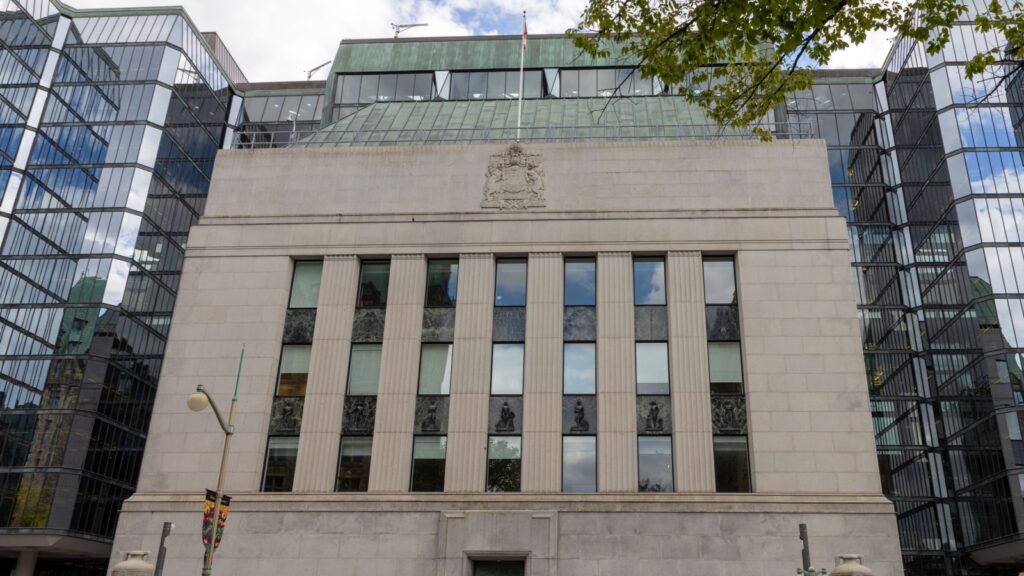
Canadian homeowners are facing a sudden shift in interest-rate expectations. Financial markets now see a much greater likelihood that the Bank of Canada will raise borrowing costs at its October 28 meeting, potentially ending a year-long period of unchanged rates.
According to Reuters, swap-market pricing on October 19 indicated an approximately 80% chance of an increase, compared with just 30% the previous Friday. The dramatic change followed renewed warnings about inflation, rising energy prices and the possibility that higher costs could spread throughout the economy.
For households carrying variable-rate mortgages or preparing to renew fixed-rate loans, the implications are significant. A rate increase has not yet been announced, but borrowing conditions can tighten before the central bank acts. The renewed uncertainty is arriving as Canadians continue managing expensive housing, substantial household debt and an increasingly fragile job market.
Rate-Hike Expectations Surged in Just One Trading Session
Financial markets dramatically changed their expectations for the Bank of Canada’s next decision on October 19. According to Reuters, overnight swap-market pricing indicated an approximately 80% probability of an interest-rate increase on October 28, up from 30% on Friday, October 16. That represents a 50-percentage-point shift in a single trading session, highlighting how quickly investors reassessed Canada’s inflation outlook.
The change followed comments from Bank of Canada Governor Tiff Macklem, who indicated that the central bank expects to raise its inflation forecast substantially because of persistently elevated crude oil and petroleum-product prices. Investors responded by pushing Canadian government bond yields higher and strengthening the Canadian dollar. The loonie gained approximately 0.3% against the U.S. dollar on October 19, reaching its strongest intraday level in nearly four weeks. However, market-implied probabilities are not official forecasts or decisions. They reflect financial contracts at a particular moment and can change rapidly as new economic information becomes available.
Canada’s Benchmark Interest Rate Remains at 2.25%
Despite the sudden increase in expectations, the Bank of Canada has not yet raised its policy interest rate. Its overnight target remains at 2.25%, where it has stood since October 2025. During its September 2 announcement, the central bank maintained that rate while acknowledging that persistent energy inflation and renewed trade tensions were making the economic outlook more uncertain.
The next scheduled decision is October 28, when the Bank will also publish its updated Monetary Policy Report. A conventional quarter-percentage-point increase would take the overnight rate to 2.50%, although policymakers are not obligated to follow market expectations. The Bank’s principal objective remains maintaining inflation near its 2% target while avoiding unnecessary damage to economic activity. That creates a difficult decision: higher borrowing costs could help restrain persistent price pressures, but they would also affect mortgage holders, businesses and consumers. For households already making expensive monthly payments, even a relatively small increase could become another recurring expense.
Rising Gasoline Prices Are Reviving Inflation Concerns
The latest inflation figures help explain why investors are reconsidering the possibility of higher interest rates. Statistics Canada reported that consumer prices increased 3.1% year over year in September, compared with 3.0% in August. The result pushed headline inflation slightly above the Bank of Canada’s 1% to 3% target-control range, although it remained below economists’ expectations of 3.2%.
Gasoline was a major contributor. Prices at the pump increased 27.8% compared with September 2025, while fuel oil and other fuels jumped 57.8%. Transportation costs rose 8.4%, creating additional financial pressure for commuters, transport companies and households dependent on vehicles. However, the broader inflation picture remains more encouraging. Excluding gasoline, consumer prices increased just 2.2%, down from 2.4% in August. Grocery prices rose 1.7% year over year, their slowest annual increase since May 2024. Policymakers must determine whether elevated energy costs will remain concentrated in fuel or increasingly affect prices throughout the economy.
Inflation Expectations Are Becoming a Bigger Concern
Two Bank of Canada reports released October 19 suggest that inflation expectations deserve close attention. The Canadian Survey of Consumer Expectations found that long-term inflation expectations increased during the third quarter, moving closer to already elevated shorter-term expectations. Canadians continued identifying energy prices and trade tensions with the United States as important reasons for expecting higher living costs.
The Business Outlook Survey presented a more complicated picture. Firms’ inflation expectations had eased overall compared with the previous quarter, but remained elevated. Responses gathered after the breakdown in Canada-U.S. trade negotiations indicated renewed pressure on costs and prices. Some businesses anticipated passing additional expenses along to customers, while hiring intentions remained relatively weak. These results matter because inflation expectations can affect actual pricing decisions. Businesses expecting higher costs may adjust prices, while workers may seek larger wage increases. However, weaker spending and excess production capacity could limit those pressures. The Bank must evaluate whether inflation expectations are translating into sustained price increases rather than reacting automatically to higher gasoline costs.
Variable-Rate Mortgage Holders Could Feel the Impact First
Variable-rate mortgage borrowers are among those most directly exposed to changes in the Bank of Canada’s overnight rate. When the central bank raises its benchmark, commercial lenders often increase their prime lending rates. Variable mortgage interest rates tied to prime generally move accordingly. However, the immediate effect depends on the type of mortgage agreement.
Borrowers with adjustable-payment variable mortgages generally see their required payments rise when interest rates increase. Those with fixed-payment variable mortgages may initially continue paying the same amount, but a larger share goes toward interest and less toward reducing the mortgage balance. If rates rise enough, borrowers can reach their contractual trigger rate, potentially requiring larger payments or other adjustments. The Financial Consumer Agency of Canada warns that these arrangements can create negative amortization, where unpaid interest causes outstanding debt to increase. A homeowner whose payment remains unchanged may therefore still be losing financial ground. Understanding the mortgage contract is essential because two households with similar loan balances can experience very different consequences.
What a Quarter-Point Increase Could Cost a Homeowner
Even a 0.25-percentage-point interest-rate increase can become meaningful when applied to a large mortgage balance. Consider a hypothetical homeowner with a $500,000 mortgage, a 25-year amortization period and an adjustable interest rate of 4.00%. Based on standard Canadian mortgage calculations, the monthly payment would be approximately $2,630. If the rate increased to 4.25%, the payment would rise to approximately $2,698.
That difference of roughly $68 per month adds up to about $818 annually, assuming the balance and remaining amortization are unchanged and the lender passes along the full increase. A second increase of similar size would create additional costs. Actual payment changes depend on the loan balance, remaining amortization, rate formula, payment frequency and lender policies. For a family already balancing mortgage payments, groceries, utilities, transportation and childcare, another recurring bill can reduce savings or discretionary spending. The financial impact is especially significant when higher borrowing costs arrive alongside rising everyday expenses.
Fixed-Rate Homeowners Are Not Entirely Protected
Homeowners with fixed-rate mortgages generally retain the same interest rate and scheduled payment until their existing term expires. That offers important short-term protection, but it does not eliminate exposure to rising borrowing costs. Renewal becomes the critical moment, especially for households that secured unusually low rates during the pandemic.
The Bank of Canada’s May 2026 Financial Stability Report estimated that the remaining pandemic-era five-year fixed-payment mortgages scheduled to renew over the subsequent 12 months represented approximately 12% of outstanding Canadian mortgages. Under the report’s assumptions, those borrowers faced average payment increases of roughly 15%. Actual outcomes could differ as market interest rates change. The Bank also found that most recent renewers had managed their higher payments, supported partly by mortgage stress tests. Nevertheless, borrowers with limited income growth or substantial outstanding balances could face more difficult adjustments. A household renewing a mortgage must consider not only the offered interest rate, but also its remaining balance and repayment period.
Higher Bond Yields Are Already Affecting Mortgage Rates
Mortgage rates do not move exclusively when the Bank of Canada changes its overnight target. Fixed mortgage pricing is influenced substantially by government bond yields, lender funding costs and financial-market expectations. As investors anticipate higher future interest rates, bond yields can rise before any official monetary policy announcement, placing upward pressure on new fixed-rate mortgage offers.
That process was visible on October 19, when Reuters reported that Canada’s benchmark 10-year government bond yield increased by approximately 11 basis points to 3.94%. Mortgage lenders also monitor bonds with shorter maturities, especially when pricing multi-year fixed products. Higher yields do not translate automatically into identical increases in every mortgage offer, but they can change the borrowing environment. The Canadian Real Estate Association has already highlighted the effects of rising fixed mortgage rates on housing demand. This means prospective buyers and homeowners approaching renewal could face higher quotes even if the Bank ultimately holds its policy rate steady on October 28. Waiting for the official decision does not necessarily prevent market rates from changing.
Canada’s Housing Market Is Showing Signs of Renewed Weakness
The latest housing statistics suggest that Canadians are already responding to tighter financing conditions. The Canadian Real Estate Association reported that national home sales declined 2.3% between August and September 2026. Sales were also 7.7% lower than in September 2025, while its national Home Price Index dropped 3.4% compared with a year earlier.
The national average sale price stood at $666,538 in September, down 1.6% year over year. CREA connected the latest pullback partly to rising fixed mortgage rates after several months of modest improvement in market activity. Higher borrowing costs can reduce how much prospective buyers qualify to borrow, potentially weakening demand further. Sellers may respond by adjusting asking prices or delaying transactions. However, falling prices do not necessarily make ownership more affordable when financing costs rise at the same time. For first-time buyers, the challenge involves the combination of down payments, mortgage qualification, monthly payments and broader household expenses. A renewed rate-hiking cycle could complicate that equation further.
High Household Debt and Weaker Hiring Raise the Stakes
Canadian households remain financially exposed to interest-rate changes despite some improvements in their overall balance sheets. Statistics Canada reported that household credit-market debt represented 176.4% of disposable income in the second quarter of 2026, down from 178.6% in the previous quarter. The household debt-service ratio also declined to 14.52%, suggesting a modest improvement in the share of disposable income used for required principal and interest payments.
The labour market, however, is showing signs of weakness. Employment declined by 68,000 positions in September after a decrease of approximately 42,000 in August. Canada’s unemployment rate increased to 6.5%, while manufacturing employment fell by about 13,000 in September. These figures help explain why raising interest rates is not a straightforward decision. Higher borrowing costs could reduce inflation pressure, but they might also discourage investment, weaken consumer spending and increase financial stress for households already uncertain about employment. The Bank of Canada has identified job losses as an especially important threat to household financial stability.
October 28 Could Set the Tone for Mortgage Rates Into 2027
The Bank of Canada’s October 28 decision will provide the clearest indication yet of how policymakers intend to respond to persistent energy costs and changing inflation expectations. Its accompanying Monetary Policy Report will be important because it will explain whether the Bank expects inflation pressures to fade naturally or require additional monetary tightening. The final scheduled rate announcement of 2026 follows on December 9.
For mortgage holders, the most useful preparation is understanding how different interest-rate scenarios would affect their finances. Borrowers approaching renewal can compare fixed and variable offers, review their repayment schedules and calculate affordability under higher rates. Homeowners with variable mortgages should understand whether payments adjust automatically or whether higher interest costs reduce principal repayment. The Financial Consumer Agency of Canada encourages borrowers experiencing financial difficulties to contact their lenders early to discuss available options. The central question is whether inflation will remain high enough to justify raising borrowing costs while Canada’s economic recovery remains uneven. Markets currently see a greater chance of tightening, but the Bank’s decision—and the longer-term impact on homeowners—remains uncertain.
