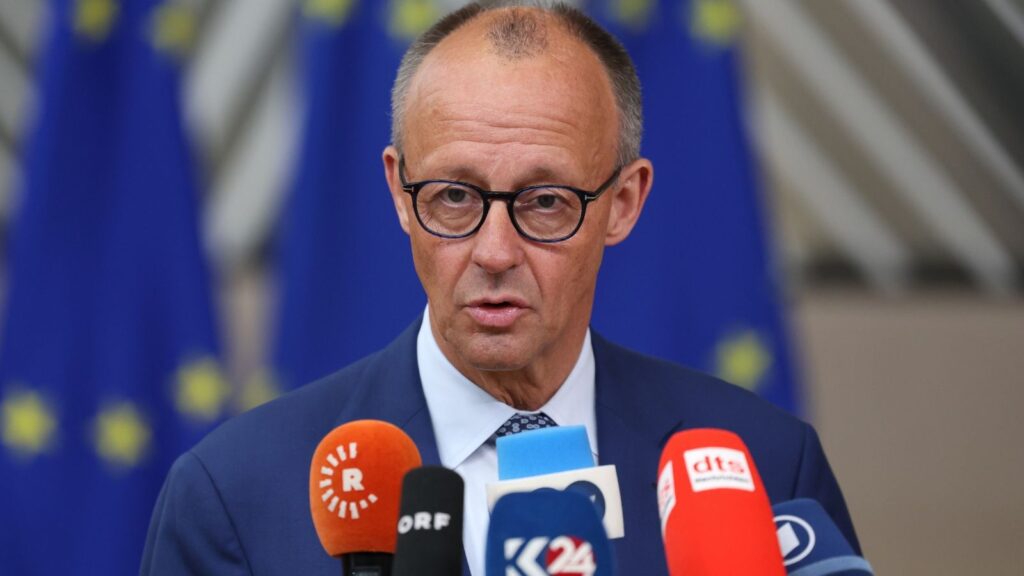
Canada’s search for more dependable trading relationships is drawing notice in Berlin. German Chancellor Friedrich Merz says the country has become “more pro-European than ever,” according to Reuters reporting on October 20, as Ottawa strengthens European ties amid continuing friction with Washington.
The relationship is acquiring practical weight through trade agreements, defence cooperation and proposed energy sales. For Canadian businesses facing uncertain access to their largest market, that offers possibilities beyond another diplomatic handshake. But Europe is not a ready-made replacement for the United States. The important question is whether warmer relations can produce lasting contracts, investment and jobs without simply exchanging one dependency for another.
Merz’s Message Was Also a Pitch to Investors
Merz made his assessment while promoting Germany as an investment destination in Berlin on October 20, 2026. The federal government’s Invest in Germany summit brought together roughly 200 business leaders and investors with senior politicians. Its agenda covered industries including energy, artificial intelligence, semiconductors and infrastructure. Against that backdrop, Canada’s closer relationship with Europe offered an example of the wider economic partnerships Berlin wants to encourage. The setting matters: Merz was addressing the investment climate, not announcing a new Canadian trade agreement.
His description should also be understood as a political judgment rather than a statistical finding about every Canadian’s views. Closer government cooperation does not establish unanimous public support, and enthusiasm from a foreign leader does not guarantee commercial results. Nevertheless, the remark is revealing. Germany is presenting stronger international partnerships as part of its economic future, while Canada is pursuing greater room to manoeuvre abroad. The challenge for both sides is converting that alignment into arrangements businesses can use.
U.S. Trade Friction Is Giving Diversification New Urgency
The immediate pressure is visible in the Bank of Canada’s October 19 business report. Responses gathered after Canada–U.S. trade negotiations broke down on August 21 showed weaker business sentiment, softer export expectations and renewed strain on investment plans. Companies also reported higher costs associated with American tariffs and Canadian counter-tariffs. For an employer deciding whether to buy equipment or add a shift, uncertainty over future border charges can complicate decisions even when customers are still placing orders.
The central bank’s findings require care. About three-quarters of its main interviews occurred before the breakdown, so the overall quarterly improvement does not describe conditions after the dispute intensified. Later responses showed some earlier gains reversing, although sentiment remained stronger than during the worst tensions of 2025. The report also supplied a concrete example of diversification: some Canadian aluminum businesses were entering European markets. That is a commercial response already being reported by firms, rather than simply an ambition voiced by political leaders.
Europe Is Already a Major Trading Partner
Canada is not starting its European trade push from scratch. The European Union’s 27 member states collectively form Canada’s second-largest trading partner for goods and services, behind the United States. Global Affairs Canada puts that two-way trade at C$178.6 billion in 2025. The Comprehensive Economic and Trade Agreement, known as CETA, has operated provisionally since 2017 and provides an established framework for companies seeking customers across the Atlantic. These are existing commercial relationships, not markets waiting to be developed.
The European Commission says CETA removes duties on 99% of tariff lines, with 98% eliminated when provisional application began. Those percentages describe categories of goods, not a guarantee that every shipment qualifies automatically. Exporters still need to meet applicable requirements, including rules establishing where products originate. Nor does removing tariffs remove product standards or every administrative obstacle. Even so, an established agreement gives a Canadian manufacturer something more useful than political encouragement: a set of trading rules around which it can evaluate a potential European sale.
Germany Brings an Established Commercial Relationship
Germany is Canada’s largest merchandise trading partner within the EU, with two-way goods trade reaching C$34.3 billion in 2025. Canadian exports accounted for C$9.2 billion, while imports from Germany totalled C$25.1 billion, according to Global Affairs Canada. Canadian shipments included machinery, mineral fuels, ores and chemicals. Services trade added another C$9 billion. Those figures show why Berlin matters to Ottawa: the relationship already reaches beyond a narrow exchange of raw materials for finished products.
Investment provides another connection. German direct investment in Canada stood at C$40.5 billion in 2025 when measured by the country of the ultimate investor. That is an accumulated investment stock, not money newly committed during Merz’s latest appearance. The distinction prevents diplomatic headlines from overstating immediate gains. It also highlights a practical opportunity: expanding existing business relationships may be more achievable than building entirely new ones. A German customer already familiar with Canadian suppliers could provide a starting point for additional contracts, while investment partnerships could help companies develop products for both markets.
Closer Association Does Not Mean Canada Has Joined the EU
Merz’s comment comes a month after a more ambitious proposal from Brussels. Addressing the European Parliament on September 17, Prime Minister Mark Carney welcomed European Commission President Ursula von der Leyen’s suggestion that Canada could become the bloc’s first associate member. He proposed deeper cooperation in critical minerals, energy, defence, artificial intelligence and financial services. He also raised expanded opportunities for young people to work and study across the Atlantic. The breadth of that agenda helps explain why European leaders see the relationship changing.
The September speech expressed ambitions; it did not itself create new immigration rights, open a common financial market or make Canada an EU member. Those distinctions are important for businesses and families considering what closer ties might mean. Practical benefits would depend on the terms negotiated and the approvals required for each arrangement. Rather than treating the label as a finished institutional design, the more useful question is what Canada and Europe can agree to do together—and what obligations each would accept in return.
Ottawa and Berlin Are Building a Broader Partnership
Canada and Germany mark 75 years of diplomatic relations in 2026, a reminder that their cooperation predates the latest tariff dispute. The next step is intended to give that relationship a more coordinated structure. After meeting on July 7, Carney and Merz announced work toward a partnership agreement covering defence, technology, investment, supply chains, raw materials, energy and space. They asked their foreign ministers to advance negotiations with the aim of completing the agreement before the end of the year.
Bringing those subjects together could help connect decisions that otherwise happen separately. A mineral-processing venture, for example, may need financing, research partners and an industrial buyer; treating each issue in isolation can leave a promising project without one essential piece. The proposed agreement offers a framework for identifying such connections. Its usefulness will depend on the specific commitments ultimately included and how they are implemented. A coordinated partnership could make cooperation easier to sustain beyond individual ministerial visits, particularly where projects require years rather than months to develop.
Critical Minerals Offer More Than a Raw-Materials Trade
Critical minerals provide one of the clearest areas of shared interest. On August 26, 2025, Canada and Germany signed a declaration aimed at securing supplies, expanding research cooperation and co-funding mineral projects. The Canadian announcement connected that work to electric vehicles, defence and aerospace. The attraction runs in both directions: Canada wants investment and dependable customers for resource development, while Germany wants reliable inputs for its industrial base. Cooperation on processing could make the relationship more valuable than a straightforward sale of unrefined material.
The same visit brought concrete company agreements. Troilus Gold reached a long-term supply arrangement with Hamburg-based Aurubis for future copper concentrate production. Quebec’s Torngat Metals and German magnet manufacturer Vacuumschmelze signed a memorandum toward a potential rare-earth supply agreement. The different stages matter: a preliminary understanding is not equivalent to a final purchase contract. For communities hoping to benefit from resource development, these relationships offer a connection between a proposed Canadian operation and a future industrial customer. Turning that interest into sustained employment still requires financing, infrastructure and projects that can operate economically.
A German Gas Contract Shows What Diversification Looks Like
Energy offers a particularly tangible example. On July 29, 2026, Ottawa announced a binding agreement under which Germany’s Uniper would buy two million tonnes of liquefied natural gas annually from the proposed Ksi Lisims project for up to 20 years. First deliveries are expected in 2032. The Nisga’a-led development on British Columbia’s northern coast links Canadian resources with a major European customer. Unlike a general promise to deepen cooperation, the agreement identifies a buyer, a volume and a prospective delivery timetable.
The timing also shows why new partnerships cannot immediately resolve today’s trade pressures. Ksi Lisims remains a proposed facility, with associated pipeline and electricity infrastructure still part of the development challenge. Natural Resources Canada says the Uniper arrangement is intended to benefit customers in Germany, the United Kingdom, Sweden and the Netherlands. For Canada, the commercial gain would be a broader customer base and a long-term outlet for gas. For the Nisga’a Nation, the opportunity includes participation in resource development—not simply watching a foreign buyer purchase exports.
Defence Cooperation Is Moving Beyond Diplomatic Support
Canada’s European ties now extend into joint defence procurement. In June 2026, the Council of the European Union formally concluded an agreement governing Canadian participation in Security Action for Europe, known as SAFE, after the agreement was signed in February. Canada became the first non-European country to join the initiative. The arrangement creates additional opportunities for Canadian industry to participate in eligible projects as European governments strengthen their defence capabilities and seek more dependable supply chains.
SAFE provides up to €150 billion in loans to participating EU countries; it is not a €150-billion payment to Canada. Canadian companies would still have to secure business through the relevant procurement arrangements. The opportunity is nevertheless significant because closer industrial cooperation can extend beyond selling finished equipment to developing components, technology and maintenance relationships. For Canada, that could mean additional customers for specialized capabilities. For Europe, a broader trusted supplier base could help meet security needs. Commercial gains will depend on actual purchasing decisions and delivery performance.
The Benefits Could Reach Professionals and Researchers
Closer ties are not limited to mines, gas terminals and military equipment. In January 2026, a Canada–EU agreement on recognizing architects’ professional qualifications entered into force. It creates a more streamlined route for eligible architects seeking recognition across the Atlantic. For a Canadian practice considering European work, that addresses a practical obstacle: whether the people designing a project can have their qualifications accepted. It does not remove every licensing requirement or automatically grant permission to immigrate.
Research cooperation offers another route into the relationship. Canada joined Pillar II of Horizon Europe in 2024, allowing eligible Canadian organizations to receive funding and lead collaborative projects under that part of the EU’s research programme. Such arrangements can connect universities and businesses before a commercial product exists. A research partnership may eventually support a new technology, while professional recognition can help a smaller firm pursue work abroad. These are less dramatic developments than a leaders’ summit, but they show how closer cooperation can affect individual careers and the opportunities available to specialized Canadian businesses.
The Goal Is More Options, Not a Replacement for America
The scale of Canada’s American relationship sets a limit on how quickly trade can shift. The United States received 71.7% of Canadian merchandise exports in 2025, down from 75.9% in 2024, according to Statistics Canada. That decline still left more than seven out of every ten merchandise export dollars dependent on U.S. buyers. Europe can provide additional customers and negotiating room without becoming an immediate substitute for that market. Diversification is better understood as reducing exposure to disruption than as choosing one trading partner and abandoning another.
The next scheduled opportunity to turn political enthusiasm into decisions is the Canada–EU summit on October 29–30, 2026. Alongside it, the proposed Canada–Germany partnership gives officials another set of commitments to develop. Businesses will have reason to look beyond the communiqués: new orders, accessible procurement opportunities and projects moving toward production would provide stronger evidence of progress. Merz’s assessment captures a diplomatic shift. Its lasting significance will depend on whether Canadians gain more dependable livelihoods and a wider choice of customers when the next trade dispute arrives.
