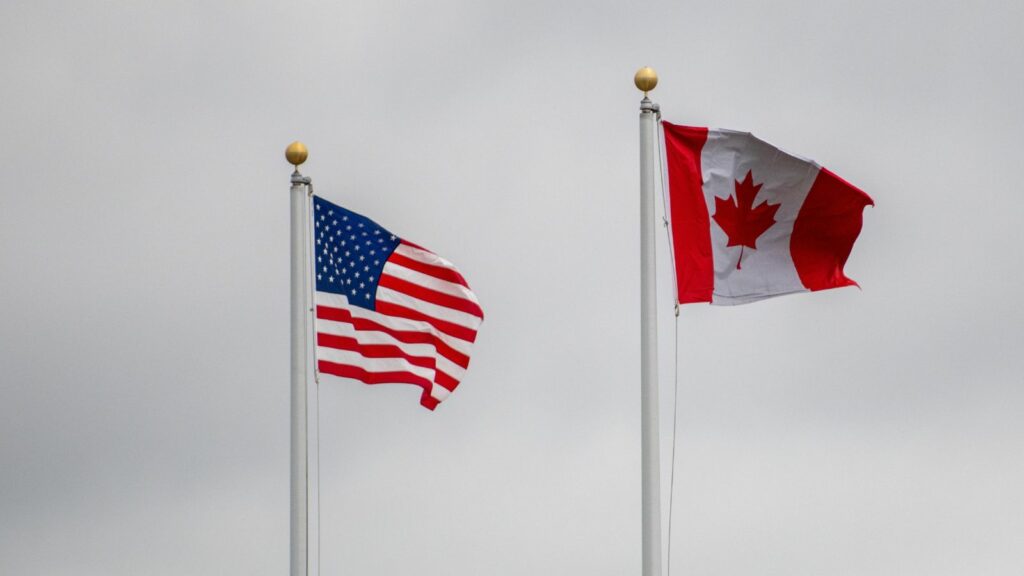
Donald Trump has turned a familiar trade dispute with Canada into a blunt test of leverage. Speaking at the White House on October 23, the U.S. president said Canada was working hard to reach a deal and declared that the United States has “all the cards.” Ottawa’s position is more complicated. Prime Minister Mark Carney says Canada is ready to resume negotiations immediately if Washington is willing to bargain in good faith, but he has also signaled that Canada will wait rather than accept terms it considers damaging. The standoff now stretches beyond tariffs. It touches autos, steel, energy, dairy, cultural policy and the future of the USMCA/CUSMA framework itself. Both governments have incentives to reopen talks, but neither wants to look as though it is negotiating from weakness.
Trump’s ‘All the Cards’ Claim Sets the Tone
Trump’s choice of words matters because it frames the dispute as a contest of power rather than a routine negotiation between integrated economies. His claim that Washington holds “all the cards” came as he said Canada was working hard to make a deal. The message was aimed at reinforcing the idea that access to the U.S. market is a privilege Canada needs more urgently than the United States needs Canadian trade.
There is logic behind that posture. The U.S. economy and consumer market are far larger, and Canada sells a substantial share of its goods south of the border. But Trump’s language also raises the political cost of compromise. If the White House publicly describes its leverage as overwhelming, any eventual concession to Ottawa can be portrayed by domestic critics as unnecessary. That turns bargaining over tariff rates and market access into a test of who can withstand pressure longer.
The U.S. Market Gives Washington Real Leverage
The clearest source of U.S. leverage is Canada’s dependence on the American market. Statistics Canada reported that 71.7% of Canadian merchandise exports went to the United States in 2025, even after that share fell from 75.9% a year earlier. Canadian exports to the U.S. were worth roughly C$562.7 billion on a customs basis. For many exporters, especially manufacturers, the border is not simply one market among many; it remains the core commercial route.
The relationship is enormous from the American side too, but less concentrated. The U.S. Trade Representative estimated total U.S.-Canada goods and services trade at US$872.3 billion in 2025. That scale gives Washington a powerful bargaining position because losing U.S. access can hit Canadian firms quickly. Still, the size of the two-way flow also means disruption is costly for American businesses, importers and consumers. Market size creates leverage, but integration creates exposure on both sides of the border.
Tariffs Have Become the Main Bargaining Weapon
Tariffs are the most visible instrument behind Washington’s leverage. After negotiations collapsed in August, the United States moved ahead with 50% duties on roughly C$27.6 billion of Canadian goods, according to the Canadian government. Ottawa responded with matching counter-tariffs on an equivalent value of U.S. imports, using rates of 15%, 25% and 50% across targeted products. The measures reach industries such as steel, dairy, appliances, agricultural equipment, pulp and paper, plastics and electronics.
The pressure has continued to evolve rather than freeze in place. On October 23, the White House announced another adjustment to the scope of Canadian products covered by Section 338 tariffs, with changes scheduled to take effect October 30. That matters for companies because uncertainty can be as disruptive as the rate itself. A manufacturer can price around a known tariff more easily than around a rulebook that may change again before its shipment crosses the border.
Canada Wants Talks Back — on Its Terms
Canada is trying to reopen the door without giving the impression that it will accept any deal available. Carney said on October 23 that Ottawa was ready to resume tariff negotiations immediately if Washington negotiated in good faith. At the same time, he said Canada could wait months or even until a future U.S. administration if that was what it took to reach acceptable terms. Formal negotiations have therefore not resumed, even though contacts continue.
That balancing act is deliberate. Canada suspended the talks on August 21 after saying last-minute U.S. demands were unfair and economically damaging. Ottawa’s stated objectives remain preserving tariff-free access, reducing U.S. tariffs on strategic sectors, protecting small businesses and maintaining Canadian sovereignty and policy flexibility. In practical terms, Canada wants the economic relief of a deal without allowing urgency to become a bargaining weakness. The message is: ready to talk, but not ready to capitulate.
Why Canada Still Has Cards of Its Own
Canada’s strongest counterargument to Trump’s “all the cards” claim is that the relationship is built around supply chains the United States also relies on. Energy is the clearest example. The U.S. Energy Information Administration says the United States imported 3.9 million barrels of Canadian crude oil per day in 2025, with Canada remaining the primary foreign source. U.S.-Canada energy trade was valued at about US$137 billion that year, most of it American imports from Canada.
Autos provide another form of mutual dependence. Statistics Canada says more than 93% of Canadian motor vehicle exports went to the U.S. in 2025, while auto-parts exports to the American market rose 2.3%. Those numbers expose Canada to U.S. pressure, but they also show why abrupt barriers can ricochet through factories on both sides of the border. North American manufacturing was designed around repeated cross-border movement of parts, energy and intermediate goods, not economic separation.
The Economic Damage Is Already Visible
The cost of the dispute is already becoming visible in communities that depend on trade-sensitive manufacturing. Cleveland-Cliffs announced plans to idle finishing operations at Stelco’s Hamilton facility, with up to 500 workers affected. The company cited tariff pressures and market conditions. For workers, the trade fight is not an abstract dispute about percentage points; it can determine whether a shift, production line or entire plant continues operating.
Governments are responding with support packages. On October 21, Ottawa and Ontario announced C$8.7 billion in measures aimed at steel, automotive manufacturing and critical-mineral development. The scale reflects how exposed these sectors are. Statistics Canada has estimated that 76.4% of payroll jobs in automobile and light-duty motor vehicle manufacturing in 2024 were tied to U.S. demand, while 67% of payroll jobs in iron and steel mills and ferro-alloy manufacturing depended on it. That dependence explains why trade negotiations carry political consequences in Ontario.
Diversification Is Becoming Canada’s Insurance Policy
Ottawa’s longer-term answer is diversification, and the data suggest the shift has already begun. Statistics Canada reported that Canadian exports to countries other than the United States rose 17.2% in 2025, while exports to the U.S. fell 5.8%. The U.S. still dominates Canadian trade, but the direction matters: businesses have a stronger incentive to build alternatives when access to their largest market becomes less predictable.
Carney’s government is trying to accelerate that change through new trade agreements and strategic partnerships. During his October visit to Türkiye, Canada announced that the first round of free-trade negotiations would take place from November 30 to December 4. Two-way merchandise trade with Türkiye reached C$4.3 billion in 2025. Ottawa has also said it wants non-U.S. exports to double over the next decade while pursuing agreements with India, ASEAN partners and others. Diversification will take years, but every new market slightly reduces Washington’s future leverage.
USMCA Is Still Alive, but Uncertainty Is Growing
The uncertainty is no longer limited to tariffs. The future of USMCA, known in Canada as CUSMA, has become part of the bargaining environment. At the July 1, 2026 joint review, the United States declined to extend the agreement for a new 16-year term. That did not terminate the pact. It remains in force, with its term running to 2036 unless the three countries agree earlier to extend it.
The consequence is a series of annual reviews, which can keep trade uncertainty alive. USTR has begun the U.S. consultation process for the 2027 review. For companies deciding where to place an assembly line or supplier facility, a tariff imposed today can be painful, but uncertainty about the rules for the next decade can be even more important. The longer the renewal question remains unsettled, the more businesses must price political risk into decisions that once assumed stable continental trade rules.
A Deal Exists on Paper, but Politics Is Harder
A path to compromise exists because the two sides have identified areas for concessions. In August, Carney said Canada had been willing to remove retaliatory tariffs on sectors including steel, aluminum and autos if the United States substantially reduced its own barriers. Ottawa was also prepared to encourage provinces to return U.S. alcohol to store shelves and consider administrative measures around supply management without dismantling the system.
The harder issues are red lines. Canada says it will not compromise sovereignty, cultural protections or its ability to pursue other trade relationships. Washington, meanwhile, has focused on Canadian dairy rules, treatment of U.S. alcohol and automotive market access. Those disputes are difficult because they are tied to domestic constituencies, not simply customs schedules. A deal therefore requires both governments to claim a win at home. The economic middle ground may be easier to find than the political language needed to sell it.
What Happens Next Could Set the Tone for 2027
The coming weeks will show whether Trump’s rhetoric is a prelude to renewed bargaining or another round of escalation. The White House’s Section 338 changes are scheduled to take effect October 30, while the U.S. midterm elections arrive on November 3. Carney has said Canada will keep working through the American political calendar rather than suspend its own decisions, but he has also made clear that Ottawa will not rush into a settlement simply to meet an election-driven deadline.
For businesses, the key signal is not another public exchange of insults; it is whether formal, detailed negotiations restart. Until then, Canada will continue supporting tariff-hit industries and expanding non-U.S. trade, while Washington can keep using tariff access as leverage. Trump is correct that the United States holds unusually strong cards. The unanswered question is whether both governments decide that playing every card is more expensive than reaching a workable deal.
