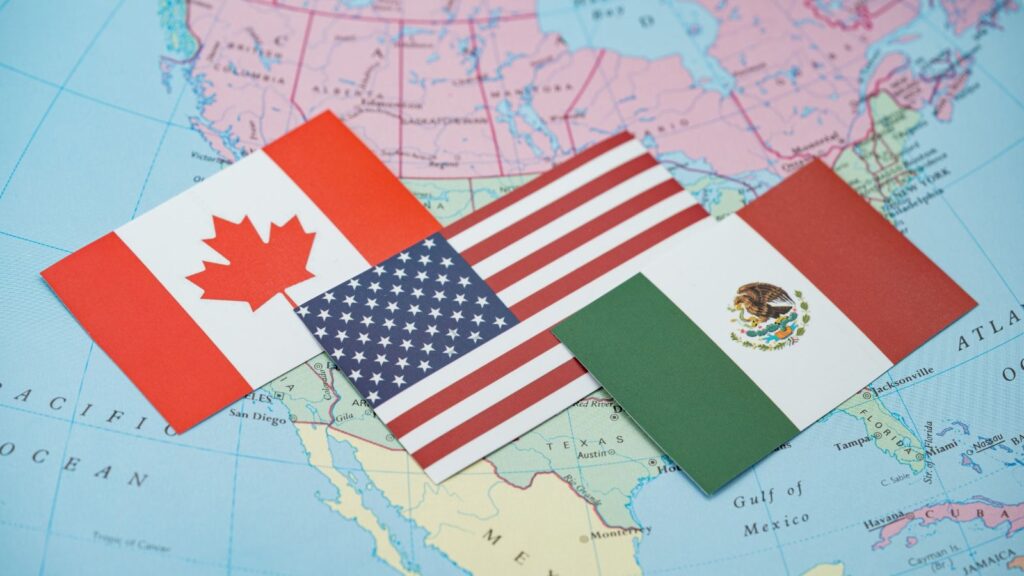
For decades, North America’s auto industry has operated less like three separate national industries and more like one sprawling factory. Engines, electronics, steel, transmissions and finished vehicles routinely move between the United States, Canada and Mexico before a vehicle reaches a dealership.
President Donald Trump’s push to put more American-made content inside North American vehicles is challenging that model. U.S. negotiators have proposed significantly tougher automotive rules under the United States-Mexico-Canada Agreement, including an 82% North American content threshold and a requirement that 50% of vehicle value come specifically from the United States. The proposal has not become law, but its direction is unmistakable: Washington wants a larger share of the region’s manufacturing value captured inside U.S. factories. For Canada and Mexico, that raises difficult questions about investment, jobs and supply chains built around three-country integration.
Washington Wants to Change the Meaning of “North American”
The existing USMCA was deliberately written around regional production. Passenger vehicles and light trucks generally need 75% North American regional value content to qualify under the agreement, compared with 62.5% under NAFTA. Separate requirements encourage North American steel and aluminum sourcing and require 40% to 45% of vehicle value to be produced through qualifying higher-wage activity. The framework was designed to make the entire continent more competitive while discouraging manufacturers from relying excessively on components from outside the region.
The Trump administration’s newer proposal would push the system in a different direction. Reuters reported that U.S. negotiators sought an 82% North American content requirement while also demanding that 50% of a vehicle’s value be produced specifically in the United States. That distinction matters enormously. A Canadian transmission or Mexican wiring harness can currently help a vehicle satisfy its regional requirement. Under a strong U.S.-specific threshold, companies could have a greater incentive to replace some Canadian or Mexican content with American components even when the existing supplier is efficient, nearby and already deeply integrated into the production process.
A Supply Chain Designed to Ignore National Borders
Modern automotive manufacturing depends on specialization. An assembly plant does not manufacture everything that eventually becomes a vehicle. Thousands of suppliers produce everything from seats and steering systems to electronics, glass, stamped metal, batteries and powertrain components. Under the North American model, companies have placed those operations where their factories, workers, logistics networks and existing customers make the most commercial sense. That is why a part can sometimes cross a border repeatedly before a finished vehicle is completed.
USMCA already tightened that system substantially. It raised the regional content requirement, added a 70% North American steel and aluminum purchasing requirement and introduced new labor-value rules. The U.S. International Trade Commission found that those rules did encourage additional U.S. parts and materials production, but they also raised costs for many companies changing their sourcing arrangements. That history offers an important clue about what could happen next. Raising regional content from 75% to 82% would already require another round of supply-chain adjustments. Layering a 50% U.S.-specific requirement on top could make sourcing decisions substantially more complicated for factories operating in Ontario, Michigan, Ohio, Texas, Nuevo León or Guanajuato.
Canada Has More at Risk Than Its Market Size Suggests
Canada produces far fewer vehicles than the United States or Mexico, but its automotive economy is exceptionally dependent on access to the American market. The federal government says Canada produced more than 1.2 million passenger vehicles in 2025, while the broader auto sector supports more than 500,000 workers and contributes more than C$16 billion annually to the economy. More importantly, over 90% of Canadian-made vehicles and roughly 60% of Canadian-made auto parts are exported to the United States.
That leaves Canadian factories particularly exposed if manufacturers begin reorganizing supply chains around U.S.-specific content. A component plant in Ontario does not necessarily lose because its products are uncompetitive; it could lose simply because an automaker needs more U.S. value in the final calculation. Ottawa and Ontario are already responding to wider trade pressure. In October, the two governments announced roughly C$9 billion in support for steel, automotive manufacturing and related supply chains, including C$2.5 billion aimed at automakers. For Canadian communities built around manufacturing, the concern is no longer limited to tariffs at the border. It is whether future investment will increasingly be steered south of it.
Mexico Sits at the Centre of the Parts Machine
Mexico’s exposure is even larger in absolute terms. The country produced nearly four million light vehicles in 2025 and has developed one of the world’s largest automotive supplier networks. U.S. Commerce Department data describes an industry so integrated with the United States that some components can cross the border numerous times during production. Mexico is also a major global producer of auto parts, with factories specializing in electrical systems, seats, suspension components, transmissions, engine parts and other high-value systems.
The dependence runs in both directions. The United States supplies more than half of Mexico’s imported auto parts, while Mexico has become the largest source of U.S. automotive imports. Its parts industry accounted for about 44% of U.S. auto-parts imports during the first 11 months of 2025, according to Mexico’s National Auto Parts Industry Association. Recent figures suggest trade friction is already having an effect. Mexican vehicle exports fell 12% year over year in September 2026, their sharpest decline of the year at that point. A U.S.-specific content requirement could therefore force Mexican plants to rethink suppliers even while they remain heavily dependent on American customers and inputs.
Automakers Warn the New Math Could Cost Billions
The political appeal of reshoring is straightforward: if manufacturers must put more American value into each vehicle, more engines, electronics, transmissions or other components could eventually be produced in U.S. factories. Automakers, however, argue that changing a supply chain is not as simple as switching vendors. Automotive components frequently require years of engineering, testing, tooling, certification and investment before they can be placed into high-volume production.
That is one reason Detroit’s largest manufacturers have been warning about the cost of tighter rules. Reuters reported in August that estimates at two automakers suggested the proposed changes could add at least $2 billion in annual costs to each Detroit manufacturer. Those costs would come on top of tariff expenses already hitting companies. General Motors expected billions of dollars in 2026 tariff-related expenses, while Ford projected a roughly $1 billion net impact. Industry groups representing Ford, GM and Stellantis have argued that North American integration remains important to their global competitiveness, particularly when vehicles imported from some other major manufacturing countries face simpler tariff structures. The debate is therefore not simply about where jobs are located, but whether reshoring gains outweigh additional production costs.
Tariffs Are Already Rewarding U.S. Content
The proposed content changes are unfolding alongside a tariff system that already gives automakers a financial reason to increase American content. Trump imposed a 25% tariff on imported automobiles in 2025 under Section 232 of the Trade Expansion Act. For qualifying USMCA vehicles, however, manufacturers can document their U.S. content so that the 25% tariff applies only to the vehicle’s non-U.S. value. In practical terms, two vehicles assembled in the same Canadian or Mexican factory can face different tariff costs depending on how much American content they contain.
That approach offers a preview of the administration’s broader objective. Instead of treating a vehicle that meets the USMCA’s regional rules as fully North American, U.S. policy increasingly distinguishes between American value and other North American value. Mexico estimates its vehicles have effectively faced tariff burdens closer to 10% to 12% when their qualifying U.S. content is considered. Canada has similarly emphasized that the American content inside CUSMA-compliant Canadian vehicles is exempt from the vehicle tariff. For manufacturers, that means supplier location is no longer just a question of wages, transportation or quality. The nationality assigned to each component increasingly affects the tariff calculation itself.
The Hidden Cost Is Tracking Every Component
One of the less visible consequences of stricter rules is the administrative work required to prove where a product came from. A modern vehicle can contain thousands of individual components sourced through multiple layers of suppliers. Manufacturers seeking preferential treatment need documentation showing that the vehicle, its core parts and qualifying inputs satisfy complex origin requirements. A new U.S.-specific threshold would require companies to track American value separately from Canadian, Mexican and non-North-American value with even greater precision.
Federal Reserve researchers have found that these compliance costs can be substantial. Using the transition from NAFTA to USMCA automotive rules as a case study, they estimated that stricter origin and reporting requirements can carry an additional compliance burden equivalent to roughly 1.4% to 2.5% of a product’s value. Applied more broadly to the new U.S. tariff environment, their analysis suggested manufacturing-sector compliance costs could run into tens of billions of dollars annually. Meanwhile, the U.S. International Trade Commission found that existing USMCA rules increased U.S. automotive employment and parts production but also slightly raised vehicle prices and reduced imports from Canada and Mexico while increasing some imports from countries outside the agreement.
The Fight Is Moving Into the 2027 USMCA Review
The biggest source of uncertainty is that the trade agreement itself remains unresolved. On July 1, 2026, the United States declined to extend the USMCA in its existing form. Canada and Mexico supported renewal, but U.S. Trade Representative Jamieson Greer said Washington wanted further negotiations over what it considers weaknesses in the agreement. USMCA remains in force, meaning the North American trading system has not disappeared, but the countries are now headed into annual reviews unless they eventually agree on an extension.
That makes automotive rules one of the most important tests for the agreement’s future. USTR has already opened consultations ahead of the 2027 review, with public comments due in January. Greer has also indicated that Washington would like interim arrangements with Canada and Mexico while leaving more complicated issues—including tighter automotive rules of origin—for further negotiations. For factories and suppliers, the result may determine where the next engine line, battery plant or electronics facility is built. North America’s automotive economy was constructed around the idea that Canadian, Mexican and American production could strengthen one another. Trump’s reshoring strategy is testing how much of that integration can survive once the United States begins demanding a larger share for itself.
