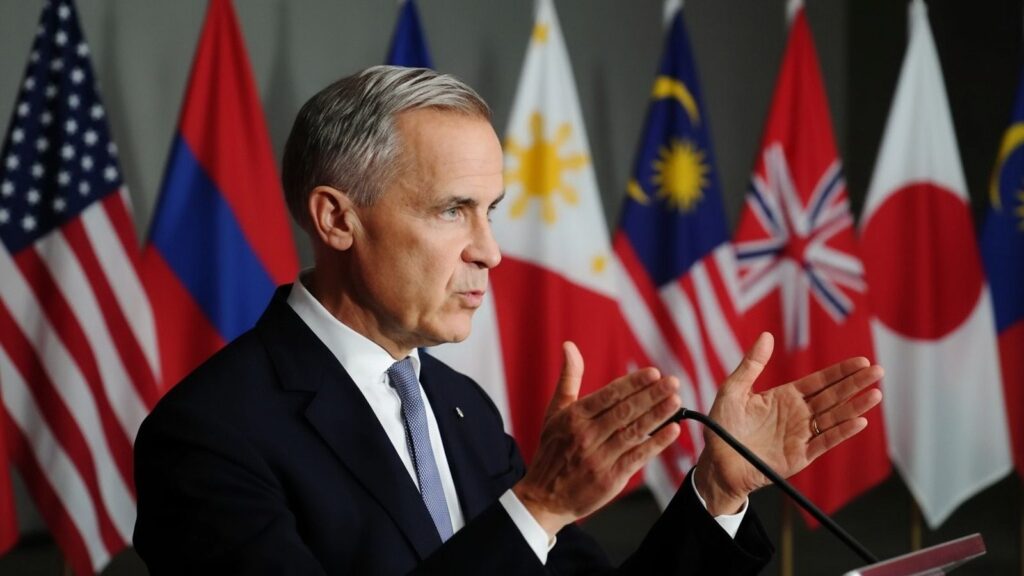
Canada’s effort to reduce its economic dependence on the United States has taken another significant step, this time at the crossroads of Europe, Asia and the Middle East. Prime Minister Mark Carney and Turkish President Recep Tayyip Erdoğan have launched a new Canada–Türkiye Strategic Partnership covering trade, investment, energy, defence and closer political ties.
The agreement comes as Ottawa searches more aggressively for markets and strategic partners beyond the United States, which still absorbs most Canadian merchandise exports. Türkiye offers something different: a population approaching 86 million, a large industrial economy, NATO membership and growing ambitions in energy and defence. The immediate result is not a free-trade agreement, but a three-year roadmap designed to turn a previously uneven relationship into a much deeper commercial and security partnership.
A Strategic Partnership, Not Yet a Free-Trade Deal
Carney and Erdoğan formally launched the Canada–Türkiye Strategic Partnership in Ankara on October 22, during the first bilateral visit to Türkiye by a Canadian prime minister. The framework is backed by a three-year action plan built around four broad areas: trade and investment, defence and security, energy cooperation, and government-to-government and people-to-people ties. It represents a significant upgrade in a diplomatic relationship that dates back more than eight decades.
The distinction between the new partnership and a free-trade agreement is important. Canada and Türkiye have not suddenly eliminated tariffs or created unrestricted market access. Instead, the leaders agreed to pursue a comprehensive FTA while signing or advancing several separate arrangements that can begin deepening the relationship sooner. Those include a defence-sector memorandum of understanding, a joint energy statement and an expanded air transport agreement. Ottawa is therefore building the institutional framework first, with the larger trade agreement still requiring detailed negotiations before it could ever enter into force.
Trade Talks Now Have a Firm Starting Date
The commercial portion of the relationship will get its first major test almost immediately. Canada and Türkiye have scheduled the opening round of formal free-trade negotiations for November 30 to December 4, 2026, in Ankara. Canadian consultations on a potential agreement ran from July 31 through September 14, following exploratory discussions that began earlier in the year. The goal is a modern agreement covering not only goods but potentially services, investment, regulatory barriers, labour, environmental standards and other areas common to contemporary Canadian trade deals.
There is already a meaningful trading base to work with. Canadian government figures put two-way merchandise trade at more than C$4.3 billion in 2025, consisting of roughly C$1.1 billion in Canadian exports and C$3.2 billion in imports from Türkiye. Canadian exports included about C$287 million in agri-food products, C$273 million in aircraft and transportation equipment and C$151 million in industrial machinery. Erdoğan has set a much more ambitious political objective, saying the two countries should move from trade he described as roughly $3 billion to $5 billion initially and eventually $10 billion. Differences in currency and trade-measurement conventions help explain why the figures cited by Ottawa and Ankara are not identical.
Türkiye Fits Carney’s Push to Build Markets Beyond the United States
The attraction of Türkiye becomes clearer when viewed against Canada’s wider trade challenge. Statistics Canada reported that 71.7% of Canadian merchandise exports went to the United States in 2025. That was down from 75.9% in 2024, but it still means economic disruptions south of the border can quickly reach Canadian factories, resource companies and workers. At the same time, Canadian merchandise exports to non-U.S. destinations increased 17.2% in 2025, suggesting companies were already finding additional customers as North American trade conditions became more difficult.
Ottawa has turned that adjustment into a formal policy objective. The federal government wants to double Canadian goods and services exports to non-U.S. markets over the decade ending in 2035, generating roughly C$300 billion in additional overseas trade. Türkiye is attractive within that strategy because of both scale and geography. World Bank data put its 2025 population at approximately 85.9 million and its economy at around US$1.6 trillion. Its position between Europe, the Middle East and Asia also gives Canadian companies access to commercial networks that extend beyond Türkiye itself. The objective is not realistically to replace the U.S. market, but to give Canadian exporters more places to turn when conditions in one market deteriorate.
Energy Cooperation Could Become One of the Biggest Commercial Openings
Energy is one of the partnership’s most expansive components. Canadian Energy and Natural Resources Minister Tim Hodgson and Turkish Energy Minister Alparslan Bayraktar signed a joint statement covering liquefied natural gas, civilian nuclear power, renewable energy, critical minerals, clean technologies and energy infrastructure. The two governments also committed to encouraging investment and expanding connections between companies, government agencies and technical institutions.
The LNG language is particularly notable because it goes beyond a general promise to cooperate. Canada and Türkiye agreed to facilitate discussions between Canadian LNG project developers and potential long-term buyers. That does not amount to a Turkish LNG purchase agreement, but it creates a pathway for commercial negotiations as Canada adds export capacity and Türkiye looks to diversify its energy supply. Mining could develop along a similar track. The countries want stronger critical-mineral supply chains and more cooperation across exploration, technical services and responsible mining. Türkiye has also adopted the Mining Association of Canada’s Towards Sustainable Mining standards, giving the relationship an existing industry link rather than requiring cooperation to begin entirely from scratch.
Canadian CANDU Technology Is Competing for a Much Bigger Prize
Civil nuclear energy may ultimately produce the partnership’s most valuable individual commercial opportunity. Carney said during the visit that Canadian engineering group AtkinsRéalis is a contender for Türkiye’s next nuclear project. The company’s Candu Energy subsidiary had already signed a memorandum of understanding with Türkiye Nuclear Energy Company, or TÜNAŞ, in March 2026 to assess opportunities for deploying Canadian CANDU reactor technology. The latest government-level energy agreement pushes that discussion further up the political agenda.
Türkiye has unusually large nuclear ambitions. Four Russian-designed reactors are under construction at Akkuyu, while additional plants are planned for Sinop on the Black Sea and in the Thrace region. Turkish authorities are targeting approximately 20 gigawatts of nuclear capacity by 2050. Sinop has received site approval, but its technology and project partner have not yet been selected, leaving Canada competing against other major nuclear suppliers. AtkinsRéalis has been working with Turkish officials on technical assessments and a feasibility process. Winning a project would therefore be transformational for the commercial relationship, but it remains a competition rather than a signed reactor order. The strategic partnership gives Canadian technology stronger diplomatic backing; it does not guarantee that Türkiye will select it.
Defence Cooperation Marks a Major Reset in a Once-Strained Relationship
Perhaps the most politically significant change involves defence. Canada and Türkiye announced a Defence Sector Partnerships memorandum of understanding intended to connect companies from both countries and encourage industrial cooperation. It builds on a Statement of Intent on Defence Cooperation signed in July 2026, which created a framework for military-to-military dialogue, operational cooperation and possible defence-industrial collaboration. Both countries are NATO allies, giving them an existing security architecture within which to expand those ties.
The speed of the rapprochement is striking because defence trade was one of the most difficult areas of the relationship only a few years ago. Canada suspended relevant export permits in 2020 while investigating reports involving Canadian-made sensors installed on Turkish-produced drones. A Global Affairs Canada review subsequently found credible evidence that certain Canadian sensors had been used on Turkish UAVs in conflicts including Nagorno-Karabakh, and Ottawa cancelled 29 permits in 2021. Following years of discussions over end-use controls, Canada removed its presumptive-denial policy for military exports to Türkiye in January 2024. The new defence MOU therefore represents more than another export initiative; it reflects a substantial political rebuilding of trust between two NATO allies.
More Flights and Export Financing Could Make the Partnership Practical
Large diplomatic agreements matter much less if businesses cannot easily move people, products and financing between markets. Canada and Türkiye are trying to address those practical barriers at the same time. Their expanded Air Transport Agreement increases the permitted number of weekly passenger-combination flights from 12 to as many as 21 per country, provides access to points across both countries and allows unlimited weekly all-cargo flights. That creates additional capacity not only for tourism and family travel, but also for high-value and time-sensitive commercial shipments.
Financing is another piece of the infrastructure. Export Development Canada and Türk Eximbank signed a memorandum of understanding aimed at helping Canadian and Turkish companies work together on projects in third countries. That potentially turns the relationship into something broader than Canadian companies selling products to Türkiye or Turkish companies selling into Canada. Businesses could instead combine financing, technology and industrial capabilities to pursue infrastructure and other contracts elsewhere. Carney also announced that Canada’s Minister of International Trade will lead a Canadian trade mission to Türkiye in 2027, giving companies a direct opportunity to test whether the political momentum can translate into customers, investment and joint ventures.
The Hard Part Begins After the Signing Ceremonies
The relationship still contains points of friction that will not disappear because economic opportunities have increased. Canada’s previous defence-export dispute remains part of the bilateral history, while human-rights organizations have urged Ottawa to challenge Erdoğan’s government over restrictions affecting journalists, activists, political opponents and LGBTQ+ people. Foreign Affairs Minister Anita Anand raised the importance of respect for human rights during her October 22 meeting with Turkish Foreign Minister Hakan Fidan. The joint Canada–Türkiye statement itself says the countries’ NATO relationship is grounded in human rights, democracy, individual liberties and the rule of law, placing those principles inside the official framework rather than outside it.
What happens next will show whether the new partnership becomes an economic shift or remains primarily diplomatic. The two governments plan annual strategic dialogues, continued Joint Economic and Trade Committee meetings and implementation of the three-year action plan under ministerial oversight. Erdoğan has also been invited to Canada, while the first FTA negotiating round begins at the end of November. For Canadian businesses, the meaningful measures will eventually be less ceremonial: whether barriers fall, contracts are signed, LNG buyers emerge, CANDU technology advances, defence firms secure partnerships and exports grow. Türkiye cannot replace Canada’s enormous U.S. market. But if even part of the agenda succeeds, it could become one of the more important examples of how Ottawa is trying to build a less concentrated Canadian economy.
