Canada’s long-established trade relationship with the United States is being tested most visibly in industries built around moving enormous volumes of heavy materials across the border. Steel and softwood lumber are now among the clearest examples. The Bank of Canada says Canadian steel exports have fallen by roughly half as most steel shipments to the United States face steep tariffs, while lumber exports were about 20% below their 2024 average by February 2026.
The pressure is reaching far beyond export statistics. Mills, manufacturers, workers and communities are being forced to adjust to a market in which access to Canada’s dominant customer has become considerably more expensive. Ottawa has responded with financing, procurement policies and trade protections intended to redirect more Canadian production toward domestic buyers, but replacing decades of deeply integrated North American trade is proving difficult.
Steel Exports Have Been Cut Roughly in Half as Producers Turn Back to Canada
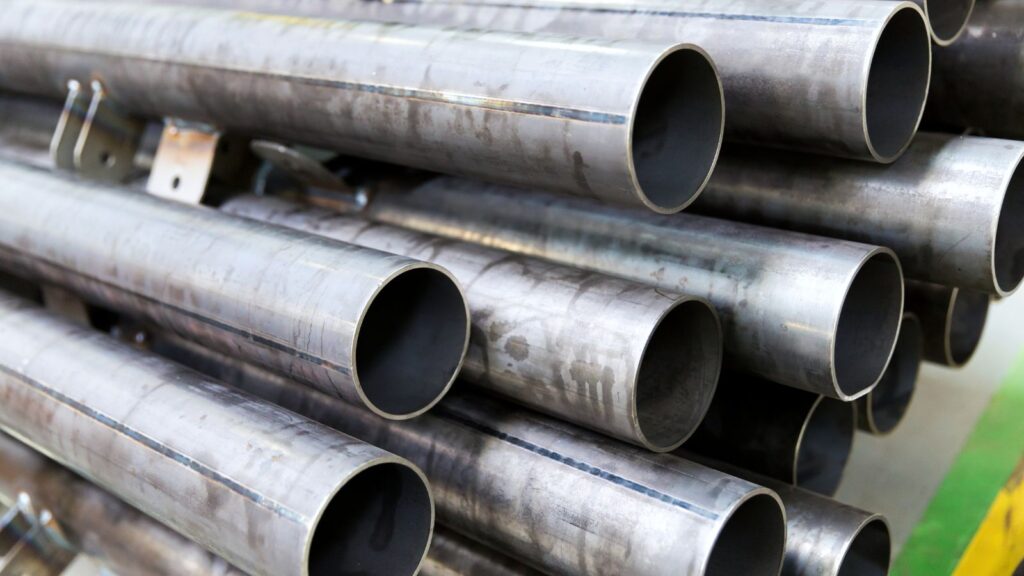
Steel demonstrates how quickly tariffs can disrupt an industry designed around an integrated continental market. The Bank of Canada says most Canadian steel exports entering the United States face a 50% tariff, and its analysis concluded that overall steel exports had fallen by about half. Industry figures paint an even sharper picture when U.S.-bound shipments are isolated. The Canadian Steel Producers Association told a Senate committee in September 2026 that Canada historically shipped about six million tonnes of steel to the United States annually, equivalent to roughly half of domestic production. During the first half of 2026, those shipments were down almost 60% compared with 2024, which the association described as the last relatively normal year before the trade disruption. That scale matters because Canadian mills were not built around a purely domestic customer base. Steel has moved repeatedly between Canada and the United States as raw material, intermediate product and finished component for decades, supplying automotive factories, construction projects, energy companies and manufacturers on both sides of the border. A tariff therefore does more than make a single shipment expensive. It disrupts purchasing relationships and production schedules that were developed around the assumption that the border would remain commercially manageable. The damage is visible in employment as well. The Bank of Canada has recorded declines in both production and employment, although those declines have so far been smaller than the drop in exports. Algoma Steel announced plans to eliminate about 1,000 positions as it accelerated changes to its operations, while workers in Hamilton have also faced uncertainty surrounding Cleveland-Cliffs’ Stelco operations. For steel-producing communities such as Hamilton and Sault Ste. Marie, a reduction in mill activity can affect far more than direct employees. Contractors, trucking companies, maintenance firms, equipment suppliers and nearby businesses are all tied to the industrial activity generated by a large plant. At the same time, simply redirecting six million tonnes of historically U.S.-bound steel overseas is not an easy solution. Canada produces roughly 12 million to 13 million tonnes in a typical year and competes in a global market already struggling with substantial excess capacity. Commodity steel is expensive to transport, and Canadian producers must compete against suppliers in countries with lower costs or state-supported capacity. That makes the domestic market increasingly important.
There are signs that this domestic pivot is beginning to work, although not enough to replace the U.S. market completely. Reuters reported in October that Canadian-made steel accounted for an estimated 51% of steel consumed domestically in 2025, according to a United Steelworkers calculation using international steel and Canadian import data. That was up from 41% in 2024, while the estimated import share fell from 59% to 49%. Canadian steel demand itself was estimated to have increased approximately 2.7% in 2025 and was projected to grow another 0.9% in 2026. Large infrastructure, energy, mining, defence and data-centre projects are creating potential new customers, particularly in Western Canada. Tenaris, for example, has invested C$306 million to expand production of Canadian-made pipe and related products intended for Canadian energy customers at its Sault Ste. Marie operations. Ottawa is trying to accelerate the same transition through several channels. The federal Buy Canadian framework gives Canadian materials, including domestic steel, a larger role in federal procurement. Canada has also tightened tariff-rate quotas to restrict surges of foreign steel and reduce the risk that material excluded from the U.S. market is redirected north. In May 2026, the federal government announced a new C$1-billion Business Development Bank of Canada financing program for companies affected by steel, aluminum and copper tariffs, offering eligible businesses working-capital loans as they adjust their operations and pursue new customers. These policies can provide breathing room, but they do not change the underlying arithmetic. Industry testimony to Parliament emphasized that even major Canadian infrastructure projects would absorb only a portion of the millions of tonnes previously sent south. The emerging strategy is therefore broader than simply finding one replacement customer. Canadian producers are attempting to capture a greater share of domestic consumption, develop specialized products, compete more aggressively against imports and reduce their dependence on U.S. sales over time. That transformation could ultimately leave the industry less exposed to political decisions in Washington, but the transition is expensive and uneven. Western Canadian fabricators are seeing stronger opportunities from resource and infrastructure investment, while producers more dependent on particular U.S. customers remain under greater pressure. The roughly 50% export decline is therefore not merely a temporary trade statistic. It represents a fundamental challenge to the business model that shaped Canadian steel production through decades of North American free trade.
Lumber Shipments Are Falling as New Tariffs Add to a Much Older Trade Fight
Canada’s lumber industry entered the latest tariff confrontation from a very different starting point, but with similar dependence on American customers. Softwood lumber has been the subject of Canada-U.S. trade disputes for decades, and Canadian producers were already paying anti-dumping and countervailing duties before the Trump administration introduced another layer of tariffs. The Bank of Canada says Canadian lumber production had already been declining for several years because of a combination of longstanding trade disputes and other industry pressures. After U.S. tariffs increased in October 2025, the deterioration continued: by February 2026, Canadian lumber exports were roughly 20% below their 2024 average. The new measure was a 10% Section 232 tariff on imported softwood timber and lumber that took effect on October 14, 2025. Unlike general tariffs from which qualifying Canadian goods can sometimes receive preferential CUSMA treatment, the Section 232 lumber tariff applies specifically to covered wood products. For products also covered by the longstanding U.S. anti-dumping and countervailing orders, the 10% tariff is added on top of those duties. That layering pushed the effective burden facing many Canadian softwood lumber exporters dramatically higher. Natural Resources Canada has estimated that between the summer and fall of 2025, the combined duty and tariff rate facing most Canadian softwood lumber exporters rose to about 45.16%, compared with approximately 14.4% previously. The U.S. Department of Commerce announced the final results of its seventh administrative reviews on October 14, 2026, indicating lower anti-dumping and countervailing rates for several major producers once the results are published and become effective. The announced combined rates were 31.11% for Canfor, 25.55% for Resolute, 20.02% for West Fraser and 24.75% for other covered exporters. Even that potential reduction does not end the dispute, because the separate 10% Section 232 tariff continues to apply where products fall within both regimes. Canadian producers therefore remain exposed to costs significantly above those confronting many international competitors.
The consequences extend well beyond lumber companies themselves because sawmills sit at the centre of regional forestry economies. Natural Resources Canada reported that the broader Canadian forest sector directly employed more than 194,000 people in 2024 and contributed C$30.7 billion in nominal GDP. Canada also remained the world’s leading exporter of softwood lumber. The dependence on the American market is particularly striking: roughly 86% of Canadian softwood lumber exports by value went to the United States in 2024, representing about C$7.3 billion. When a sawmill reduces production, the impact travels through logging operations, trucking businesses, equipment contractors and the pulp, paper, panel and bioenergy facilities that use sawmill by-products. The industry’s problems cannot be blamed entirely on tariffs. Fibre availability, weak market conditions, mill economics, wildfires, insect damage and years of production rationalization have all contributed to closures and curtailments. Still, industry representatives told senators in September that the current trade environment was making those structural problems significantly harder to manage. The Forest Products Association of Canada said at least 61 mills had permanently closed or been indefinitely idled since 2014, with approximately 12,600 direct jobs lost during that broader period. The association also pointed to European competition in the U.S. market, arguing that Canadian producers facing tariff burdens above 45% were increasingly competing against European wood entering at considerably lower rates. Diversification offers some relief, but there are practical limits. The association told senators that Canada sells about C$14 billion in lumber and other wood products to the United States annually and noted that developing approximately C$1 billion in annual business with Japan took decades. Building a market for Canadian lumber involves changing building codes, developing distributor relationships, training builders and establishing dependable shipping networks; surplus lumber cannot simply be redirected overseas overnight. Ottawa has responded with financing and programs intended to keep mills operating while producers search for new markets. In July 2026, for example, the federal government announced a C$60-million tariff-related loan for Quebec-based Arbec Bois d’œuvre, which operates eight plants and employs nearly 800 people. The challenge facing lumber is therefore similar to steel even though the trade rules are different. Both industries were built around unusually close access to the world’s largest economy. Tariffs have exposed how valuable that access was—and how difficult it is to replace. Canada can encourage domestic construction, expand wood use in housing and public projects, pursue Asian and European customers and support companies through the transition. But for communities whose economic life revolves around a mill, the adjustment is measured less in trade percentages than in shifts worked, logs purchased, trucks dispatched and whether the local plant continues running.
