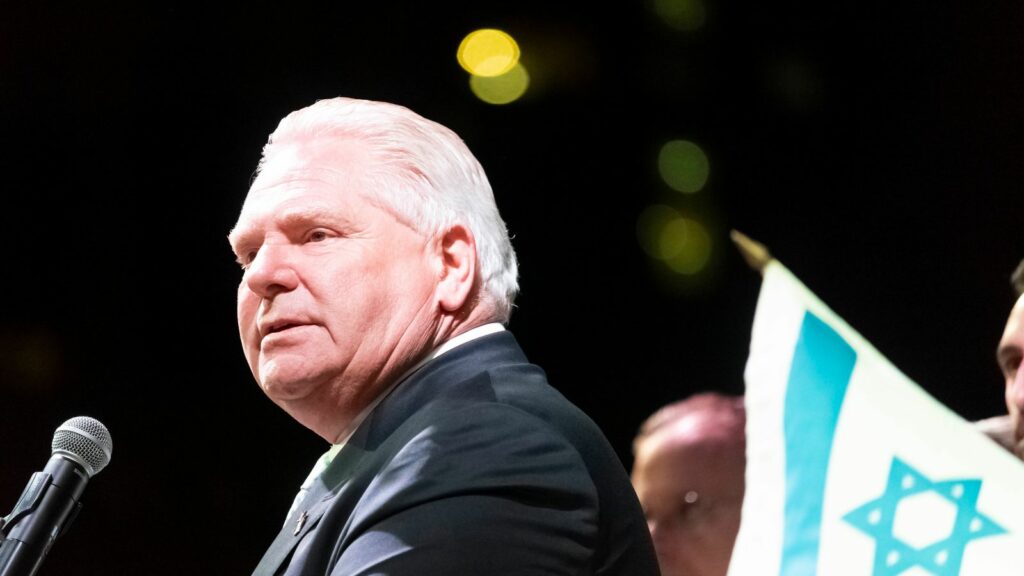
The latest turn in Canada’s trade fight with the United States has produced an unusual split-screen moment. Ontario Premier Doug Ford says Prime Minister Mark Carney has not briefed him lately on the state of negotiations, even as senior figures in Washington are publicly suggesting an agreement could be close.
The gap matters because Ontario sits at the centre of Canada’s exposure to U.S. tariffs, particularly in autos and steel. Ford says he wants the two governments back at the table and would support a fair agreement, but Ottawa is sounding far more cautious than the White House. Carney says talks have intensified only slightly and insists any progress reflects Washington moving closer to Canadian demands. With the U.S. midterm elections days away and the August collapse still fresh, optimism is rising without anything resembling a guaranteed deal.
Ford Is Waiting for Details From Ottawa
Ford’s revealing comment was also one of his shortest. Asked Monday whether Carney had recently updated him on the negotiations, the Ontario premier said “not lately.” He nevertheless made clear that he wants a settlement, arguing that tariffs on Canadian goods function as a cost for American consumers and that both countries should return to the table. Ford also said the final call belongs to Carney and indicated he would support the prime minister if Ottawa secures what he considers a fair agreement.
That combination — limited information but backing — captures Ford’s awkward position. Ontario has major economic exposure to the outcome, yet international trade negotiations are run by the federal government. Ford has spent much of the dispute acting as Canada’s aggressive provincial advocate in U.S. media, while Ottawa has emphasized that bargaining is a federal responsibility. For now, he is waiting for details while publicly urging movement.
Washington Sounds Much More Confident Than Ottawa
The strongest claims that a deal is near come from Washington. White House economic adviser Kevin Hassett said negotiations had “picked up” and were “gathering steam,” adding that he believed the countries were very close to an agreement. Trump went further at a rally in Port Huron, Michigan, saying the dispute would be settled “pretty soon.” U.S. Commerce Secretary Howard Lutnick has also been in contact with Canada-U.S. Trade Minister Dominic LeBlanc as talks accelerate.
Ottawa is deliberately lowering expectations. Carney described a “slight intensification” in discussions and said Canada’s position has not changed. He argued that any progress has come because the United States is moving closer to Canadian demands, not because Ottawa has weakened its red lines. Canadian sources have similarly cautioned that frequent contact does not mean an agreement is imminent. The two governments are talking more, but they are not describing the same level of certainty.
Autos and Steel Are at the Centre of the Latest Push
Autos and steel are at the heart of the latest push. Reuters reported that officials are discussing relief from U.S. Section 232 tariffs that reach 50 per cent on Canadian steel and 25 per cent on automobiles. Trump has also threatened to raise auto and steel tariffs on Canada to 50 per cent beginning January 1, 2027, creating another deadline. Sources said a limited sectoral agreement could emerge quickly, even if a broader settlement remains out of reach.
For Ontario, the details matter as much as the headline rate. The North American auto system is built around parts, materials and vehicles moving repeatedly across the border, so rules covering Canadian content, components and different classes of trucks can determine whether a tariff reduction actually protects production. That is why negotiators are focused not simply on reducing duties, but on the fine print determining which products qualify and under what conditions.
Ontario Has More at Stake Than Most Provinces
Ontario’s urgency is clear from the numbers. Federal data says roughly 933,000 Ontario jobs depend on U.S. export demand, while about 72 per cent of the province’s goods exports went to the United States in 2025. The automotive sector employed more than 95,000 workers and shipped about $60 billion in autos and parts to the U.S. that year, representing 96 per cent of Ontario’s automotive exports. Steel and aluminum exports to the U.S. were worth about $6.5 billion.
National data tells the same story. Statistics Canada found that 76.4 per cent of payroll jobs in automobile and light-duty vehicle manufacturing were supported by U.S. demand in 2024. In iron and steel mills and ferro-alloy manufacturing, the figure was 67 per cent. Those are not abstract statistics. They translate into household income, municipal tax bases, supplier contracts and investment decisions in communities from Windsor to Hamilton and Sault Ste. Marie.
August’s Collapse Is Still Shaping the Negotiations
The memory of August explains why Canadian officials are resisting another victory rush. The two sides appeared close to an agreement before talks collapsed on August 21. Carney said the United States introduced last-minute terms Canada considered unfair, uneconomic and inconsistent with Canadian sovereignty. He later pointed to disputes involving automotive treatment, restrictions on Canada’s ability to negotiate with other countries, and demands touching language and cultural protections. Ottawa recalled its negotiators rather than accept the package.
The breakdown had consequences. Washington imposed new 50 per cent tariffs on roughly $20 billion in Canadian goods, while Canada announced dollar-for-dollar retaliation targeting steel, dairy, appliances, agricultural equipment, pulp and paper and electronics. Reporting later showed medium- and heavy-duty vehicles were another major fault line, with Canada seeking relief covering trucks produced in Ontario. The episode made one lesson unavoidable: a political understanding is not the same as a signed, durable agreement.
U.S. Midterm Politics Are Increasing the Pressure
The calendar is adding urgency. U.S. midterm elections are November 3, and the trade fight has become a problem for Republicans in northern border states. A Washington Post-Schar School poll in September found more than 60 per cent of likely Michigan voters opposed Trump’s 50 per cent tariffs on Canadian products, while 68 per cent of independents disapproved. Other polling shows concern that the levies raise costs and hurt Michigan’s economy.
That pressure helps explain why Trump chose Port Huron, across from Ontario, to predict a settlement was coming soon. Republican Senate candidate Mike Rogers has distanced himself from parts of the tariff policy, particularly its impact on autos. In Maine, Senator Susan Collins pushed for exemptions on Canadian products important to her state. That does not guarantee a deal, but it gives the White House an incentive to show progress before voters go to the polls.
Ford and Carney Are Still Working Together on the Economic Response
Ford’s complaint about not receiving a recent trade update doesn’t mean the federal-provincial relationship has broken down. Earlier, Carney and Ford stood together in Ottawa to announce an $8.7-billion Canada-Ontario plan for industries facing U.S. tariff pressure. The package includes more than $5 billion in combined support for steel and $2.5 billion for automotive capital projects, alongside measures tied to critical minerals and infrastructure. They presented the plan as protection against a more uncertain North American economy.
That cooperation matters because Ontario cannot negotiate directly with Washington, but it can shape the economic and political conditions around Ottawa’s decisions. Ford controls provincial levers, including procurement, industrial support and the LCBO’s treatment of U.S. alcohol. He has said American products could return to Ontario liquor-store shelves quickly if a fair deal protects steelworkers, autoworkers and manufacturing jobs. Provincial support may therefore become part of implementation even if Ottawa signs the agreement.
Any First Deal Could Be Narrower Than Expected
If an agreement emerges, it may be narrower than the settlement both governments once discussed. Current reporting points to possible relief on steel and automobiles, with a Canadian industry source telling Reuters that a near-term breakthrough could be limited. That would still matter greatly to Ontario because those sectors are among the province’s most tariff-exposed industries. It would not settle every dispute over dairy, lumber, retaliation, cultural policy or broader North American trade rules.
There is a structural issue in the background. The United States declined in July to renew CUSMA for a fresh 16-year term, although the agreement remains in force and can still be extended. Canada supports renewal, while Washington has demanded changes to the trading relationship. A sectoral tariff deal could lower immediate pressure without resolving that bigger argument. Businesses may get relief, but long-term certainty would still depend on the future of the continental trade pact.
The Next Test Will Be the Terms, Not the Optimism
For Ford, the next development is not another optimistic sound bite from Washington but a concrete briefing from Ottawa and terms he can evaluate against Ontario’s interests. He has defined a fair deal around protection for autos, steel, forestry, agriculture and manufacturing, and his willingness to restore U.S. alcohol to LCBO shelves is tied to that standard. Until details are known, his position remains supportive but watchful.
Carney is signaling similar caution nationally. He says Canada is ready to sign an agreement that benefits Canadians, but he has acknowledged he cannot know whether Trump would stand by a new deal. That uncertainty is why the language on both sides matters. Washington is selling momentum; Ottawa is emphasizing conditions. A deal may be closer than it was several weeks ago, but after the August failure, Canadian leaders have strong reasons to treat “close” as a negotiating status rather than an outcome.
