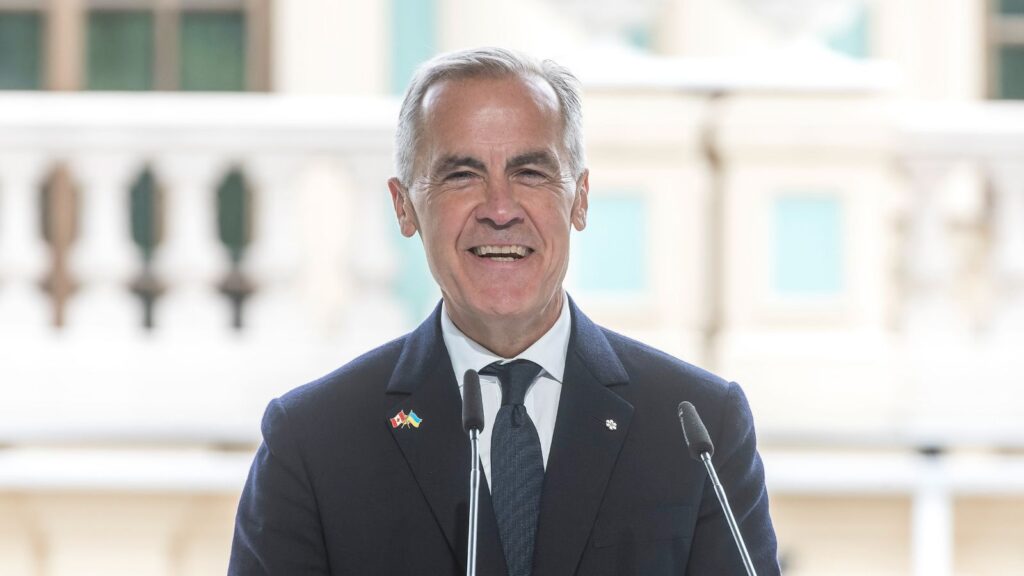
Canada-U.S. tensions have moved beyond tariffs and trade negotiations into a more politically explosive argument: whether Canadian efforts to pressure Washington amount to interference in the November 3 U.S. midterm elections. Prime Minister Mark Carney has rejected that accusation, saying the claims have “no merit,” while the Trump administration’s representatives have focused heavily on Industry Minister Mélanie Joly and Ontario Premier Doug Ford. At the centre of the dispute are retaliatory tariffs, political meetings, public advocacy and Ontario’s high-profile anti-tariff advertising campaign. What makes the confrontation unusual is that almost all of the conduct cited by Washington has occurred openly. Ottawa insists it is defending Canadian jobs and economic interests; U.S. officials argue some of those actions are designed to influence American politics. The disagreement now risks becoming another source of instability in an already damaged bilateral relationship.
Washington Turns a Trade Fight Into an Election-Interference Dispute
The immediate trigger was an October 21 fact sheet from the U.S. Embassy in Ottawa describing what it called Canadian efforts to influence American politics. The document highlighted public comments, meetings and trade measures involving Canadian officials, with Joly and Ford receiving particular attention. It also cited a Liberal MP’s campaigning activity in Florida and cases involving Canadians accused of illegally voting in U.S. elections, although the embassy did not publicly connect those individual voting cases to a Canadian government operation. The timing matters: Americans vote in the November 3 midterms, when all 435 House seats and roughly one-third of the Senate are being contested.
The embassy’s argument is broader than a traditional allegation of secret election meddling. Much of its case rests on Canadian officials openly trying to create political pressure inside the United States so the Trump administration will change its tariff policy. That is precisely why the controversy has become so contentious. Washington is treating political pressure aimed at changing U.S. policy as potentially election-related; Ottawa says responding publicly to tariffs is normal statecraft. Carney’s government has framed its measures as defensive actions taken after the United States imposed trade restrictions on Canadian goods.
Why Mélanie Joly Became the Main Federal Target
Joly is central to Washington’s case because she has repeatedly described Canada’s tariff strategy in political terms. The embassy cited remarks in which she discussed targeting products from particular U.S. states to create pressure on the Trump administration. It also highlighted her September meetings with Democratic political figures in Boston and Chicago and a response in which she linked those meetings to the possibility of a different political environment after the midterms. Those remarks are easy for critics to frame as an effort to influence American political calculations, especially so close to voting day.
Joly has rejected the interference label and offered a different explanation for her U.S. outreach. She has said she met with both Democrats and Republicans and described her work as an effort to attract investment to Canada and defend Canadian economic interests. That distinction is important. Governments routinely lobby foreign legislators, governors, companies and interest groups when trade policy threatens domestic industries. The controversy is therefore less about whether Joly hoped to create political pressure — she openly said Canada wanted pressure — and more about whether that pressure crossed from legitimate trade diplomacy into an attempt to shape an election. The embassy’s fact sheet publicized examples of her conduct but did not present evidence of a covert Canadian government operation directed at influencing the vote.
Doug Ford’s Reagan Campaign Is Back at the Centre of the Fight
Ford’s role in the dispute reaches back to Ontario’s 2025 advertising campaign against U.S. tariffs. His government committed C$75 million to an American media blitz built around excerpts from Ronald Reagan’s 1987 radio address warning about the economic damage caused by protectionism. Ford said the campaign would reach Republican-held districts, making the political target explicit even though the message itself focused on trade policy. The ad aired across major U.S. networks and later during the World Series, giving Ontario’s argument an audience far larger than most provincial governments could normally command.
The campaign also demonstrated how quickly political messaging can spill into trade policy. Trump terminated trade negotiations with Canada after attacking the Ontario ad, while Ford initially kept it on air through the World Series weekend before pausing the campaign. Trump then announced an additional 10% tariff increase in response to the continuing broadcasts. A FactCheck.org review later found that Ontario had rearranged portions of Reagan’s remarks and omitted some context, but had not changed his underlying anti-tariff position. A year later, the U.S. Embassy is using that same campaign as evidence that Canadian officials intentionally sought to influence American political opinion. Ford, however, has said he has no interest in interfering in U.S. elections.
Carney Rejects the Accusations and Publicly Rebukes Hoekstra
Carney’s response has been unusually direct for a prime minister speaking about a U.S. ambassador. During a visit to Türkiye, he said there was “no merit” to the election-interference claims and expressed disappointment that Ambassador Pete Hoekstra was making them. Hoekstra, a former Republican congressman and Trump ally, had already warned Canadian politicians to keep their “nose out” of American politics and said U.S. officials were closely watching Canadian activity ahead of the midterms. The embassy’s fact sheet turned that warning into a formal diplomatic dispute rather than a one-off comment.
Carney has also emphasized that Canadian diplomats and officials are instructed to avoid even the appearance of partisan involvement. At the same time, he has refused to accept the idea that a U.S. election should freeze Canada’s efforts to protect its own economy. His position is that Canadian officials can continue negotiating, lobbying and responding to tariffs without participating in the American electoral process. He has also linked the dispute to a wider sovereignty argument, reiterating that Canada will not become a U.S. state and that Ottawa is prepared to pursue a more independent economic strategy. That combination — restraint around elections but firmness on trade — is now the core of his response.
Ottawa Tightens the Rules for Diplomats Anyway
Even while rejecting Washington’s accusations, Global Affairs Canada has taken a highly cautious approach to the final stretch of the U.S. campaign. A memo sent to Canadian foreign-service personnel in the United States instructed diplomats not to meet with or attend events involving midterm candidates. If officials unexpectedly found themselves in the same physical space as a candidate, they were told to avoid photographs and public communications that could create the appearance of political alignment. Meetings with elected officials who were not candidates could still occur when necessary, but senior officials were expected to be consulted.
Global Affairs described election-period guidance as routine, but the language reported from the memo was notably risk-averse and referred to heightened sensitivity. That matters because it shows Ottawa is treating perception as a diplomatic risk even while disputing the substance of the U.S. allegations. In practical terms, Canada is drawing a firewall between normal government-to-government engagement and anything that could be interpreted as campaign activity. It also gives Carney a stronger factual basis for arguing that Canada is actively trying to avoid election involvement. The posture is defensive, but it reflects how fragile the relationship has become: a photograph, public appearance or poorly phrased remark can now trigger consequences far beyond ordinary diplomacy.
The Crucial Difference Between Influence and Interference
The dispute turns on a distinction that governments themselves normally recognize. Canada’s Public Safety department says foreign influence is a normal part of international affairs when it is legal, transparent and conducted through tools such as lobbying, public communication, political dialogue, trade negotiations and diplomacy. It defines foreign interference more narrowly as covert, deceptive, coercive or threatening activity aimed at manipulating political decisions or democratic processes. Canada’s intelligence service makes a similar distinction, describing foreign interference as conduct that goes beyond normal diplomatic activity and is clandestine, deceptive or threatening.
U.S. election law adds another layer. Federal Election Commission guidance prohibits foreign nationals — a category that includes foreign governments — from making contributions, donations or election-related expenditures, and from participating in decisions about another entity’s election spending. Those rules establish a clear legal boundary around campaign finance and election activity. But the public record surrounding the current Canada dispute is focused mainly on tariffs, lobbying, political meetings and government messaging. That does not automatically settle the legal or diplomatic question, but it explains why experts have challenged Washington’s use of the term “interference.” The central issue is whether openly pressuring U.S. policymakers about trade is being reclassified as election meddling because an election is imminent.
The Economic Stakes Are Too Large for a Semantic Fight
The argument is unfolding between two economies that remain deeply connected despite the trade war. U.S. government data put total U.S. goods-and-services trade with Canada at about US$872.3 billion in 2025. Statistics Canada reported that 71.7% of Canadian merchandise exports still went to the United States that year, even after the share fell from 75.9% in 2024. That dependence explains why Canadian governments have spent so much political energy trying to influence American tariff policy. For Ontario in particular, steel and auto manufacturing make any escalation immediately tangible for workers, suppliers and communities.
Carney and Ford underscored those stakes on October 21 by announcing C$8.7 billion in federal-provincial investments and measures for Ontario’s steel, automotive and critical-minerals sectors. The package included C$5.22 billion in combined commitments for a Joint Steel Action Fund and another C$2.5 billion for large-scale automotive capital projects. Ottawa says Canada’s auto sector supports more than 120,000 direct jobs and contributes more than C$16 billion annually to GDP, while the steel industry supports more than 23,000 direct jobs. Those figures turn the diplomatic fight into something more concrete: every new tariff, delayed negotiation or retaliatory measure can affect payrolls, investment decisions and plant planning on both sides of the border.
The Midterms Could Decide How Long This Dispute Lasts
The November 3 vote will not resolve the trade war by itself, but it could change the political incentives around it. Midterm elections determine control of the House and can shift control of the Senate, shaping the final two years of a presidential term. McGill University political scientist Daniel Béland has warned that the U.S. accusations could provide a ready-made narrative for blaming Canada if Republicans suffer losses. Carney has said he does not expect disappointing Republican results to produce another tariff escalation, but he has also acknowledged that the Trump administration has used a wide range of rationales for trade measures.
Ottawa is therefore preparing for more than one political timeline. Carney says Canada is ready to resume trade negotiations quickly if Washington is prepared to negotiate in good faith, yet he has also said Canada could wait months — or even for another U.S. administration — rather than accept a deal it considers unacceptable. That is a significant shift from the urgency that surrounded earlier negotiations. The election-interference dispute reinforces the logic behind diversification: Canada is trying to reduce its exposure to decisions made in Washington while keeping the door open to a future settlement. Until then, Ford and Joly are likely to remain symbols of the broader argument over how aggressively Canada can defend its interests inside the United States without being accused of entering American politics.
