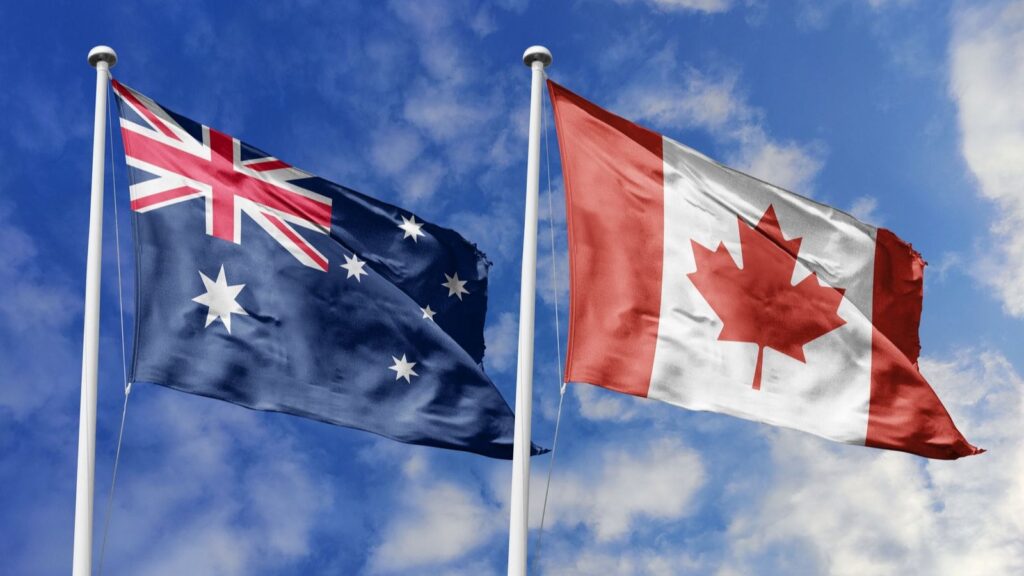
Canada’s push to build more trade options outside the United States has gained another piece of financial infrastructure. Export Development Canada and Export Finance Australia signed a memorandum of understanding on October 27, 2026, creating a framework to work together on financing, investment projects and business connections between the two countries. The agreement does not create new tariff cuts or guarantee that money will immediately flow to specific projects. Its importance is more practical: it gives the two national export-finance agencies a clearer route to share expertise, facilitate transactions and explore co-financing where Canadian and Australian interests overlap. With Ottawa targeting a major increase in non-U.S. exports and both countries already cooperating on critical minerals, energy, defence and technology, the pact adds financing capacity to a relationship that has been becoming more strategic.
What the New Pact Actually Does
The new agreement is a memorandum of understanding between Export Development Canada, Canada’s export credit agency, and Export Finance Australia, Australia’s trade and strategic finance agency. Under the framework, the organizations will explore co-financing, transaction facilitation, joint outreach and knowledge sharing. They also plan to connect Canadian and Australian companies and investors pursuing opportunities in areas of mutual interest. The stated goals include economic growth, energy security, supply-chain resilience and sustainable development.
The distinction matters. The memorandum does not itself lower tariffs, rewrite procurement rules or promise a fixed pool of money for Canadian companies. Financing decisions still have to be made transaction by transaction under each agency’s mandate and risk processes. In practical terms, the agreement creates an institutional lane that can make it easier for both agencies to examine the same project, coordinate support and bring complementary financing tools to deals spanning the two countries or the Indo-Pacific.
A C$7.3 Billion Trade Relationship With Room to Grow
Canada and Australia have a substantial commercial relationship, even though it is small beside Canada’s trade with the United States. The October 27 announcement put bilateral merchandise trade at C$7.3 billion in 2025, with Canadian exports to Australia exceeding C$3 billion. It also said merchandise trade between the countries has grown at an average annual rate of about 8% since the CPTPP entered into force in 2018. That gives the financing pact a base of real business rather than diplomatic ambition.
The mix is broader than a single commodity story. Global Affairs Canada has identified machinery, precious metals, vehicles and parts among important Canadian exports to Australia, while pointing to opportunities in infrastructure, information technology, agriculture and food, defence and aerospace. The opportunity is not simply to increase shipments. It is to help Canadian firms participate in larger projects, long-term supply arrangements and investment-led business that can produce recurring trade.
The Investment Relationship Is Already Much Bigger Than the Trade Flow
The key number in the Canada-Australia relationship may be investment rather than annual merchandise trade. Statistics Canada reported Canadian direct investment in Australia at C$50.1 billion at the end of 2025, while Australian direct investment in Canada reached C$36.4 billion. The new EDC-EFA announcement identified Australia as the largest Asia-Pacific destination for Canadian direct investment abroad. Those figures explain why an export-finance partnership can matter even when two-way goods trade remains smaller.
Large cross-border investments often create business around them: engineering contracts, equipment purchases, professional services, local supply chains and financing needs that can continue for years. Canada and Australia also have pools of institutional capital, and their governments recently encouraged closer ties between Canadian pension funds and Australian superannuation funds. The memorandum does not merge those channels, but it strengthens the public financial infrastructure around a relationship in which companies and investors already commit tens of billions of dollars.
Why Export Finance Can Move Deals That Banks May Not
Export-credit agencies exist partly because international deals can carry risks or financing requirements that commercial lenders do not always handle comfortably. Export Development Canada offers loans, guarantees, credit insurance and structured finance for transactions. Its insurance can protect exporters against non-payment, while guarantees can help companies obtain working capital. Export Finance Australia provides loans, bonds, guarantees, insurance and, in some circumstances, equity participation, including support for projects where longer tenors or country risk can discourage private lenders.
That makes cooperation potentially useful on complex projects. A Canadian supplier may join an Australian-led development, an Australian company may need Canadian technology, or both countries may participate in a third-market project. Co-financing can spread risk and combine expertise. It can also help attract lenders on terms they can accept rather than replace them. The pact’s value is therefore about making ambitious cross-border deals more financeable when risk, scale or duration narrows the field.
Critical Minerals Could Be an Early Test Case
Critical minerals stand out as one of the clearest areas where the financing framework could be used. Canada and Australia signed a joint declaration on critical-minerals cooperation in 2025 calling for stronger links across mining, processing, refining and recycling. Importantly, it contemplated using Canadian and Australian public investment tools, including their export-finance instruments, to support commercially viable projects. In March 2026, the two governments deepened that agenda again when Australia joined the Critical Minerals Production Alliance launched under Canada’s G7 presidency.
The logic is straightforward. Both countries are resource economies with deposits important to batteries, advanced manufacturing, defence systems and clean-energy technologies. Yet bringing a mine or processing facility into production can require large upfront capital, long construction schedules and credible buyers. Export-finance agencies can help structure funding around those hurdles. The October memorandum names no critical-minerals transaction, but its financing relationship closely matches commitments the governments had already made.
Energy, Infrastructure and Defence Broaden the Pipeline
The potential pipeline extends well beyond mining. The EDC-EFA memorandum lists infrastructure, energy and the energy transition, agri-food and agtech, digital technologies, defence and aerospace among areas of opportunity. Earlier in 2026, Prime Ministers Mark Carney and Anthony Albanese also highlighted energy, critical minerals, defence and artificial intelligence as priorities for deeper cooperation. Canada and Australia launched a clean-energy partnership during Carney’s March visit, while both governments said they wanted closer defence-industrial collaboration and more joint investment in strategic projects.
Those priorities fit the way export finance is often used: to support equipment, services or investment tied to large projects with long payback periods. Export Finance Australia said it provided more than A$6.6 billion in finance in 2025-26, including support for infrastructure, clean energy, manufacturing, resources and defence. EDC facilitated C$135 billion in trade-related activity in 2025 and has made Asia-Pacific growth one of its strategic priorities for Canadian companies.
CPTPP Gives the Partnership a Ready-Made Trade Framework
Canada and Australia are not starting from scratch on market access. Both were among the first six countries for which the CPTPP entered into force on December 30, 2018. The agreement provides a rules-based framework for goods, services and investment, and Global Affairs Canada says it established duty-free access between Canada and Australia for a range of products. Across the CPTPP, most tariff lines became duty-free at entry into force and 99% are scheduled to be duty-free once implementation is complete.
That matters because financing works best when companies have predictable rules for selling, investing and moving goods across borders. A Canadian exporter may have an attractive product, but expansion can still stall if it lacks working capital, buyer financing or protection against payment risk. The CPTPP addresses market-access barriers; the EDC-EFA memorandum addresses another part of the problem by improving the machinery around financing and deal execution for businesses.
The U.S. Backdrop Makes Diversification More Urgent
The pact lands as Ottawa is trying to reduce the risks of dependence on one market. Statistics Canada reported that the United States accounted for 71.7% of Canadian merchandise exports in 2025, down from 75.9% in 2024. Over the same year, exports to the United States fell 5.8%, while exports to countries other than the United States rose 17.2%. Global Affairs Canada’s diversification strategy aims to double non-U.S. exports over the next decade, with a goal of generating C$300 billion more in trade.
None of that means the United States is becoming unimportant. It remains Canada’s largest export market, and Ottawa continues to emphasize preserving favourable access under CUSMA. Diversification is better understood as risk management than separation. For a manufacturer, miner or technology firm, customers and financing channels in Australia or other Indo-Pacific markets can reduce exposure to shocks in any single destination. The Australia memorandum fits that approach.
What Canadian Businesses Could Gain—and What They Still Have to Prove
For Canadian companies, the useful outcome would be easier access to financing around transactions rather than another layer of government messaging. EDC already offers credit insurance, guarantees, direct loans and structured finance, and its 2025 results show the scale: the agency facilitated C$135 billion in exports, foreign investment and trade-development activity while serving nearly 24,000 customers. It facilitated C$14.8 billion in business in the Asia-Pacific region. Closer work with EFA could help identify Australian buyers, investors and projects earlier.
There are hurdles. Export finance is not automatic approval, and businesses must show viable economics, acceptable risk and a connection to the agencies’ mandates. EFA, for example, requires an Australian benefit for supported transactions, while EDC evaluates financing and insurance based on eligibility and risk. Companies need competitive products, reliable delivery, local partners where necessary and enough management capacity to operate far from home. The pact can materially reduce financing friction.
The Real Test Will Be the First Co-Financed Deals
The October 27 announcement did not identify a jointly financed project, set a funding ceiling for the partnership or provide a transaction timetable. The next phase will matter more than the signing ceremony. Success would be deals where Canadian and Australian firms win contracts, secure investment or complete projects that would have been harder to finance without cooperation between EDC and EFA. Critical minerals, clean energy, infrastructure and defence are areas to watch because both governments have placed them near the centre of the bilateral agenda.
For Ottawa, the strategic value extends beyond Australia. EDC’s strategy is focused on broadening Canada’s trade partners, especially in Europe and the Asia-Pacific, while the federal government has made doubling non-U.S. exports a national objective. A Canada-Australia financing channel would show how diversification can move from diplomacy into concrete capital. The memorandum is only a framework, but execution will determine its importance in practice.
