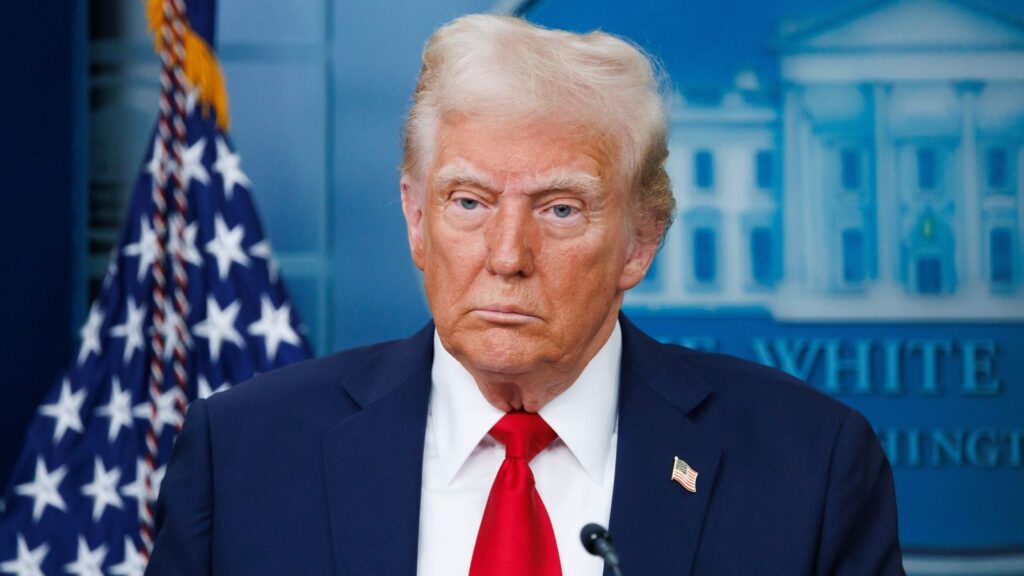
Donald Trump has inserted himself into Canadian politics at an unusually delicate moment. On October 27, the U.S. president publicly congratulated British Columbia Conservative leader Lorne Doerkson after his party’s provincial election victory, then separately praised Parti Québécois leader Paul St-Pierre Plamondon following the sovereigntist party’s return to power in Quebec.
The messages arrived while Prime Minister Mark Carney’s government was locked in difficult trade negotiations with Washington over tariffs affecting billions of dollars in cross-border commerce. That combination — American presidential commentary on Canadian provincial elections alongside an unresolved trade confrontation — has turned what might ordinarily have been routine congratulations into something much more politically charged. For Carney, the challenge now stretches beyond tariffs: Ottawa is trying to protect Canadian economic interests while preventing domestic political divisions from becoming another source of leverage for Washington.
Trump’s Twin Congratulations Were Anything but Routine
Trump’s two social-media messages came within minutes of one another. He congratulated Doerkson on what he described as a major victory and portrayed the B.C. result as evidence of growing Conservative strength in Canada. He then congratulated St-Pierre Plamondon, linking to coverage that characterized the Parti Québécois victory as a political setback for Carney. The Quebec message came 22 days after the province’s October 5 election, making its timing particularly noticeable.
The two politicians Trump praised have little in common beyond having defeated incumbent governments. Doerkson leads a provincial conservative party that spent much of the B.C. campaign rejecting attempts to associate it with Trump. St-Pierre Plamondon, meanwhile, leads a centre-left sovereigntist movement committed to eventually holding another referendum on Quebec independence. Treating the two victories as part of one Canadian political trend therefore oversimplifies what voters actually decided. What connects the results more clearly is that both removed governments or parties associated with the political status quo — and both create new complications for Ottawa at a time when national unity has acquired unusual economic importance.
B.C. Conservatives Won After Rejecting the Trump Label
British Columbia delivered the clearest electoral upheaval. Elections BC’s completed initial count showed the Conservatives leading in 63 of the legislature’s 93 districts with 48.06 per cent of the vote. The B.C. NDP stood at 28 seats and the Greens at two. Those results remain preliminary until the scheduled final count from November 6 to 10, but the Conservative advantage is far beyond the 47 seats required for a majority.
That outcome is especially striking because former premier David Eby had tried to make Trump part of the campaign’s broader argument. When Eby called the September snap election, he portrayed his government as a potential “firebreak” against both U.S. economic pressure and what he described as Trump-style politics. Doerkson responded by distancing himself from the American president, describing Trump as a bully and arguing that British Columbia needed economic strength rather than rhetoric to withstand U.S. pressure. As the campaign progressed, affordability, health care and household finances increasingly displaced Trump as the central voter concerns. The Conservative victory therefore cannot credibly be reduced to British Columbians embracing Trumpism, even if Trump is now trying to attach himself to the result.
Quebec’s PQ Victory Was Not a Referendum Mandate
Quebec presents an even more complicated picture. Official election data show the Parti Québécois winning 28.02 per cent of valid ballots and 60 seats, leaving it four seats short of the 64 required for a majority in the 127-seat National Assembly. Voter turnout reached about 66.9 per cent. The election returned the PQ to government, but it did not produce anything resembling majority public support for Quebec independence.
Post-election polling reinforces that distinction. A Léger survey conducted from October 9 to 12 found support for Quebec sovereignty at 29 per cent, while only 20 per cent of respondents wanted St-Pierre Plamondon to hold a referendum during his mandate. Even before the election, the PQ leader had promised that no sovereignty vote would occur while Trump remained president. His stated timetable rules out a referendum before January 20, 2029, because he has argued that such a consequential decision requires a calmer environment free from disruption by an unpredictable U.S. administration. That makes Trump’s congratulations deeply ironic: one of the main politicians he praised has explicitly cited Trump himself as a reason to delay the separatist project.
Carney Is Keeping the Trade Fight Focused on Red Lines
While Trump comments on Canadian elections, Carney’s more immediate confrontation with Washington is taking place at the negotiating table. The prime minister said this week that discussions had intensified slightly and argued that whatever progress had been achieved reflected the United States moving closer to Canada’s position. Canadian officials subsequently offered a more guarded assessment, saying there had been only limited progress.
Ottawa’s caution follows the collapse of negotiations in August. Canada rejected U.S. terms that the federal government said demanded too much while offering too little, and Washington subsequently imposed a 50 per cent tariff on $27.6 billion worth of Canadian goods. Canada answered with tariffs of 15, 25 and 50 per cent on an equivalent $27.6 billion of U.S. imports. Trump has more recently suggested that an agreement could come quickly, particularly as the November 3 U.S. midterm elections approach. Carney has resisted framing the negotiation around Washington’s political calendar. His message has remained that Canada will sign an agreement if the overall package protects Canadian workers, strategic industries and sovereignty — not simply because the White House wants a headline before election day.
The Economic Stakes Extend Far Beyond Political Theatre
The confrontation matters because Canada remains extraordinarily dependent on access to the American market. Statistics Canada reported that 71.7 per cent of Canadian merchandise exports went to the United States in 2025, despite that share falling from 75.9 per cent in 2024. Canadian merchandise exports to the U.S. declined 5.8 per cent during 2025, while exports to countries outside the United States increased 17.2 per cent.
Those figures help explain why tariffs on steel, autos, machinery and other products are more than negotiating chips. Factories, suppliers and transportation networks have been built around cross-border production for decades, particularly in Ontario and the Great Lakes manufacturing corridor. Washington is also continuing to alter the tariff landscape: new U.S. changes scheduled for October 30 remove some Canadian products from additional duties while adding others, with certain measures layered on top of existing Section 232 tariffs. For a Canadian company deciding whether to invest in another production line or hire additional workers, that unpredictability can matter almost as much as the tariff rate itself. Businesses can plan around a known tax more easily than around rules that may change repeatedly during a political confrontation.
U.S. Midterm Politics Are Now Entangled With Canada
Canada has also become an issue inside American election campaigns. At an October 25 rally in Port Huron, Michigan, Trump predicted the dispute would be settled soon while defending his tariff strategy. Michigan is particularly sensitive because its manufacturing economy is deeply integrated with Canadian supply chains, including the automotive sector. Republican Senate candidate Mike Rogers has publicly called for an end to the Canada tariff fight, declaring in a campaign advertisement that Canada is not an enemy.
The dispute has produced another unusual argument. The U.S. Embassy in Canada accused Canadian politicians of trying to influence American politics through rhetoric about retaliatory tariffs and politically sensitive U.S. states. Carney rejected the allegation, while Canadian officials have maintained that retaliatory measures are intended to defend Canadian workers and companies against tariffs initiated by Washington. The episode illustrates how thoroughly trade policy has become intertwined with election strategy. Measures designed in Ottawa as economic retaliation can create political pressure in Michigan, Maine or other states — while Trump’s comments about B.C. and Quebec demonstrate that political commentary is moving in both directions across the border.
Carney’s Longer-Term Answer Is More Trade Outside the United States
Ottawa is not pretending that Canada can quickly replace the American market, but Carney is trying to reduce the country’s vulnerability to decisions made in Washington. The federal government has established a goal of doubling Canadian exports to non-U.S. markets over the next decade, which Global Affairs Canada says could generate roughly $300 billion in additional trade. Statistics Canada’s recent numbers suggest that diversification is already becoming more visible, although the United States remains overwhelmingly Canada’s largest customer.
One example arrived on October 27, the same day as Trump’s posts. Canada and the United Arab Emirates announced a Comprehensive Economic Partnership Agreement expected to lower or eliminate tariffs on more than 99 per cent of current Canadian exports to the UAE once implemented. Ottawa also highlighted the UAE’s previously announced commitment to pursue up to $70 billion in Canadian investment opportunities involving areas such as energy, infrastructure and technology. Such agreements will not replace hundreds of billions of dollars in U.S.-Canada commerce. Their strategic purpose is different: every additional export market gives Canadian businesses another option when access to the United States becomes more expensive or politically unpredictable.
Trump’s Praise May Be More Complicated for Its Recipients Than It Looks
The central irony is that Trump’s interventions may strengthen arguments his Canadian targets have already been making against excessive dependence on Washington. Doerkson won B.C. while explicitly distancing himself from the U.S. president. St-Pierre Plamondon has delayed the defining project of his political movement because he does not want Trump’s presidency distorting a referendum campaign. Carney, meanwhile, has repeatedly framed the trade conflict as evidence that Canada needs stronger domestic capacity and more international options.
That does not mean Trump’s comments will transform Canadian politics on their own. Provincial elections are driven primarily by provincial concerns, and both the B.C. and Quebec results had strong domestic explanations. But the timing gives the posts more weight than ordinary diplomatic congratulations. Canada is negotiating simultaneously over tariffs, market access, industrial policy and the future reliability of its largest trading relationship. In that environment, Washington openly celebrating provincial political change inevitably feeds questions about how Trump views Canada’s internal divisions. For Carney, the safest response may be the strategy already taking shape: keep Canadian governments aligned where possible, negotiate without accepting artificial deadlines, and make dependence on a single trading partner gradually less consequential.
