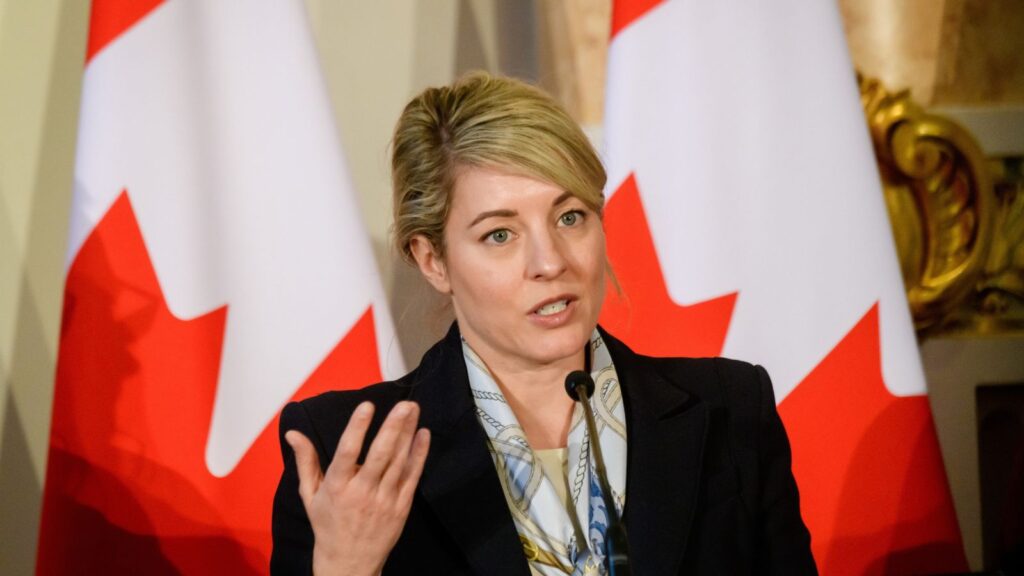
A fight over 175 steel jobs in Hamilton has become a test of how far Ottawa is willing to go when a foreign buyer is accused of breaking promises made to acquire a major Canadian company. Industry Minister Mélanie Joly says she will not meet Cleveland-Cliffs chairman and CEO Lourenco Goncalves until the U.S.-based steelmaker first provides a concrete plan and timeline for returning the laid-off Stelco workers to their jobs. Cleveland-Cliffs insists it has done nothing wrong, arguing that Stelco remains fully compliant with the employment commitments attached to its 2024 takeover. The disagreement now goes well beyond a scheduling dispute between a cabinet minister and a chief executive. It touches on U.S. tariffs, the future of Hamilton steelmaking, legally binding foreign-investment commitments and whether Ottawa is prepared to take one of North America’s largest steel producers to court.
Ottawa Makes the Meeting Conditional
Cleveland-Cliffs has been trying to get Goncalves in a room with Joly as the confrontation over Stelco intensifies. The company says Stelco requested a meeting on October 23 to discuss a route back to full employment for 175 Hamilton workers who are temporarily laid off. Joly’s response was effectively that the conversation needs to start on paper. Before agreeing to the meeting, she wants Cleveland-Cliffs to spell out how those employees will return and when that will happen.
That position raises the stakes because Ottawa is no longer treating another round of corporate talks as sufficient progress. Joly has accused Cleveland-Cliffs of failing to respect six binding commitments connected to its purchase of Stelco, while the company says it complies with all 34 undertakings associated with the transaction. The minister has left the door open to eventually sitting down with Goncalves, but she has made a return-to-work proposal the price of admission. For the affected families, that shifts the discussion from broad promises about preserving Canadian steelmaking to a much simpler question: when do the paycheques from those jobs start again?
Why 175 Workers Became the Immediate Test
The figure of 175 is smaller than the number that initially put Ottawa on alert. Stelco announced in late September that it planned to lay off as many as 500 workers across its Hamilton Works and Lake Erie Works operations in Nanticoke. The United Steelworkers initially expected roughly 350 union members to be affected in Hamilton and about 40 more at Lake Erie. Layoffs then began rolling out in stages as the company proceeded with plans to idle portions of the Hamilton operation.
Cleveland-Cliffs now identifies 175 Hamilton employees as temporarily laid off and says it wants to discuss restoring full employment for that group. That makes 175 the immediate focus of Joly’s demand, but it does not erase the broader dispute over the original restructuring plan. The distinction matters. A company can announce a maximum number of potential job losses and ultimately have fewer people off the payroll at a particular moment. Ottawa, meanwhile, is concerned with whether Stelco is honouring employment undertakings over the life of the takeover agreement. What looks like a disagreement over one headcount is therefore also a disagreement over what Cleveland-Cliffs promised Canada before it was allowed to buy Stelco.
The 2024 Takeover Came With Five-Year Job Promises
Cleveland-Cliffs announced its deal to acquire Stelco in July 2024, valuing the Canadian steelmaker at roughly US$2.5 billion, or C$3.4 billion in enterprise value at the time. The transaction required a federal review under the Investment Canada Act before it could proceed. Ottawa approved the purchase in October 2024, and Cleveland-Cliffs completed the acquisition on November 1. Government approval was not unconditional: the buyer supplied a package of binding undertakings designed to demonstrate that foreign ownership would deliver a net benefit to Canada.
The commitments publicly disclosed by Ottawa were substantial. Cleveland-Cliffs agreed for five years to keep Stelco’s head office in Hamilton, maintain at least the same number of unionized employees as existed when the transaction was announced, retain the vast majority of non-union employees, honour collective agreements and pension and benefit obligations, and make significant capital and research spending. Environmental commitments were included as well. Those conditions explain why Joly is treating the layoffs as more than an ordinary restructuring decision. Ottawa approved the transaction partly because Canadian employment would be protected. Cleveland-Cliffs, however, disputes the government’s interpretation of what those protections require in the present circumstances.
Cleveland-Cliffs Says Its Employment Math Still Works
Cleveland-Cliffs has responded with numbers of its own. In its latest compliance statement, the company said Stelco expects average employment during the current reporting period to reach at least 1,879 bargaining-unit full-time-equivalent workers. Cleveland-Cliffs says the applicable required level is 1,766, putting the projected average 113 workers above that threshold. It also expects an average of at least 627 salaried full-time-equivalent employees against what it says is a requirement of 603.
Those figures form a central part of the company’s defence. Cleveland-Cliffs argues that temporary layoffs do not mean Stelco has automatically fallen below the employment levels required by its undertakings when staffing is assessed across the reporting period. Ottawa plainly disagrees with the company’s broader conclusion that it remains compliant. An important limitation for outsiders is that the complete undertakings are not publicly available; information submitted through Investment Canada Act reviews is generally protected by strict confidentiality rules. The government released a summary of the major commitments when the acquisition was approved, while Cleveland-Cliffs has now disclosed some of the numerical thresholds it says apply. That leaves a legal question that cannot be conclusively settled from the public documents alone.
Tariffs and Galvanized Steel Are at the Centre of the Company’s Defence
Cleveland-Cliffs says the layoffs are the consequence of a steel market that changed dramatically after its Stelco purchase. Canadian steel continues to face U.S. tariffs of 50 per cent, and Stelco has told Ottawa that Canadian exports of cold-rolled and coated steel to the United States fell 58 per cent from pre-trade-war levels. According to Stelco, second-quarter 2026 shipments were 226,000 tonnes below the 2024 quarterly average. It has also argued that imports still account for about 45 per cent of the Canadian market for those products while domestic demand has weakened.
That helps explain why the company is concentrating more of Stelco’s business on hot-rolled steel while idling finishing operations in Hamilton that make products such as galvanized steel. Yet the financial picture is not simply one of a collapsing Stelco. Cleveland-Cliffs said Stelco delivered its strongest quarter since the acquisition during the third quarter of 2026 as Canada’s hot-rolled steel market improved. The company says roughly 2,000 Canadian jobs remain preserved and that affected finishing workers can return when market conditions support those operations. Ottawa’s problem with that argument is that commercial conditions are colliding with commitments Cleveland-Cliffs voluntarily made to secure federal approval of the acquisition.
Ottawa Has More Than Rhetoric Behind Its Threat
Joly escalated the confrontation on October 22 by sending a formal demand giving Cleveland-Cliffs 15 days to address the alleged violations, reverse the job cuts or explain why Ottawa’s interpretation is wrong. Such a demand matters because it is part of the enforcement machinery of the Investment Canada Act rather than merely a political warning. Cleveland-Cliffs responded before that period expired by asserting that Stelco is fully compliant and saying it will update its compliance report after the current reporting period closes on October 31.
If Ottawa remains unsatisfied, the law gives it significant options, although some require a court rather than unilateral action by the minister. Section 40 permits an application to a superior court when a foreign investor fails to comply with a ministerial demand. If the court agrees with the government, it can order the investor to comply with its undertakings, impose financial penalties and, in an extreme case, direct the foreign investor to divest control of the Canadian business. For a non-Canadian investor, the Act provides for penalties of up to $10,000 for each day of contravention. A forced sale therefore is legally possible, but it is not something Joly can simply announce and execute without the statutory enforcement process.
Hamilton Has Seen This Fight Before
For longtime Hamilton steelworkers, the idea of Ottawa pursuing a foreign Stelco owner over takeover commitments is not unprecedented. United States Steel Corporation acquired Stelco in 2007 and made undertakings under the Investment Canada Act. After production cuts and layoffs followed, the federal government concluded that U.S. Steel was not meeting employment and production commitments. Ottawa sent a formal demand in May 2009 and went to Federal Court that July, marking the first major court enforcement action of its kind under the Act.
The dispute eventually ended through negotiation rather than a final court order. In December 2011, Ottawa settled after U.S. Steel agreed to new and enhanced undertakings. Those included continuing Canadian steel production, operating both the Hamilton and Lake Erie plants until 2015, making at least $50 million in additional capital investments and contributing $3 million to community and educational programs in Hamilton and Nanticoke. The history does not determine the outcome of the Cleveland-Cliffs fight, because the commitments and economic circumstances are different. It does show, however, that federal threats to enforce Stelco-related takeover promises have previously progressed from demand letters to litigation and ultimately to negotiated concessions.
The Next Move Could Shape More Than Stelco
The dispute lands at a difficult moment for Canadian manufacturing. Canada produces more than 12 million tonnes of crude steel annually, and domestic steel operations directly employ about 23,000 people while supporting an estimated 100,000 additional indirect jobs. The industry has historically been deeply dependent on the U.S. market: in 2024, Canadian producers exported just over half their output, with more than 90 per cent of those exports heading to the United States. Fifty-per-cent U.S. steel tariffs have exposed how quickly that relationship can turn from an advantage into a vulnerability.
That is why the fate of 175 Hamilton workers is attracting attention far beyond one plant. If Ottawa accepts Cleveland-Cliffs’ staffing calculations, other foreign investors may look closely at how takeover employment commitments are measured when markets deteriorate. If the government pursues a court case or a forced divestiture remedy, the case could instead demonstrate that employment undertakings survive even severe trade disruptions. Cleveland-Cliffs says it wants a meeting and promises its compliance figures will be updated after October 31. Joly says the next step comes first: a credible plan and timeline to put people back to work. Until one appears, the meeting itself has become leverage.
