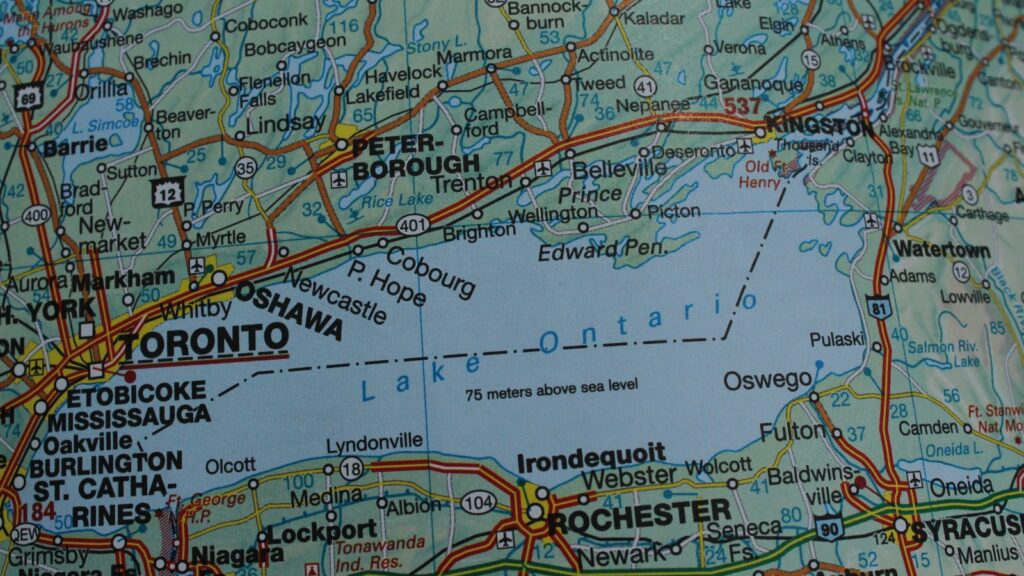
Bryan Adams has spent decades singing about love, freedom and the moments that shape people’s lives. Now, the Canadian rock legend is using his music to challenge U.S. President Donald Trump over a controversy involving one of North America’s most recognizable lakes.
Released on October 28, 2026, Adams’ new single, “Lake Ontario,” takes aim at Trump’s executive order renaming the shared body of water “Lake America” for U.S. federal purposes. The song also references the war in Iran and the Jeffrey Epstein files, suggesting the naming dispute is distracting attention from more serious political questions.
For the Kingston-born musician, the controversy represents something bigger than a disagreement over geography. It touches on Canadian identity, Indigenous history and the limits of political power.
Bryan Adams Turns a Geographic Dispute Into a Protest Song
Bryan Adams released “Lake Ontario” on October 28, adding his voice to the growing opposition to Trump’s attempt to change the lake’s name. The 66-year-old singer-songwriter delivers his criticism through a driving rock arrangement that blends historical references with pointed political commentary. Although the lyrics never explicitly identify Trump by name, their references to the executive order, Iran and the Epstein files leave little doubt about the intended target.
The song’s accompanying video features Adams performing alongside imagery of the lake, reinforcing the message that the waterway’s identity extends beyond political decisions. In a statement announcing the release, Adams described the song as a message to people on both sides of the border who believe the current dispute will eventually fade. He declared, “Lake Ontario is forever.” The statement captures the central argument of the song: presidents, governments and political controversies may come and go, but a place with centuries of history cannot simply be redefined through an executive order.
Trump’s ‘Lake America’ Order Sparked an International Dispute
On August 27, 2026, Trump signed Executive Order 14422, formally directing U.S. federal agencies to replace the name Lake Ontario with “Lake America” in official government references. The order instructed the Department of the Interior and the U.S. Board on Geographic Names to update federal geographic records and ensure the new designation appeared in government maps, documents and communications. The White House justified the change by emphasizing American economic activity, maritime commerce and contributions to maintaining navigation across the Great Lakes.
However, the president’s authority has significant limits. Lake Ontario is an international body of water shared by Ontario and New York, and the executive order cannot force Canadian authorities, international organizations or private institutions to recognize the new name. Trump presented the decision as an acknowledgment of America’s historical contribution to the region, while Canadian leaders interpreted it as an unnecessary provocation during an increasingly strained trading relationship. For residents of communities such as Toronto, Kingston and Rochester, the dispute raised an uncomfortable question about whether political disagreements should determine the names of shared geographical landmarks.
The Epstein Files Reference Makes the Song More Confrontational
One of the most politically charged moments in “Lake Ontario” comes when Adams references the Jeffrey Epstein files. The lyrics suggest that the debate over renaming the lake could be another political distraction at a time when questions surrounding the government’s handling of Epstein-related records were attracting considerable public attention. Rather than focusing exclusively on Canadian sovereignty, Adams connects the naming controversy to a broader debate about political accountability, transparency and the issues governments choose to emphasize.
The reference concerns a substantial body of records involving the late financier Jeffrey Epstein, whose sexual abuse of girls and young women prompted investigations and widespread demands for disclosure. In January 2026, the U.S. Justice Department reported releasing more than three million additional pages, bringing its total production to nearly 3.5 million pages under the Epstein Files Transparency Act. Importantly, Adams’ suggestion about political distraction remains artistic commentary, not established evidence that Trump ordered the lake’s renaming to conceal information. Nor does the song establish wrongdoing by anyone mentioned in the files. Its significance lies in bringing a controversial accountability issue into a mainstream rock song.
Iran Becomes Another Target of Adams’ Political Criticism
The Epstein reference is not the only indication that Adams intended “Lake Ontario” to be more than a patriotic tribute. The song also alludes to developments involving Iran, portraying the lake’s renaming as the response of a political leader frustrated by events beyond his control. Through humour and an unflattering comparison to childish behaviour, Adams suggests that the naming dispute belongs to a larger pattern of attention-grabbing political confrontations.
These references connect a Canadian geographic controversy to the international pressures facing Trump’s administration in 2026. The United States’ military conflict involving Iran had become a major political issue, while Washington’s escalating trade disagreements with Canada were simultaneously putting pressure on the relationship between the neighbouring countries. Adams appears to be questioning the political priorities behind the lake’s renaming rather than offering a detailed explanation of foreign policy. There is no demonstrated evidence that the executive order was caused by developments in Iran. Nevertheless, placing these issues together gives the song a sharper edge and turns an otherwise narrow naming dispute into a criticism of presidential decision-making.
The Name Lake Ontario Carries Centuries of Indigenous History
Long before Canada and the United States existed as modern countries, Indigenous peoples inhabited, travelled and traded throughout the Great Lakes region. The name Ontario has Indigenous linguistic origins, commonly traced to the Wendat word Ontari. Interpretations vary, including references to a beautiful or great lake. Adams emphasizes that history in his lyrics, challenging the idea that a contemporary political decision should override a name connected to generations of Indigenous knowledge and relationships with the land.
The lake itself is an important part of North America’s geography. According to Canadian government data, Lake Ontario covers approximately 18,960 square kilometres, making it the smallest of the five Great Lakes by surface area. It receives water from the Niagara River and drains into the St. Lawrence River, connecting the Great Lakes system to the Atlantic Ocean. Its shores include major population centres, industrial facilities, ports and recreational areas. These physical and cultural connections help explain why the renaming provoked such strong reactions. For Indigenous communities, the controversy also raised concerns about the erasure of historical identity through government-led changes to established place names.
Canadian Leaders and Indigenous Representatives Rejected the Change
Prime Minister Mark Carney publicly rejected Trump’s renaming order on August 27, emphasizing that Lake Ontario’s name predates both Canadian Confederation and the establishment of the United States. Carney highlighted its Wendat origins and made clear that Canadians would continue using the historical designation. Ontario Premier Doug Ford also rejected the change, while New York Governor Kathy Hochul announced that her state would not adopt the new name. The reactions demonstrated that opposition extended beyond Canada’s political leadership and included officials on the American side of the lake.
Indigenous representatives expressed particularly strong objections. Wendat Nation Grand Chief Pierre Picard told The Canadian Press that the decision was deeply troubling because the name forms part of his nation’s historical connection to the region. He characterized the change as an attempt to erase Wendat history. These objections added a dimension to the controversy that went beyond Canada-U.S. trade disagreements. For Adams, the reaction provided a powerful cultural backdrop for his new song. His message echoed a broader refusal to allow an established geographical identity to be replaced through a unilateral decision made in Washington.
Adams’ Connection to the Lake Begins With His Birthplace
The choice of Lake Ontario as a subject carries personal significance for Adams. Born in Kingston, Ontario, on November 5, 1959, the singer entered the world in a city situated near the lake’s eastern end, where its waters meet the St. Lawrence River. Although his childhood included years abroad because of his father’s diplomatic career, and he later established his musical roots in Vancouver, Kingston remains part of his biography. That connection makes the subject more personal than an abstract dispute over an international landmark.
Adams rose to global prominence through albums including Cuts Like a Knife in 1983 and Reckless in 1984, which helped establish him as one of Canada’s most recognizable musical exports. His career also produced international successes such as “Summer of ’69” and “(Everything I Do) I Do It for You.” In 2006, he was inducted into the Canadian Music Hall of Fame. With a career spanning more than four decades, Adams has the unusual advantage of reaching audiences who remember his earliest hits while continuing to introduce new music. His decision to address the lake controversy brings that established cultural influence into a current political argument.
‘51st State’ Shows Adams Was Already Challenging Trump’s Canada Rhetoric
“Lake Ontario” is not Adams’ first politically pointed song about Canada in 2026. On July 1, Canada’s national holiday, he released “51st State,” a rock anthem responding to the idea that Canada could become part of the United States. The song addresses cross-border friendship, national pride and the tensions created by Trump’s tariff policies and rhetoric about Canadian sovereignty. Rather than rejecting the historical relationship between the two countries, Adams emphasizes their shared values while drawing a clear boundary around Canada’s independence.
The Canada Day release helped establish a theme that now continues through “Lake Ontario.” Both songs draw on recognizable political controversies while presenting Canadian identity as something worth defending. When announcing “51st State,” Adams explained that his motivation came from considering Canada his home and recognizing the connections that unite its people. The song was released digitally and as a limited-edition red-and-white vinyl single, reflecting the national imagery behind its message. Taken together, the two releases suggest a deliberate creative direction in which Adams is increasingly using familiar rock melodies to explore the country’s relationship with its powerful southern neighbour.
His Upcoming Album Expands the Focus to Canadian History
The two politically themed songs form part of a broader musical project. Adams’ forthcoming studio album, How’s It Goin’, is scheduled for release on November 6, 2026, through BAD Records. The standard album contains 12 tracks, while “Lake Ontario” appears as a bonus track on the digital edition. The project blends rock, folk and country influences, drawing inspiration from Canadian landscapes, historical events and national figures rather than concentrating exclusively on contemporary politics.
Among the songs are “The Battle of Lundy’s Lane,” “The Ballad of Terry Fox,” “Highway 16,” and “When Canada Joined Newfoundland.” Adams has explained that the project began after he wrote music for the documentary Canada’s Wild Eastern Edge. Research for that production encouraged him to explore additional stories about his homeland. The album will be offered on CD and vinyl, alongside a special hardcover book edition containing lyrics and imagery connected to its subjects. This broader context makes “Lake Ontario” more than a stand-alone response to Trump. It is part of a sustained creative effort to explore what Canadian history, geography and identity mean in a period of heightened political tension.
Blue Rodeo Fans Had Already Turned Lake Ontario Into a Rallying Cry
Adams’ song arrives after another Canadian musical moment transformed the lake’s name into a public declaration of identity. On August 29, Blue Rodeo performed at Toronto’s RBC Amphitheatre, a waterfront venue overlooking Lake Ontario. During the band’s 1993 hit “Hasn’t Hit Me Yet,” co-frontman Greg Keelor encouraged approximately 16,000 concertgoers to sing the lake’s name with conviction. The audience responded loudly, while a map identifying Lake Ontario appeared on screens behind the performers. Videos of the moment spread widely online.
Keelor later told The Canadian Press that he had considered directly criticizing Trump but ultimately decided the music could carry the message more effectively. He described the audience’s response as unexpectedly emotional and welcomed the song’s new role as a rallying cry. Adams’ latest release builds on that same cultural response, but with explicitly contemporary political references. Both episodes demonstrate how familiar landmarks can acquire renewed symbolic importance when their identities are challenged. Trump’s executive order may have changed the terminology used by U.S. federal agencies, but for these Canadian musicians and their audiences, the name Lake Ontario represents something that cannot be settled by a presidential signature alone.
