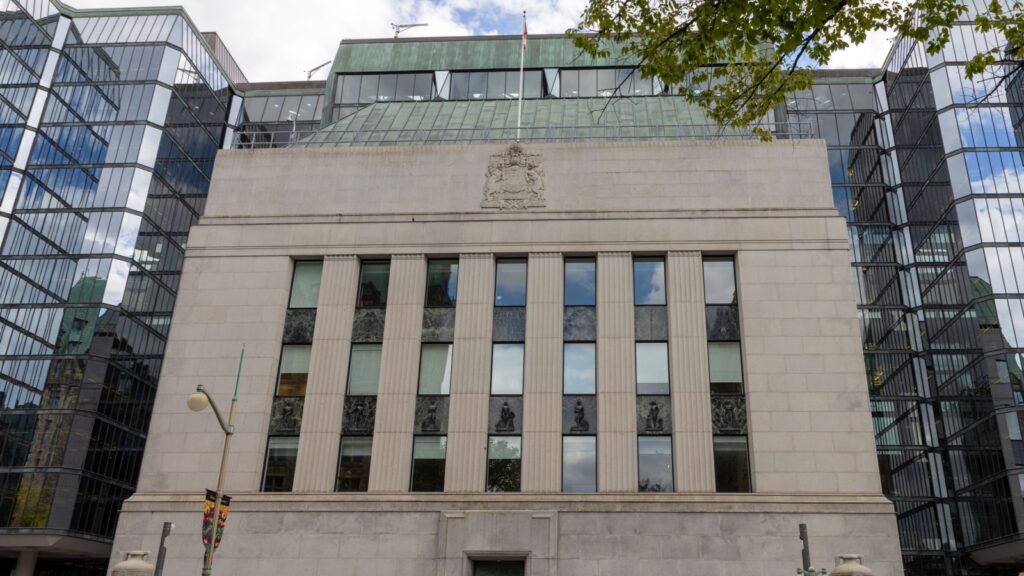
Canada’s economy appeared to be regaining its footing after months of trade uncertainty, but a fresh round of American tariffs is threatening to interrupt that recovery. The Bank of Canada is warning that economic growth will slow sharply in the final quarter of 2026, even as exports and business investment have shown surprising resilience.
In its October 28 economic outlook, the central bank identified renewed trade tensions with the United States as a major obstacle to growth. The warning comes at a difficult moment for Canadian businesses and households, already navigating elevated energy prices, higher borrowing costs, and an unpredictable trading relationship with Washington.
While the broader outlook has improved, the immediate picture is considerably more complicated, raising questions about how long Canada’s economic recovery can withstand escalating trade pressures.
A Strong Summer Gives Way to a Weaker Economic Finish
Canada’s economy delivered a stronger performance during the middle of 2026 than many economists had anticipated. Real gross domestic product expanded at an annualized rate of 3.3% in the second quarter, supported by recovering exports, stronger consumer spending, and increased business investment. The Bank of Canada estimates that growth remained relatively healthy at approximately 2% in the third quarter, suggesting the economy had developed some momentum despite continued trade disruptions.
However, that improvement is unlikely to continue uninterrupted. In its October 28 Monetary Policy Report, the central bank projected that annualized growth would fall below 1% during the fourth quarter. New American tariffs, uncertainty surrounding trade negotiations, and tighter financial conditions are expected to weaken economic activity. For businesses that had begun planning around stronger orders and improving demand, the sudden deterioration creates another difficult adjustment. The contrast between Canada’s summer recovery and its projected year-end slowdown illustrates just how quickly international trade disputes can change the country’s economic outlook.
Trump’s New Tariffs Create Another Major Trade Shock
The latest economic pressure follows the breakdown of Canada-U.S. trade negotiations in August 2026. The Trump administration imposed tariffs of 50% on selected Canadian products under Section 338 of the Tariff Act of 1930. Affected categories include machinery, plastics, furniture, and wood and paper products. Unlike most existing trade restrictions, these measures can apply even when goods otherwise qualify for preferential treatment under the Canada-United States-Mexico Agreement, commonly known as CUSMA. Some products also face overlapping duties, increasing the financial burden on exporters.
The Bank of Canada estimates that the average American tariff rate on Canadian goods has risen from 5% in July to 7.5% in October. Although approximately 80% of Canadian merchandise exports to the United States remain tariff-free, the additional duties create considerable challenges for affected industries. Canada has responded with counter-tariffs covering approximately $28 billion in American goods, pushing its own average tariff rate on U.S. imports to 3.9%. The escalating measures increase costs and uncertainty for businesses operating across the border.
Canadian Exports Are Recovering Despite Growing Trade Barriers
One of the more encouraging developments has been the recovery in Canadian exports. Statistics Canada reported that merchandise exports increased 2.5% in August 2026, reaching approximately $77.9 billion. Exports to the United States climbed 8.1% during the month, helping widen Canada’s merchandise trade surplus with its southern neighbour to $11.2 billion. The improvement was not confined to a single industry. Energy exports increased 4.7%, while shipments of industrial machinery, equipment, and parts rose 10.1%.
Yet stronger export figures do not necessarily mean the effects of tariffs have disappeared. Statistics Canada cautioned that some American importers may have accelerated purchases before additional duties took effect, temporarily boosting shipments. That possibility makes the August recovery difficult to interpret as a lasting trend. The Bank of Canada nevertheless sees encouraging signs that businesses are adapting to changing trading conditions. Stronger American demand, higher energy production, and improved shipments across several product categories have helped sustain Canadian trade. The question now is whether that momentum can continue under the higher tariffs.
The Impact Is Uneven Across Canadian Industries and Provinces
The recovery in Canadian manufacturing has been especially uneven. Statistics Canada reported that exports of passenger cars and light trucks increased 27% in the second quarter as automotive production rebounded after earlier declines. However, the sector continues to face complicated American trade restrictions, including tariffs affecting vehicles and components. Steel and aluminum producers are also dealing with substantial duties, limiting their ability to compete in the American market. For manufacturers dependent on tightly integrated cross-border supply chains, stronger overall export numbers provide little reassurance when their particular products remain heavily restricted.
Regional differences make the challenge even clearer. An October analysis from Canada’s Parliamentary Budget Officer found that Quebec’s domestic merchandise exports to the United States were at 92% of their 2024 level in the second quarter of 2026. Ontario’s stood at 105%, while Alberta’s reached 111%. Quebec has faced greater pressure from tariffs on aluminum and manufactured goods, whereas Alberta has benefited from energy exports that largely remain exempt from the newest restrictions. These figures demonstrate how national economic improvements can conceal serious difficulties within individual industries and communities.
Businesses Are Becoming More Cautious About Investment
Trade uncertainty is changing how Canadian companies make financial decisions. The Bank of Canada’s third-quarter Business Outlook Survey initially revealed improving confidence, supported by stronger sales expectations and continued American demand. The proportion of businesses planning or budgeting for a Canadian recession over the next 12 months declined from 17% to 6%. However, most interviews occurred before negotiations with Washington deteriorated. Responses collected after the breakdown showed weaker expectations for exports, investment, and overall business conditions.
For companies considering new facilities, machinery, or additional employees, unpredictable trade policies make long-term commitments more difficult. Some businesses are responding by changing suppliers, investing in automation, or exploring markets outside the United States. Others are postponing projects, reducing production capacity, or considering investments abroad to avoid tariff exposure. The central bank’s consultations indicate that the steel and automotive industries are particularly vulnerable to these decisions. Even when demand remains reasonably strong, a company may hesitate to expand if it cannot predict what exporting its products will cost six months later.
Canada’s Job Market Faces Growing Pressure From Trade Uncertainty
The labour market is another area where Canada’s recovery remains vulnerable. Statistics Canada’s September Labour Force Survey recorded a decline of approximately 68,000 jobs, while the unemployment rate increased to 6.5%. Despite some periods of stronger hiring earlier in the year, overall employment has remained largely unchanged since January. The Bank of Canada reports that private-sector employment has shown relative strength, but hiring has been weaker in industries heavily dependent on American demand. Job vacancies also remain subdued, making it difficult for unemployed Canadians to secure new positions.
The potential longer-term consequences are significant. In an October 20 assessment, the Parliamentary Budget Officer estimated that trade measures introduced since early 2025 could reduce Canada’s real GDP by 1.4% after five years relative to a pre-tariff baseline. Under a scenario where current tariffs remain permanent, the modelling also suggests employment could fall by as much as 185,000 jobs relative to that baseline. These are conditional projections, not jobs already lost. Nevertheless, they illustrate why the consequences of a prolonged trade dispute could extend well beyond exporters’ balance sheets and into household financial security.
Inflation Makes the Bank of Canada’s Response More Complicated
Canada’s economic challenges extend beyond slowing growth. Consumer price inflation reached 3.1% in September 2026, with gasoline prices increasing 27.8% from a year earlier. Excluding gasoline, inflation was a more moderate 2.2%, showing how heavily energy prices have influenced the overall figures. However, higher transportation costs and more expensive imported materials are creating additional pressure for businesses. The Bank of Canada expects inflation to climb to approximately 3.5% by the end of 2026 as those pressures continue affecting the economy.
On October 28, the central bank raised its policy interest rate by 25 basis points to 2.5%, marking its first increase since July 2023. Governor Tiff Macklem explained that the decision was intended to prevent elevated energy costs from spreading into broader inflation. The move highlights a difficult balancing act. Higher interest rates can help contain inflation, but they can also make borrowing more expensive when businesses and households are already facing economic uncertainty. The central bank has indicated that additional increases may be necessary, although future decisions will depend on changing conditions.
Housing Weakness Adds Another Obstacle to Economic Growth
Canada’s housing market is unlikely to provide substantial support for the economy in the near term. According to the Canadian Real Estate Association, national home sales declined 2.3% in September 2026 compared with August, while its benchmark Home Price Index was down 3.4% from a year earlier. Elevated borrowing costs, affordability challenges, and uncertainty about household incomes continue to influence purchasing decisions. The Bank of Canada expects housing activity to remain relatively weak even as other parts of the economy gradually improve.
The outlook for residential construction is similarly restrained. The central bank projects that residential investment will increase by slightly less than 1% annually, on average, during 2027 and 2028. Higher energy costs and prices for imported construction materials are expected to make projects more expensive, while rising borrowing costs could discourage both developers and prospective buyers. For families considering a home purchase, the combination of expensive financing and an uncertain employment outlook can encourage postponement. For builders, weaker demand makes it harder to justify new projects, potentially limiting construction activity during an already challenging period.
Federal Support Measures Could Help Cushion the Economic Damage
Ottawa has introduced financial assistance intended to protect workers and businesses affected by American trade restrictions. Following the August tariff escalation, the federal government announced a package that included an additional $1.5 billion for its Regional Tariff Response Initiative, $500 million in new business liquidity support, and $2 billion for the Canada Strong Diversification Fund. Another $3.5 billion was directed toward worker and employer assistance, including income support, retraining, and workforce retention initiatives. These measures are designed to help affected companies manage immediate difficulties while adjusting to changing market conditions.
The Bank of Canada expects government support to partially offset the economic weakness caused by new tariffs during the fourth quarter. However, financial assistance cannot completely replace lost export opportunities or eliminate uncertainty surrounding future trade restrictions. Canadian counter-tariffs may also increase costs for businesses that depend on imported American materials. That creates a complicated policy environment in which protecting domestic producers can sometimes raise expenses for other Canadian industries. Government programs may help companies maintain operations and retain employees, but a more predictable trading relationship would provide greater confidence for long-term investment decisions.
A Recovery Is Expected in 2027, but Trade Risks Remain Significant
Despite its warning about the fourth quarter, the Bank of Canada has not abandoned its expectation of a broader economic recovery. Its October outlook projects Canadian GDP growth of 1% in 2026, followed by 2% in both 2027 and 2028. Stronger business investment, continued export activity, and government spending are expected to support the improvement. The central bank also anticipates that business investment will grow by approximately 4% annually, on average, during 2027 and 2028, supported partly by federal investment incentives and technological adoption.
Nevertheless, other economic projections are more cautious. The Parliamentary Budget Officer forecasts growth of 0.9% in 2026 and 1.5% in 2027, reflecting concerns about the continuing effects of trade restrictions. Both outlooks underline the importance of Canada-U.S. trade relations in determining the country’s economic direction. A negotiated reduction in tariffs could improve business confidence and strengthen exports, while further escalation could weaken investment and employment. Canada’s recent export recovery demonstrates that businesses can adapt to difficult conditions, but the Bank of Canada’s latest warning makes clear that adaptation alone may not fully protect the economy from prolonged trade uncertainty.
