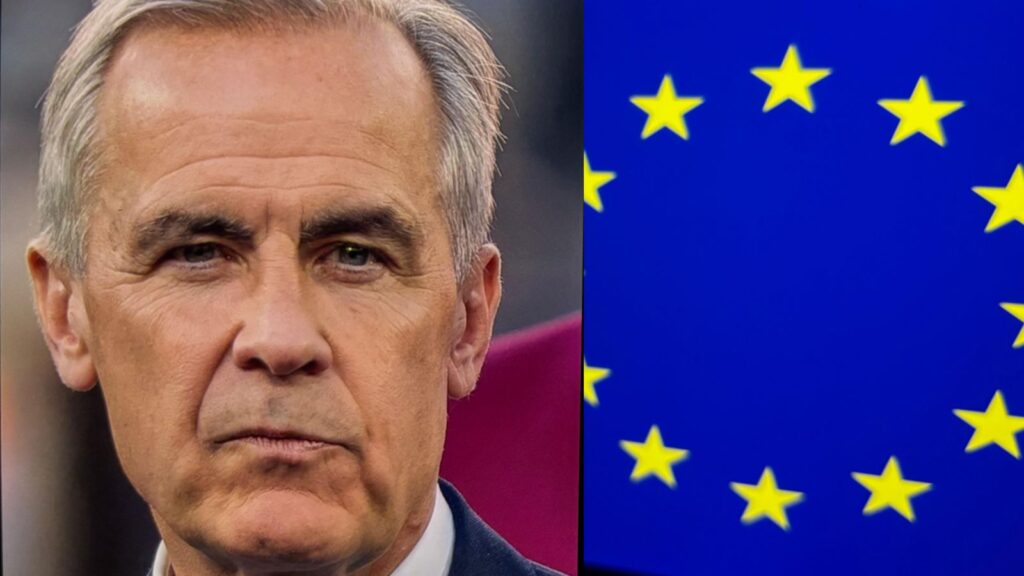
What looked like a diplomatic breakthrough for Canada is running into resistance inside Europe. Germany has emerged as the most prominent critic of describing Canada as the European Union’s first “associate member,” questioning an undefined status that does not currently exist in the bloc’s treaties.
The timing matters for Prime Minister Mark Carney. As Canada deals with tariffs and an increasingly unpredictable economic relationship with Donald Trump’s administration, Ottawa is trying to build deeper alternatives abroad. Yet the disagreement with Berlin appears to be more about institutional language than strategic direction. European and Canadian leaders are still preparing an ambitious new partnership covering trade, defence, technology, critical minerals, energy and research at their October 29-30 summit in Montreal.
Berlin’s Objection Is About the Label, Not Canada
Germany’s pushback emerged while EU governments were reviewing the declaration intended for the Montreal summit. A draft explicitly referred to European Commission President Ursula von der Leyen’s proposal for Canada to become an “associate member.” Berlin objected to using a term whose legal and political meaning has not been settled. Greece also pushed back, France raised objections and concerns, while Italy successfully sought wording making clear that the concept originated with the European Commission rather than the EU’s member governments.
The distinction is significant. European diplomats say there remains broad agreement on bringing Canada closer in areas including trade, defence, energy, critical minerals and border security. Berlin’s position is essentially that the package should be defined before governments attach an unprecedented institutional title to it. That leaves Germany opposing the label while continuing to support much of the substance behind it. For Canada, the disagreement is inconvenient, but it is far from a rejection of closer ties with Europe.
Germany Already Used the Same Idea for Ukraine
The phrase “associate membership” has particular political baggage in Berlin because German Chancellor Friedrich Merz proposed something similar for Ukraine in May. His plan envisioned an interim stage on Ukraine’s path toward full EU membership, potentially allowing Ukrainian officials to attend EU summits and ministerial meetings without voting rights. Merz also raised the possibility of non-voting Ukrainian representation in European institutions and a political commitment to extend stronger security guarantees.
That concept was designed for a country already pursuing EU accession. Applying the same terminology to Canada changes its meaning considerably. Canada is not an EU candidate and is seeking a strategic partnership rather than a path toward ordinary membership. European diplomats consequently worry that using the same label for two fundamentally different relationships could create confusion over enlargement and establish expectations among other countries seeking privileged access to the bloc. Reports from Brussels also indicate irritation in Germany that a concept originally promoted by Merz in connection with Ukraine was repurposed for Canada without extensive consultation with national governments.
Carney Wants a ‘Unique Alliance,’ Not EU Membership
Carney has repeatedly drawn a line between closer integration and actually joining the European Union. After speculation about associate membership accelerated in September, he said Canada was not seeking EU membership and instead wanted a “unique alliance” built around complementary economic and strategic strengths. Ottawa’s own language has increasingly centred on an “Alliance for the Future,” allowing the government to embrace deeper cooperation without committing itself to an undefined membership category.
Carney’s proposals to European lawmakers were considerably more practical than the debate over terminology. He called for closer cooperation in critical minerals, defence manufacturing, artificial intelligence, computing infrastructure, energy security, space and financial services. He also raised deeper digital trade, greater opportunities for young Canadians and Europeans to live, work and study across the Atlantic, Canadian participation in Erasmus+, and future research cooperation through Horizon Europe. In that sense, the Canadian strategy is less about putting an EU label on the relationship than building a network of arrangements that increases Canada’s economic choices while preserving political sovereignty.
Trump’s Trade Pressure Is Driving the Search for Alternatives
The urgency behind the European push is difficult to separate from Canada’s worsening trade relationship with Washington. U.S. and Canadian officials were still negotiating this week over tariffs affecting major industries including steel and automobiles. Current U.S. measures include tariffs reaching 50% on Canadian steel and 25% on automobiles, while Trump has threatened further increases. Canada rejected an earlier U.S. proposal in August after Ottawa concluded that the terms did not adequately protect Canadian interests.
Carney is therefore trying to reduce the amount of leverage any single trading partner can exert over the Canadian economy. His government says non-U.S. exports are on track to double over the next decade. That diversification has already become more visible: Global Affairs Canada reported that exports to countries outside the United States increased 11.1% in 2025, lifting their share of total Canadian exports to 32.8%, the highest level in more than four decades. The shift will not happen overnight, however. The Bank of Canada has warned that finding new customers and restructuring supply chains takes time and can initially increase costs for businesses.
CETA Gives the Canada–EU Pivot Real Economic Weight
Canada is not starting its European strategy from scratch. The Comprehensive Economic and Trade Agreement, or CETA, has been provisionally applied since September 2017 and has already dismantled most tariffs between the two economies. About 98% of tariff lines disappeared when provisional application began, and by 2024 roughly 99% had been eliminated. EU data show that bilateral trade in goods and services reached approximately €130 billion in 2025, about 80% higher than in 2016.
That makes the EU Canada’s second-largest trading partner after the United States and gives policymakers an existing framework to expand rather than requiring them to construct an entirely new commercial relationship. CETA itself is still not fully ratified by every EU member state, meaning certain provisions, particularly parts of its investment regime, have not entered into force. At the same time, Canada and the EU launched negotiations in March 2026 for a Digital Trade Agreement designed to modernize their commercial rules. Those existing mechanisms could ultimately matter more to businesses than whether the relationship receives an “associate member” title.
Defence, Technology and Critical Minerals Could Matter More Than the Title
The most consequential pieces of the emerging relationship may sit outside traditional trade policy. The official Montreal summit agenda includes economic security, supply chains, critical raw materials, digital cooperation, climate and energy, security and people-to-people connections. Canada is already the only non-European country participating in the EU’s €150-billion Security Action for Europe program, known as SAFE, which is designed to increase joint defence procurement and European defence production.
Germany is simultaneously deepening its own bilateral relationship with Canada. Carney and Merz launched negotiations in July toward a Canada-Germany Strategic Partnership Agreement covering security and defence, technology, investment, supply chains, critical minerals, energy and space. Germany is Canada’s largest trading partner inside the EU, with bilateral trade valued at more than $34 billion. That relationship helps illustrate the paradox behind the current dispute: Berlin is resisting a new political title at the same time it is negotiating more extensive cooperation with Ottawa. For Canadian businesses and workers, those practical agreements may ultimately matter much more than the institutional branding debated in Brussels.
Canadian Support Is Broad, but It Depends on the Terms
Closer European ties have considerable public support in Canada. A Léger survey conducted September 19-21 among 1,533 Canadian adults found that 70% supported Canada becoming an EU “associate member,” compared with 13% who opposed it and 18% who were unsure. The numbers became more revealing when respondents were asked what closer cooperation might actually involve.
Greater market access would make 63% of respondents more supportive, while 53% said stronger defence and security cooperation would increase their support. Easier travel received similar enthusiasm. Regulatory integration was noticeably less popular: only 25% said having Canada align some laws, regulations and standards with Europe would make them more supportive of closer relations. Conservative Leader Pierre Poilievre has seized on that concern, declaring that Canada should never become the EU’s “28th state” and warning against transferring decision-making authority to Brussels. The undefined nature of associate membership therefore creates both an opportunity and a political risk for Carney: Canadians appear interested in the benefits, but not necessarily every form of integration.
Montreal May Settle the Direction Before It Settles the Name
As of October 28, European diplomats were still working on the language of the summit declaration, meaning the final treatment of “associate membership” remained unsettled on the eve of the meeting. The European Council’s official agenda is much clearer about the underlying objective. Carney, von der Leyen and European Council President António Costa are expected to launch an “Alliance for the Future” in Montreal and pursue deeper cooperation across trade, digital policy, critical minerals, defence, research, education and economic security.
That means Germany’s pushback could weaken or remove the most dramatic label without derailing the broader project. Carney can still emerge from Montreal with meaningful progress if Canada secures concrete advances in digital trade, defence procurement, critical-mineral supply chains, research cooperation, energy and mobility. Europe cannot simply replace the United States as Canada’s dominant economic partner, and diversification will take years. The more immediate objective is different: create enough alternatives that Canada has greater room to manoeuvre when Washington applies pressure. In that strategy, the substance of the European relationship may prove far more important than what Brussels ultimately decides to call it.
