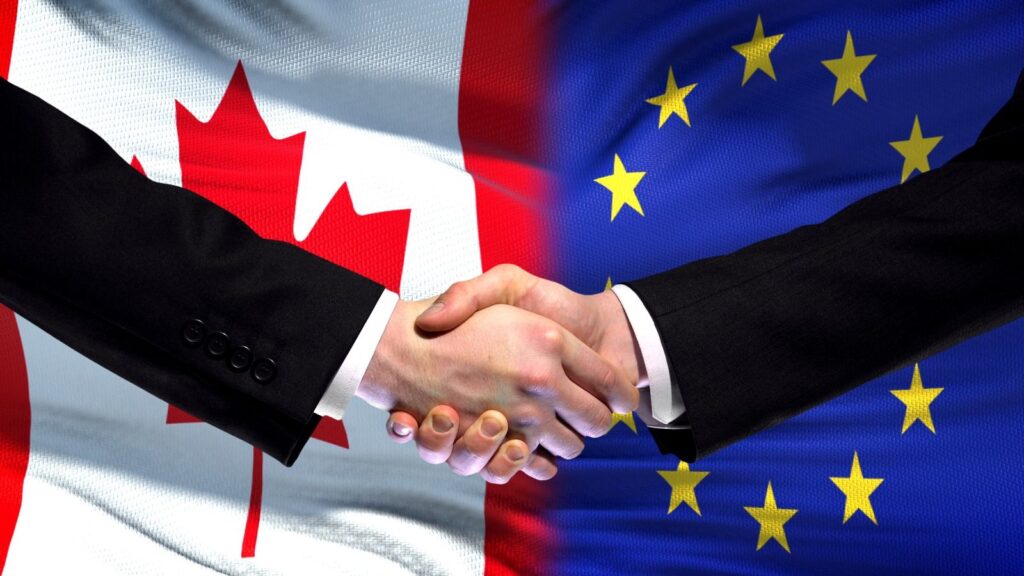
Canada is moving toward a potentially historic relationship with the European Union, but a disagreement over its proposed status is raising questions about what has actually been agreed. At the October 29–30, 2026, Canada-EU Summit in Montreal, Prime Minister Mark Carney declared that Canada was working toward becoming the EU’s first “associate member,” a designation that does not currently exist under EU law.
The summit produced an ambitious agreement covering trade, technology, energy, defence and economic security. However, the official joint statement avoided the phrase “associate member,” committing instead to an “ever-closer association” by 2027.
The difference highlights an important diplomatic challenge: Canada and Europe share an ambition to deepen their partnership, but European governments have not yet agreed on the legal and political meaning of that relationship.
Carney’s Historic Announcement Comes With an Important Qualification
On October 30, standing alongside European Commission President Ursula von der Leyen and European Council President António Costa, Carney framed a new phase in Canada’s European relations as more than another trade partnership. The leaders had just launched an “Alliance for the Future” in Montreal, but the Canadian government’s own announcement went further. It described work toward the “deepest possible partnership” short of accession and explicitly said Canada would become the EU’s first “Associate Member.” The words made a long-term ambition sound like an approaching institutional breakthrough.
Yet those remarks did not announce admission into an established EU category. Ottawa’s release said the parties would determine the substance, scale and scope of the proposed relationship over the coming months. That is a crucial qualification for businesses weighing new markets and Canadians imagining easier movement across the Atlantic. Carney was describing a destination that still has to be negotiated, rather than a status available to Canadians today.
What the Official Summit Statement Actually Promises
Read the leaders’ joint statement and the language becomes more restrained. The document launches the Alliance for the Future, commits to closer coordination and promises to define an “ever-closer association” by the 2027 EU-Canada Summit. It specifies that the arrangement would fall short of full EU membership. Nowhere does it describe Canada as an associate member, nor does it establish a new membership category. That omission carries considerable political weight.
The statement nevertheless contains detailed commitments covering digital research, critical minerals, financial services, defence and exchanges between citizens. It welcomes more frequent meetings involving Canadian ministers and EU institutions, alongside regular summits and cooperation committees. Those steps draw governments closer without resolving the membership debate. The distinction matters because a joint declaration records what leaders were prepared to endorse together. Carney’s preferred terminology remains a political objective; the agreed text sets out a negotiating process, not a completed constitutional arrangement.
Germany and Other EU Countries Opposed the Membership Label
The missing phrase reflects disagreement inside the 27-country EU. Germany led objections to including “associate membership” in the declaration. Reporting by Euronews identified concerns from France, Italy and Greece as well. Diplomats questioned why leaders should endorse a status that has no definition in the EU treaties, before negotiating its rights, obligations or institutional consequences. Their resistance did not amount to rejection of closer cooperation with Canada.
The debate also reaches beyond Ottawa. German Chancellor Friedrich Merz had previously discussed an associate-style arrangement for Ukraine, whose path toward EU accession is a separate issue. Applying the same expression to Canada could confuse what membership-related promises mean for different partners. Countries such as Norway and Switzerland maintain distinct relationships with the EU. For European governments, the challenge is to develop something useful and politically durable without unintentionally creating expectations for other countries, or implying rights the bloc has not agreed to grant.
The Associate Membership Proposal Began in September
The proposal surfaced on September 16, when von der Leyen addressed the European Parliament in Strasbourg before Carney. In her State of the Union speech, she proposed opening the door to Canada becoming the EU’s first associate member. She linked the idea to an alliance extending far beyond trade, with cooperation in artificial intelligence, defence manufacturing, energy, the Arctic and critical minerals. It was an invitation to design something new, not an offer of a ready-made legal status.
Carney responded the next day before European lawmakers, welcoming the ambition while emphasizing benefits and sovereignty. His speech advocated easier digital trade, research collaboration, energy security and more opportunities for young people to study or work abroad. By late October, he had adopted the associate-member description more directly. The shift in language helps explain why the Montreal declaration attracted attention: political expectations had advanced faster than agreement among the EU’s member governments.
Associate Membership Would Not Mean Joining the European Union
Canada is not about to become the EU’s twenty-eighth member. Article 49 of the Treaty on European Union makes full accession available to European states that meet specified democratic and legal conditions. “Associate membership,” by contrast, is not a defined status in the EU treaties. Negotiators therefore need to specify which institutions Canada could engage with, whether it would influence policy discussions and what obligations might follow. None of those questions was settled by the Montreal announcement.
A useful comparison is the relationship Canada already has with Europe. The Comprehensive Economic and Trade Agreement reduces trade barriers, while Canada’s existing association with the Horizon Europe research program supports joint research. Neither arrangement gives Canadian citizens EU citizenship or Canadian ministers a vote in EU lawmaking. A new association could build on such arrangements, but it does not yet automatically guarantee unrestricted migration, single-market rights or a vote in EU institutions.
Digital Trade and Competition Pacts Bring Practical Progress
Montreal brought completed negotiations on a Canada-EU Digital Trade Agreement. The European Commission says the planned rules would support electronic contracts, signatures and invoices while protecting consumers and enabling trusted cross-border data flows. Bilateral trade in digitally delivered services reached €19.8 billion in 2025, according to Eurostat figures cited by the Commission. For a Canadian software company selling subscriptions in Europe, greater certainty about digital transactions could be more useful than a new diplomatic title.
The two sides also completed negotiations on an updated competition cooperation agreement, intended to help authorities address anti-competitive conduct across borders. Concluding negotiations is not the same as putting an agreement into force. The digital trade text still requires legal review, formal signature and completion of approval procedures. Canada’s existing CETA trade agreement has been provisionally applied since September 2017 and still awaits full ratification by every EU member state. Progress and implementation are different milestones.
Critical Minerals and Energy Give the Alliance an Industrial Purpose
Critical minerals give the partnership an industrial purpose. Canada has deposits used in batteries, defence equipment and manufacturing, while Europe seeks reliable supplies. At the summit, the European Investment Bank and the Canadian government signed a framework agreement enabling future investment in Canada. Critical raw materials are an early priority. Ottawa and Brussels also proposed closer cooperation on processing, refining, recycling and possible stockpiles of strategic resources.
Energy cooperation is more exploratory. The joint declaration calls for a long-term feasibility study of Canadian liquefied natural gas exports to Europe, subject to infrastructure and climate considerations. It also promises work on electricity grids, battery storage, nuclear cooperation and more secure transportation corridors. These initiatives could eventually create contracts for Canadian producers and new options for European industries. But a feasibility study is not a pipeline, an LNG terminal or a guaranteed export deal. The economic payoff will depend on financing and execution.
Supercomputers and Student Exchanges Offer Tangible Openings
A summit breakthrough involves research infrastructure. Canada joined the European High Performance Computing Joint Undertaking, opening a route for Canadian researchers and companies to access powerful European facilities, including Germany’s JUPITER supercomputer. Such machines can support work ranging from artificial intelligence to scientific modelling. Canadian universities already participate in Horizon Europe projects under a separate association arrangement dating from 2024; the summit also envisages negotiations on participation in future European research programs.
Opportunities for students remain less settled. Ottawa and Brussels plan negotiations to expand Canadian participation in Erasmus+, the EU’s education and skills exchange program. For a student hoping to study in Paris or a researcher developing cleaner industrial processes with European colleagues, access to established programs could make the partnership feel practical. Still, there is no new automatic right to work, settle or study anywhere in Europe. Future benefits depend on the terms eventually negotiated.
Defence and Arctic Security Give the Partnership a Strategic Edge
Security cooperation is moving beyond speeches. In February 2026, Canada became the first non-European country to join the EU’s Security Action for Europe initiative, a €150-billion defence financing program. At Montreal, Ottawa highlighted a contract exceeding C$44 million for Montreal-based Galvion to supply military helmets to Latvia, where Canadian troops are stationed. It followed an earlier procurement involving Canadian-built radios for Poland’s military. Those orders show how European defence cooperation can translate into work for Canadian manufacturers.
The summit emphasized Arctic cooperation, maritime security and protection against foreign interference. Leaders proposed talks on Canadian access to Europe’s Galileo navigation services and cooperation with the IRIS² secure satellite system. These projects could strengthen connectivity and resilience in remote regions, although the space arrangements are not finalized. The EU partnership complements Canada’s NATO commitments; it does not replace them or establish a joint European-Canadian military.
Canada’s Dependence on U.S. Trade Raises the Stakes
The urgency behind the European push is visible in Canada’s export figures. Statistics Canada reports that 71.7% of Canadian merchandise exports went to the United States in 2025, down from 75.9% in 2024. Exports to destinations outside the U.S. increased 17.2%. The EU is already Canada’s second-largest trading partner for goods and services, with bilateral trade valued at approximately C$178 billion in 2025, according to Ottawa. Those numbers make Europe a serious diversification opportunity rather than a symbolic alternative.
The pressure is familiar to businesses facing U.S. tariff uncertainty and difficult cross-border decisions. An Ontario manufacturer may welcome European customers while still depending heavily on American supply chains. CETA already provides an important commercial foundation, but shipping costs, regulations, production capacity and established relationships shape actual trade flows. Deeper integration might gradually widen Canada’s options; it cannot quickly replace the enormous U.S. market.
The Real Test Comes in Quebec, Parliament and 2027
Negotiations could prove politically sensitive at home. Quebec Premier Paul St-Pierre Plamondon did not attend the Montreal summit, objecting that his government lacked a meaningful role in the talks. He sent a provincial representative instead. That dispute matters because agreements affecting education, professional recognition and labour mobility could touch areas where provinces hold substantial responsibilities. Businesses might welcome new opportunities while provinces seek assurances that decisions are not made without them.
Carney has indicated that an eventual agreement would face debate and a vote in Parliament. European leaders must also settle what association entails and how member states would support it. The joint statement calls for the concept to be defined by the 2027 Canada-EU Summit, not necessarily implemented by that date. For now, the Alliance for the Future is real, but the promised membership label remains unresolved. Its meaning will emerge through negotiations rather than a single announcement.
